Print This Post
 PhD Career Support – A new report is calling on universities to provide better career support for doctoral researchers as growing numbers consider careers beyond academia.
More than academia: Expanding career support for doctoral researchers, published by the Higher Education Policy Institute (HEPI), finds a significant gap between the careers PhD researchers are considering and the preparation they receive.
While academia remains the most popular single destination, selected as the first choice by 46% of UK respondents, a combined 54% placed another sector first. Industry was the preferred destination for 31%, followed by the non-profit, government and medical sectors.
Despite this, 82% said their doctoral programme was preparing them well for a research career, while only 40% felt well prepared for a non-research, science-related career.
The findings suggest doctoral training has not kept pace with the changing ambitions of researchers or the realities of the employment market.
More PhD researchers, but limited academic opportunities
The number of doctoral researchers in the UK has continued to grow. In 2024/25, 110,455 people were enrolled on doctoral research degrees, more than 10,000 higher than in 2016.
Academic opportunities have not expanded at the same rate, and neither has PhD Career Support. The number of university staff on research-only contracts, which the report uses as a proxy for postdoctoral researchers, remained between 49,995 and 52,220 from 2020 to 2025.
This imbalance is reflected in researchers’ concerns about life after their PhD. More than half of respondents, 52%, were worried about a lack of available research jobs, while 47% were concerned about financial pressures and 37% feared only being offered temporary or short-term contracts.
Among those who did not rank academia as their preferred destination, 62% described the academic funding climate as discouraging. Almost half were concerned about academic salaries, work-life balance and the shortage of job opportunities.
Only 24% said academia was less appealing simply because they were not interested in an academic research career. This suggests many researchers are not necessarily rejecting research itself, but responding to the insecurity and working conditions associated with academic careers.
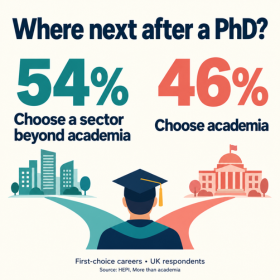
Among UK respondents, 54% chose a sector beyond academia as their preferred career destination, compared with 46% who chose academia.
Supervisors cannot provide all the answers
The report also raises concerns about the career guidance doctoral researchers receive from their supervisors.
One-third of respondents were dissatisfied with the quality of their career guidance, while 35% disagreed that their supervisor made time for frank conversations about their future. Only 52% said their supervisor had encouraged them to attend career training or events.
Most strikingly, just 27% thought their supervisor could offer useful advice about careers outside academia.
The report does not argue that supervisors should become specialist careers advisers. Many have spent most or all of their own careers within universities and may have limited experience of other sectors. Instead, universities should train supervisors to recognise when additional help is needed and signpost researchers towards appropriate careers services, resources and opportunities.
Closer collaboration between supervisors and specialist postgraduate careers teams could help ensure researchers receive support from people with the right knowledge and experience.
Researchers want better information
When asked which career resources were missing or limited, 66% of respondents selected grants to help them move into permanent positions and 47% wanted access to mentorship.
Researchers also wanted more practical information about where a PhD could take them. Forty-three per cent called for better information about available career opportunities, while 38% wanted data showing what previous graduates from their programme had gone on to do.
At present, the UK’s Graduate Outcomes Survey follows doctoral graduates 15 months after completing their studies, but there is no consistent longer-term follow-up. HEPI describes this as a “black hole” in our understanding of doctoral careers.
The report recommends that the Higher Education Statistics Agency should track doctoral graduates nationally over a longer period. As well as informing policy and workforce planning, this could give current researchers realistic examples of the many careers pursued by people with PhDs.
Internships and training should be available to everyone
HEPI also calls for more doctoral researchers to be given opportunities to experience workplaces beyond universities.
Some Doctoral Training Programmes already include internships, career coaching and professional development. However, access varies considerably, particularly for researchers whose PhDs are not part of a funded programme.
The report recommends that universities advertise non-academic internships and, where possible, provide funding for travel, accommodation and other costs. It also calls for careers events and training to be recorded and made available online, helping part-time researchers, disabled researchers and those unable to travel or leave laboratory and fieldwork commitments.
Universities should also work together when developing careers resources and events. Sharing provision could reduce duplication, extend access and make specialist support more practical for smaller institutions.
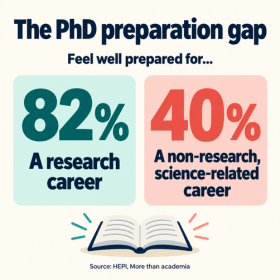
While 82% felt their doctoral programme prepared them well for a research career, only 40% felt prepared for a non-research, science-related career.
A career beyond academia is not a failure
Underlying many of the report’s recommendations is the need to challenge the idea that an academic post is the only successful outcome from a PhD.
Doctoral researchers develop skills in critical thinking, communication, project management, problem-solving and independent working. These skills are valuable across industry, policy, healthcare, charities, research management, publishing, communication and many other fields.
This is particularly relevant in dementia research, where progress depends on people working across universities, healthcare, charities, government, technology, pharmaceutical companies and community organisations. Moving beyond academia does not necessarily mean leaving research or abandoning the ambition to improve people’s lives.
Universities and funders therefore need to present career development as a core part of doctoral training, rather than something researchers consider only when an academic career becomes uncertain.
The message from the report is not that doctoral researchers should be discouraged from pursuing academia. It is that every researcher should receive honest information and meaningful support to explore the full range of careers available to them.
A PhD should prepare someone for more than one possible future.


 Dr Ajantha Abey

 Nature Careers Blog