
 Print This Post
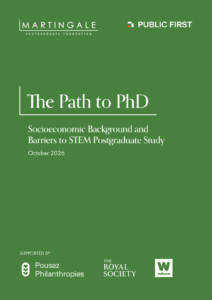 STEM PhDs – A major new report finds that students from low-socioeconomic backgrounds are far less likely to reach a STEM PhD than their more advantaged peers, even when they graduate with a first from a top university.
The Path to PhD: Socioeconomic Background and Barriers to STEM Postgraduate Study was published on 1 October by the Martingale Foundation, which runs fully funded postgraduate scholarships for talented students from low-socioeconomic backgrounds. Carried out by Public First, with support from the Royal Society, Wellcome and Pousaz Philanthropies, it is billed as the biggest look yet at who makes it into STEM postgraduate study in the UK.
The team used previously unpublished Higher Education Statistics Agency (HESA) data to follow around 400,000 UK-domiciled STEM students through university between 2015/16 and 2022/23, alongside a comparison dataset of more than two million students across all subjects. Background is measured by parental occupation, using the Office for National Statistics’ NS-SEC classification, split into high, medium and low groups. Three focus groups with current PhD students from low-socioeconomic backgrounds fill in what the numbers can’t.
The headline gap is hard to ignore. Around a third (33%) of people in England and Wales come from the highest socioeconomic backgrounds, yet students from those backgrounds make up two-thirds (66%) of STEM PhD students. Students from low-socioeconomic backgrounds are 24% of STEM undergraduates but just 18% of STEM PhD students.
Why this matters for dementia research
Dementia research leans heavily on the subjects this report covers: biology, chemistry, physics, maths and statistics, engineering, computing and multidisciplinary science. That’s where many of our lab scientists, imaging specialists, statisticians and data scientists start out. The report leaves out medicine, health and psychology, which have their own routes in and are common ways into our field, so it isn’t the whole picture. But every talented student lost from this pipeline is one fewer person who might have spent a career working on neurodegeneration.
If you came into research from a background like the ones described here, much of this will sound familiar. And if you supervise PhD students, write PhD adverts or sit on recruitment panels, some of the recommendations are things you can act on now.
Fewer at every step
The share of students from low-socioeconomic backgrounds shrinks at every stage, from 24% of STEM undergraduates to 20% of STEM masters students and 18% of STEM PhD students. Over the same steps, the share from high-socioeconomic backgrounds climbs from 57% to 62% to 66%.
STEM does worse than most of academia on this. Measured against students from high-socioeconomic backgrounds in the same subject area, students from low-socioeconomic backgrounds reach a STEM PhD at 63% of the rate, against 80% in the humanities and 72% in the social sciences. Only the arts are lower, at 54%.
Mathematics and statistics PhDs have the smallest share of students from low-socioeconomic backgrounds (15.5%), followed by the physical sciences (17%). In the biological sciences, the closest fit for much of our field, it’s 18.5%. Even computing, one of the most socially mixed subjects at undergraduate level, falls from around a third (32%) of undergraduates to 19% of PhD students.
A first-class degree isn’t enough
This is the finding that should stop anyone blaming ability. Among STEM graduates with a first, 10.8% of those from high-socioeconomic backgrounds went on to a STEM PhD, compared with 7.9% from low-socioeconomic backgrounds. At the ‘Golden Triangle’ universities (Oxford, Cambridge, Imperial, UCL, King’s College London and LSE), the figures were 15.7% and 10.4%. Look only at Golden Triangle graduates with a first and it’s still 22.5% against 16.9%.
The authors are careful about what this does and doesn’t show. Prior attainment and the type of university attended are the strongest predictors of who goes on to a PhD, and once those and other factors are controlled for, background on its own wasn’t statistically significant in their model. They put that down to a selection effect, as students from low-socioeconomic backgrounds who make it onto a STEM degree at all have already beaten the odds. But the model also found that achievement pays off less for them. Top entry grades and a Golden Triangle place give them a smaller boost than their advantaged peers, and a weak degree result costs them more.
The masters squeeze
The biggest drop comes straight after the undergraduate degree, when the funding runs out. Among STEM graduates with a first or a 2:1, 30.4% of those from low-socioeconomic backgrounds whose parents hadn’t been to university went on to a STEM masters, compared with 42.7% of graduates from high-socioeconomic backgrounds whose parents had. More than two-thirds (69.6%) of that first group left the pipeline after their degree.
Once they reach a masters, the gap almost disappears: 16.8% went on to a PhD, against 18.2% of their advantaged peers. That’s why the report wants funded masters years built into PhD programmes. If you’re weighing up a masters yourself, our guide on whether a masters in dementia is worth it may help.
Martingale puts the cost at as many as 5,600 potential STEM researchers since 2015, nearly 700 a year. That figure comes from the masters stage. Had high achievers from low-socioeconomic backgrounds progressed at the same rates as their advantaged peers, there could have been 5,676 more STEM masters students (41% more) and 1,223 more STEM PhD students (52% more) from those backgrounds, assuming the number of places had kept pace.
Where background meets gender and ethnicity
Once other factors are accounted for, women are 3.5 percentage points less likely than men to go on to a STEM masters and 1.1 points less likely to go on to a PhD, and women from low-socioeconomic backgrounds face an extra penalty at the masters stage.
Ethnicity follows a different pattern. Almost every minority ethnic group is more likely than white students to progress to a STEM masters, but that flips at PhD level. Only 1.5% of British Bangladeshi STEM undergraduates went on to a STEM PhD, compared with 6.1% of white students. After controlling for other factors, British Bangladeshi, Pakistani, Indian and Black African students were between 4.7 and 9.3 percentage points less likely than white students to progress to a PhD. Ethnic minority students from low-socioeconomic backgrounds were also 1.88 points less likely to progress to a PhD than ethnic minority students from high-socioeconomic backgrounds, which the authors suggest makes the step from masters to doctorate a particular pinch point for some groups.
What PhD students told the researchers
The focus groups put people behind the numbers. Students described falling for research as undergraduates, then finding their way through applications and funding with little inside knowledge, and with family and friends who often struggled to understand what they were doing. As one biological sciences PhD student put it: “It didn’t occur to me that I could be a researcher.”
Money was the biggest pressure, even for those on funded stipends. Most said they didn’t have enough to live on comfortably, and described the strain of covering food, housing and basic health care. One had to choose between buying food and paying £30 for a doctor’s note. Some were picking up extra work without telling their university or funder. The costliest months often come before the first stipend payment, when deposits, rent and moving costs fall due, and reimbursement culture means paying for conference travel up front, then waiting months to be paid back.
Support was patchy too. Students described thin inductions, an awkward status somewhere between student and staff, and support that came down to the luck of getting a good supervisor. Where supervisors or postdocs acted as mentors, it made a real difference. Where support was thin, students felt isolated, and that fed imposter syndrome.
Many felt the case against a PhD was almost as strong as the case for one, and several asked for doctoral study to be treated more like a job. Graduate schemes in consultancy, finance, pharma and tech offer clear applications, transparent pay and a structured start, and can pay more in year one than even a generous stipend. The PhD is competing with that.
What the report recommends
Martingale makes eight recommendations under three headings. To engage prospective researchers earlier:
- Outreach to undergraduates from their first year, modelled on industry graduate schemes, with wider support for summer schools and research placements such as UNIQplus, In2research, Research Ready and Generation Research
- Research readiness, through funded masters years built into PhD programmes, so students take a one-year masters followed by three or four years of PhD
For clearer access and fairer treatment of postgraduate students:
- Terms and conditions that treat PhD students as researchers in training, with standard access to parental and carers’ leave, part-time living-cost support, and sickness and return-to-work policies
- Finances that work for students without family money: advances to cover moving costs, guarantor schemes, prompt stipend payments, and travel, accommodation and conference costs paid up front rather than reimbursed
- Transparency in every PhD advert, setting out the stipend, how long funding lasts, the project, what applicants need, the application process and who to ask, so applicants can approach supervisors with confidence
For data tracking and accountability:
- Fair access, extending systems such as the Office for Students’ Access and Participation Plans, and their equivalents in Wales, Scotland and Northern Ireland, to postgraduate taught and research students
- Monitoring, by recording socioeconomic background in the Postgraduate Research Experience Survey
- Accountability, with UKRI and other major funders putting fair access to postgraduate research into their guidance, from wording in grant conditions to criteria in the people section of the REF’s Strategy, People and Research Environment element
Making the path to a PhD fairer
Martingale’s Chief Executive, Cassandra Hugill, who co-founded the In2research programme while at UCL, puts it bluntly in her foreword: “Potential isn’t the variable here: background is.”
The report’s case is that ability isn’t in short supply among students from low-socioeconomic backgrounds, but the route to a PhD still favours those who already know how it works and can afford to wait for the money. Some of the fixes need funders, regulators and government. Others don’t. Put the stipend and funding details in the advert. Explain the process to students who don’t know what to ask. Where you can, book travel and conference costs directly rather than leaving students to claim them back. Who gets to become the next generation of dementia researchers shouldn’t depend on where they started out.



 Beccy Owen
 LSE Impact Blog

 Dr Yvonne Couch


 Dr Ajantha Abey
 Dr Becky Carlyle