 Print This Post
Every autumn we get the same email. Someone has finished their degree, or has been working in care for a few years, and they want to know whether to do a masters in dementia. They have usually already picked one. What they are really after is permission.
We tend not to give that permission straight away. The question underneath is almost never “which course”, it is “how do I get from here to doing research”, and a masters is only sometimes the answer to that. A masters in dementia can be a very good decision. It can also be a way of putting off the step that would get you further.
So here is the longer reply, starting with the short version.
In brief
A masters in dementia is sometimes the only way in, often optional, and occasionally an expensive mistake. If you are aiming at a PhD, check first whether the doctoral programmes you want would take you without one, because plenty will and some will pay for the masters themselves. If you do go ahead, pick the course by what its dissertation actually involves and who supervises it, not by the words in the title. Most people end up self funding, because free routes are narrower than they look: the dementia charities fund PhDs rather than taught masters, and the main funded schemes are restricted to health and care professionals. Check what the government loan covers before you budget around it, since it only covers your first masters and stops at 60.
Funded routes exist for all three main paths into dementia research, clinical, laboratory and social science. They differ from each other, so find yours before you spend anything. And if you are going back to the university where you did your first degree, ask about the alumni discount first.
On this page
In this article we’re going to work through the decision making process in the order it needs making. It starts with why people do it, because the reason you give yourself changes the answer more than anything else does. Then the money question, what it really costs and what free routes exist, followed by the three funded routes into dementia research. They differ enough that you should read your own and ignore the other two. There is one if you work in health or care, one if you are heading for the lab, and one for social science and qualitative work.
After that it gets practical. What it costs, including the part nobody writes down, and how to pay for it, which works differently in each of the four UK nations and trips people up constantly. Then the kinds of courses and how people end up on the wrong one, where to look, and how to judge a course once you have a shortlist. It closes with applying and what to try first, which for some readers will be the only section that matters.
Jump to whatever is useful. Nobody needs to read the whole thing to answer a question they have already half answered.
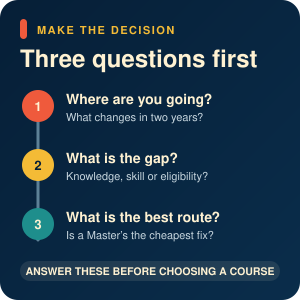
Before choosing a course, define your destination, identify the gap and decide whether a master’s is the best route.
Why people do it
Ask around and the same handful of answers come back.
“I want to do a PhD.” By far the most common, and the one where the most money gets wasted. Skip to the next section before you spend anything, because a fair number of doctoral programmes will take you without a masters and some will pay for one.
“I don’t know what to do next.” Also common, and more reasonable than it sounds. Finishing a degree with no plan is unsettling and a masters is a legitimate looking place to stand while you work it out. The trouble is the cost. A year in a research assistant post answers the same question, pays you instead of charging you, and leaves you employable at the end. Some people do find their direction during a masters, though more of them find it in a job.
“I want to know more about dementia.” Nothing wrong with the motive, but check how much of it you can get for nothing first. There are free MOOCs and open courses that cover a lot of ground, and if they hold your attention for eight weeks that tells you something useful before you commit twelve months and a five figure sum.
“My gran has dementia.” A parent, a grandparent, someone you cared for. This is more common in our field than in most, and it is a perfectly good reason to be here. Two things to think about. First, whether you want to work with people living with dementia or study the condition, because those lead to very different courses. Second, that grief and study are hard to run at the same time, and there is no prize for doing it sooner rather than when you are ready.
“My employer expects it,” or a scheme requires it. Straightforward, and the only version where the answer is simply yes. Read the actual requirement yourself rather than relying on what someone said in a corridor, because “masters level credits” and “a masters” are not always the same thing.
“I want to switch field.” You have a degree in one subject and want to work in another. This is where a masters earns its keep most reliably, because there is often no other way in.
The one to be wary of is a masters bought purely to strengthen an application. Letters after your name do not fix a CV that is short of research experience, and if that is the gap, there are cheaper ways to close it. Adverts saying “masters desirable” mean desirable. Look at who is actually getting appointed. In a future article we will talk about how you might get some research experience outside gaining a qualification.
Whatever brought you here, the useful question is the same. What do you want to be different in two years, and is this the cheapest way to get there?
We followed Morgan Daniel through her whole MSc year at UCL, from the week she arrived to the week she finished. She wrote about this exact decision twice, once before she was sure and again halfway through, along with the imposter syndrome, the homesickness, the dissertation and the job hunt at the end. If you would rather hear it from someone living it than from us, start there.
The funding reality
Start with the number, because it is what stops most people. Fees for a taught masters commonly land somewhere between £12,000 and £15,000 for a home student. Lab based courses cost more. International fees are higher again, often double. On top of that sits twelve months of rent and food, and for many people a pile of undergraduate debt that is already there.
The England loan is £13,206, and it has to cover fees and living costs together. For most courses it will not stretch to both.
So cost is a real obstacle rather than a failure of nerve. Plenty of capable people decide against a masters because of the money, and that is frequently the right decision. What follows is what free money exists, and it is less than people hope.
What the dementia charities do and do not fund
Worth clearing up first, because it is the most common misunderstanding we hear. As a rule, Alzheimer’s Research UK and Alzheimer’s Society fund PhD studentships rather than taught masters. As far as we are aware there is no standing charity scheme you can apply to for MSc fees, so if someone has pointed you at a dementia charity for masters funding, they are most likely thinking of doctoral money.
There are exceptions, so keep your eyes open. ARUK has previously partnered with HDR UK to fund a masters in dementia data science. In Scotland, the Alzheimer Scotland Student Research Programme aims to fund at least one masters level studentship every year, covering tuition fees, a stipend and consumables, and it runs an annual round. Applications are open only to Scottish Dementia Research Consortium members, though membership is free. Other charities, dementia or otherwise, occasionally do the same.
Notice the shape of these, though. Applications come from research teams at universities or NHS Scotland, not from students directly, and the Scottish scheme says plainly that it will not accept an application from an individual without formal institutional backing. That is the same pattern as the PhD studentships. Your job is to find the research team, not the application form. And with roughly one award a year in that particular case, this is opportunistic money rather than something you can plan around.
The routes that do exist, and who they are shut to
There are four, and each has a gate on it.
NIHR INSIGHT will fund a research masters outright, fees and money to live on. It is open only to registered health, social work and public health professionals early in their careers, and the section below sets out the detail.
NIHR Pre doctoral fellowships pay for salaried time and will sometimes cover a masters, but you need to be employed in health or care to apply at all.
A 1+3 doctoral award pays for a taught year, and this is the one people misread. It is not a masters application. You are applying for a PhD and the masters year comes attached to it. If what you want is the masters on its own, this route is shut.
Your employer might pay. This is the most widely available of the four and much the slowest. It usually means two or three years of building a case, proving the value and waiting for a training budget to come round.
Beyond those, the money thins out fast. Institutional scholarships are real but few and heavily contested. Small educational trusts hand out hundreds rather than thousands. Neither will fund a masters on its own.
If none of them fit you
This will be a lot of readers. A bioscience graduate heading for the lab, with no NHS employer behind them and no wish to commit to a PhD yet, has no free route to a taught masters. That is simply the position, and pretending otherwise wastes your time.
At that point the question changes. It stops being how do I get this funded and becomes whether this is worth borrowing for. Four things to weigh before you take on the debt.
- Would the doctoral programmes you want take you without a masters? Many will, and an afternoon reading four sets of eligibility criteria is a good trade against twenty thousand pounds.
- Would a year in a research assistant post give you the same experience while paying you rather than charging you?
- Would a PGCert or PGDip close the specific gap for a third or two thirds of the cost?
- Is waiting two years for an employer to fund it genuinely worse than borrowing the money now?
If you have worked through those and still want it, then borrow and go. Wanting the qualification is a legitimate reason to pay for one, and this is not an argument that nobody should. The mistake is paying without checking whether you had to.
If you work in health or care
This is the group with the best odds, and a lot of people never find out.
NIHR INSIGHT runs as regional programmes through universities. Successful applicants get a funded place on an eligible research masters, plus money that can be taken as a tax free stipend or used to backfill the clinical role during study. No previous research experience is needed. It is aimed at people at an early stage of their professional career, usually within about five years of qualifying, and the eligibility page is worth reading carefully, because being further along makes you ineligible. Doctors and dentists are not covered, since they have their own route through Integrated Academic Training. INSIGHT has until now been an England programme, but it is absorbing the INSPIRE scheme and expanding across all four UK nations, so the picture is changing in your favour.
The eligible courses vary by region and are usually research focused rather than subject focused, things like clinical research, healthcare research methods, health informatics or public health. That is a point in their favour rather than against, for the reasons in the section on methods courses below.
NIHR Pre doctoral fellowships
If INSIGHT has passed you by, these are the next rung. Separate schemes run for medical and dental trainees, for other registered professions, and for people specialising in research methodology. You do not need a masters to apply, and some will fund one as part of the award, whether that is a full MSc or a certificate, diploma or MRes.
There are also shorter research internships for registered health and care professionals, and a separate masters level route for experienced practitioners moving into research delivery leadership rather than academia.
These schemes change names, merge and get restructured fairly often, so check the current position on the NIHR site rather than relying on what a colleague did three years ago.
If you are heading for the lab
Be clear about the position here. There is no funded route to a standalone taught masters in biomedical science. If you want the MSc on its own, you are paying for it, and the loan will not cover all of it.
What does exist is the four year doctoral programme, now common, which frequently builds in a research masters year with rotations through several labs before you commit to a project. That is a funded masters, but it comes attached to a funded PhD. You get it by applying for the doctorate, not by applying for the masters.
The dementia charities fund studentships too, across cause, cure, care and prevention: see the ARUK PhD Scholarship scheme and Alzheimer’s Society resources for early career researchers. One thing to understand about those: applications are made by the supervisor rather than by you. You cannot apply directly, which means your job is finding the researcher, not finding the form. Identify people whose work you want to be part of, approach them, and get yourself named on their application. Studentship advertising runs all year but peaks between November and January for autumn starts, so the autumn before you want to begin is when to be having conversations.
Do you need a masters first? Frequently not. Plenty of funded studentships ask for a 2:1 and relevant lab experience without requiring one. A current dementia charity funded studentship advertised at one of the big centres says an MSc or MRes is favoured but not a prerequisite, which is a fair summary of the field. Where a masters genuinely helps is when you have no wet lab experience at all, because that is the gap panels notice, and an MRes closes it better than a taught MSc.
If you are heading for social science or qualitative research
This is where the 1+3 is most likely to be worth pursuing, because social science routes more often expect prior methods training and several partnerships hold that option for applicants who have none. Read their entry routes carefully. The same partnership frequently runs a 1+3, a straight PhD and a shorter option with a research methods certificate attached, and which you apply for depends on the training you already have.
One reassurance on scope. Alzheimer’s Society funds across psychology, health and social sciences as well as biological subjects, so care research, qualitative work and social care studies sit inside the remit rather than at the edge of it.
The methods point matters most here. Qualitative and mixed methods training is genuinely hard to pick up informally, and it is the thing that makes you employable across projects. If you are paying for a masters yourself, a serious methods course will do more for you than a subject course with a couple of methods modules bolted on.
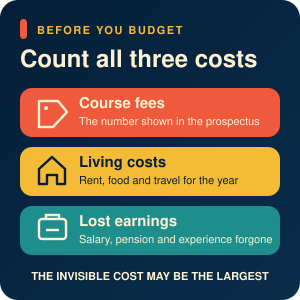
The true cost includes fees, living expenses and the earnings and experience you give up.
What it costs
Three costs. Most people count one.
Fees swing widely by subject and institution, with lab based courses dearer than classroom based ones, and international fees frequently more than double.
Then living costs. A full time masters is not something you slot around a job, whatever the word “flexible” is doing in the prospectus, so twelve months of rent and food has to sit somewhere in the sums.
The third is the salary you did not earn. It is usually the biggest number involved and the one nobody writes down: a year of pay, a year of pension contributions, a year of experience not gained. Put a figure on it.
How to pay for it
Government postgraduate loans
All four UK nations offer something. They are not the same thing, which causes no end of confusion.
England lends up to £13,206 for courses starting on or after 1 August 2026, as set out on GOV.UK. Here is the catch people fall into: that is the total for the entire course, not a yearly amount, so a two year part time course splits the same sum across both years. It is not means tested. It goes to you rather than the university, and you decide how much covers fees and how much covers rent. Repayment starts the April after you finish, at 6% of anything over £21,000, alongside your undergraduate loan if you have one.
Wales is the largest package in the UK at up to £19,635, confirmed by Student Finance Wales. It used to be part grant, but since 2024/25 the whole thing is a loan. Like England it covers fees and living costs, it is paid to you in three instalments, and repayment is 6% of income over £21,000.
Scotland splits it in two through SAAS: a tuition fee loan of up to £7,000 paid to the institution, and a living cost loan of up to £6,900 for full time students. The fee loan is a hard cap, so anything dearer leaves a gap you fill yourself. Repayment is Plan 4, at 9% of income over £33,795, which is a much higher threshold than the rest of the UK. Check the current position on studying outside Scotland, as the rules differ from the other nations.
Northern Ireland changed substantially for 2026/27. The tuition fee loan rose from £6,500 to £10,000, an increase of just over half, and Student Finance NI confirms the new figure. It and it works differently from the rest of the UK. It goes straight to your university rather than to you, and it covers fees only, with nothing towards living costs. Repayment is on Plan 1 at 9% of income over £26,900, added to your undergraduate balance rather than collected separately. Students who started before 2026/27 stay on the old £6,500 limit.
Three rules that catch people out
These apply everywhere, so check them before you plan around any of this. You need to be under 60 on the first day of the first academic year. It has to be your first masters, so anyone already holding one, or a higher qualification, is out. And the course has to be a full standalone masters, normally 180 credits, which means topping up an earlier certificate or diploma usually will not qualify.
All of these figures move every year, so check with your own funding body rather than trusting a number you read somewhere. None of them are open to international students.
The alumni discount, if you are going back to your old university
The most reliable money on this page, and the one people most often walk past. Most UK universities cut tuition fees for their own graduates coming back for postgraduate study. Twenty per cent is typical, some do ten, a few go to twenty five, and it usually applies to postgraduate certificates and diplomas as well as full masters. Normally it lands automatically when you enrol, without an application.
Twenty per cent off a twelve thousand pound course is most of a term’s rent. If you are weighing up two decent courses and one is at your old university, put that in the sum.
Four things to check. A few discounts are capped in cash rather than being a straight percentage, so on a dear course the real saving is smaller than the headline. Others cannot be stacked with the university’s own scholarships, which means picking between the automatic discount and a bigger competitive award. Some vanish entirely if an external body is invoiced for your fees, so employer sponsorship can quietly cost you the discount, though most institutions will still apply it to whatever you are funding yourself, including from a government loan. And the eligibility is often wider than people assume, covering exchange students, summer school attendees and foundation course students, not only full degree graduates.
It is always worth asking, because it takes one email and nobody volunteers the information.
Scholarships, trusts and employer funding
Institutional scholarships and hardship funds exist almost everywhere, are poorly advertised, and go underspent on the less fashionable subjects. Small educational trusts, professional bodies and subject associations hand out a few hundred to a few thousand pounds each. Applying to fifteen of them is a slog, but fifteen small awards is still a term’s rent. If you are employed, ask what your organisation has funded before now, because that tells you more than the written policy will. And taking one module at a time spreads the cost and gives you somewhere to stop.
Three kinds of course, and why people pick the wrong one
Courses with near identical names do very different jobs. Getting the family wrong is the most expensive mistake available here.
Practice facing courses are built for people already working in health and social care. Usually part time, frequently distance or online, centred on care, services, policy and practice. They will help you evidence your practice, lead a service, or move sideways into applied research. They will not get you into a laboratory PhD.
Science facing courses are built for bioscience and psychology graduates aiming at a research PhD. Full time, campus based, lab or data work, a substantial project. Strong preparation for a research degree, and close to impossible alongside a job.
Then the methods courses, which carry no disease label at all: epidemiology, statistics, health data science, clinical trials, public health, health economics, qualitative methods, neuroscience. For a research career these are frequently the smarter purchase, because a technique travels across projects and subject knowledge does not. A lot of people in this field learned their methods on a course, then picked up the dementia knowledge on the job. Going the other way round is much rarer.
So the question to sit with is whether you are short of knowledge or short of technique. That is what should decide which family you apply to.
One more thing, because the letters look alike and the courses are not. A taught MSc is mostly modules with a project bolted on the end. An MRes, or an MSc by research, is mostly project with a few modules bolted on the front. If you already know a PhD is the destination, the research heavy version usually leaves you in a stronger position.
Where to look for a masters in dementia
Start with our higher education courses directory, which pulls together dementia and neurodegeneration relevant postgraduate courses from across the UK and beyond: dementia studies and dementia care through to neuroimaging, neurobiology, data analysis, lab work, ethics and science communication. If you want a masters in dementia specifically rather than a broader research qualification, filter it by level and go straight to the MSc list if that is what you are after. After that, FindAMasters is the widest net for courses beyond our own list.
Then look past it. Find out where the authors of papers you admire teach, because a course is a different proposition when the people running it are still doing the work. Check your professional body for accredited programmes. Look at research centres and institutes as well as universities, since taught provision often hangs off a centre and gets badged under a department name no database search will surface. And put the course name into a search alongside “review” or “experience” to see what gets said away from the prospectus.
If you are in work, ask colleagues who have done one recently. Not whether they enjoyed it. Whether it did the specific job they wanted, and whether they would spend the money again. With nobody to ask, Morgan’s year is the nearest thing to that conversation, and she talked the whole thing over once it was behind her.
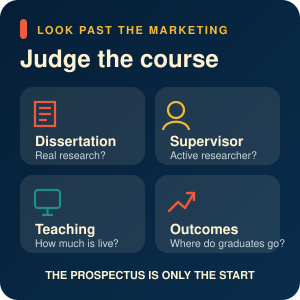
Look beyond the prospectus and examine the dissertation, supervision, teaching and graduate outcomes.
Judging a course once you have found it
Prospectuses are marketing. These are the things that tell you whether it will do the job.
The dissertation matters more than anything else on the page. Is it original empirical research, a secondary analysis, a service evaluation, or a literature review? Is it attached to a live project or invented from scratch? A project attached to live research gives you data and a supervisor with something at stake. It can also lead to a publication, which a literature review written from scratch rarely will.
Ask who supervises and whether they still do research, how supervisors get allocated, how many students each one carries, and whether you can approach someone before you apply.
Find out what “flexible” means in practice. Distance and part time courses range from well designed online teaching to a folder of PDFs and a discussion board. How much live teaching is there, and how many people are on the course?
Ask where the last two or three cohorts ended up. A course that routes people into research keeps those numbers and is usually pleased to share them. If the answer comes back vague, treat that as information.
And check the qualification is recognised wherever you need it recognised, which for some professional routes is the whole reason you are doing it.
Questions to ask the course leader
Email them before applying. The reply tells you a great deal. Worth asking:
- What did the last cohort go on to do?
- Can dissertations attach to ongoing projects, and how does that get arranged?
- Who might supervise in my area?
- How many staff teach on the course?
- What does a typical week look like for a part time student in work?
- What costs sit outside the fee?
- Is there an exit route with a certificate or diploma?
- What does the course do for people heading towards a PhD?
That last question is the test. A serious answer covers supervision and proposal writing. A weak one tells you many graduates go on to further study.
Applying
First, whether you will get in. Most courses ask for a 2:1, but that is a starting position rather than a wall. Plenty accept a 2:2, particularly with relevant experience, and practice facing courses frequently say outright that they will consider professional experience in place of the grade. If you are working in health or care and have a 2:2 from a decade ago, you are very likely still a serious applicant. Ask the admissions team directly rather than ruling yourself out from the website, because the published requirement and the actual decision are not the same thing.
Start earlier than feels sensible. Funding deadlines frequently fall before course deadlines, and working backwards from the wrong one is what catches people out, so run both applications in parallel.
Writing the personal statement
Write it about what comes next, not about what you have already done. The usual failure is a chronological account of a degree the reader can see on your transcript. Tell them what you intend to do with the qualification and why this course in particular lets you do it. Name modules. Say which dissertation topic interests you. Mention the member of staff whose work you want to be near. Do that and the statement could not have been sent anywhere else, which is the entire point.
Be plain about the gap you are filling. “Clinical experience, no research methods training, this course fixes that” beats any amount of lifelong passion. Deal with anything odd in your history in a sentence, because unexplained gaps get imagined worse than they are. Ask referees early, tell them what the course is, and send them the statement so they can back it up.
Much of this carries over to PhD applications, and Ajantha Abey’s advice on assessing and approaching a lab is a good companion.
If you are already working
Have the conversation with your employer before you apply, not after you have a place. Three things are on the table: money, protected time, and what happens when work gets busy. Protected time is the valuable one and the one you are least likely to be offered.
Be realistic about the load. Part time study on top of a full time job and a family is hard, and it goes better for people who put it in the diary than for people who intend to fit it in. If you suspect you will let it slide, pick a course with fixed study days.
If you are applying from outside the UK
No UK government loan is available to you, and international fees run considerably higher, so the funding picture starts from a different place. Scholarships designated for international students, schemes run in your own country and institution level awards are the main routes, and the institutional ones are usually the largest. Budget for the visa, the immigration health surcharge and evidence of maintenance funds.
One date matters more than the rest. The Graduate route, which lets you stay and work without sponsorship after your course, is being cut from two years to 18 months for bachelor’s and masters graduates. Applications submitted on or before 31 December 2026 still get the full two years, and anything from 1 January 2027 gets 18 months. It goes on the date you apply rather than when you graduate or start. PhD graduates are unaffected and keep three years. If you are weighing up a UK masters partly for the work experience afterwards, that changes the sums, and it is another argument for the research heavy route if a doctorate is where you are heading.
And check how a UK masters is treated wherever you plan to work afterwards, since recognition varies.
Things to try first
A research assistant or technician post pays you, hands you real research experience, and often comes with part time study and fee support attached. If you are not certain you want a research career, that is a far better way to find out than paying to find out. Our jobs board carries them regularly, however the competition for these roles is stiff, with many getting around 100+ applications for a single roll. If you are turned down, you could look for internships, or ask for some lab experience, but we realise this is a luxury not everyone can afford to do.
A postgraduate certificate or diploma costs a third or two thirds of a masters and frequently does the specific job you need. One warning if you are planning to top up to a full masters later: the government loan is generally only available for a complete standalone masters, so a top up may not attract funding. Worth checking with your funding body before you treat the staged route as the cheap option. The directory filters for both, so you can see the PGCert options and the PGDip options without wading through the full list.
Short courses and summer schools will cover a single technique in a week, many of them free or heavily subsidised through research networks and doctoral training programmes. There are free dementia MOOCs and free online Stanford courses that cost nothing but time, which makes them a cheap way to test whether you like a subject before committing a year to it.
And getting involved in a real study, even informally, leaves you with a named contribution and someone who knows your work. In an application that can outweigh a taught qualification.
If you are building a CV for a future PhD application, any role that involves working with people living with dementia will stand you in good stead, including care work. Being able to talk first hand about the impact of the condition carries real weight at interview, and it is something most applicants cannot do.

A master’s should solve a defined problem, not simply postpone a difficult decision.
So is a masters in dementia worth it?
If a scheme you want requires one, yes, and all that is left is picking it and paying for it.
If you are switching fields and there is no other way in, usually yes.
If you want a funded PhD, find out whether the programmes you have your eye on would take you without one before you spend anything. For a fair number of people the answer is that they would, and what looked like a requirement turns out to be something you did not have to buy.
And if you are here because you do not know what comes next, a masters is an expensive way to find out. A year in a research assistant post costs nothing, pays you, and answers the question faster.
Five things to do next
- Write down what you want to be different in two years. Vague is fine to start with, but keep going until you can say what changes.
- Read the eligibility criteria for three or four doctoral programmes you would want to be on, and find out whether they need a masters or would fund one through a 1+3.
- Check what your own nation’s funding body will lend you this year, and whether it covers the fee.
- If you would go back to your old university, email them about the alumni discount and ask what would void it.
- Email one course leader with two specific questions, then judge the course by the reply.
Common questions about doing a masters
Do you need a masters to do a PhD in the UK?
Not always. It varies between disciplines and between individual doctoral programmes. Some expect a masters, some state explicitly that they do not, and some will fund one for you as part of a combined award. Read the eligibility criteria for the specific programmes you are interested in rather than relying on a general rule.
What is a 1+3 studentship?
A funded award combining a one year taught masters with a three year PhD, usually covering fees and a stipend for the whole thing. It is aimed at people who need masters level training before starting doctoral research, and it means you do not pay for the masters yourself.
How much is the postgraduate masters loan?
In England, up to £13,206 for courses starting on or after 1 August 2026, and that is the total for the whole course rather than a yearly amount. Wales offers a loan of up to £19,635, the largest package in the UK. Scotland offers a tuition fee loan up to £7,000 plus a living cost loan up to £6,900. Northern Ireland rose to £10,000 for 2026/27, covering fees only and paid directly to the university. Figures change annually, so check with your own funding body.
Do I need a masters before a PhD in dementia neuroscience?
Frequently not. Many funded studentships ask for a 2:1 and relevant laboratory experience rather than a masters, and four year programmes often include a research masters year with lab rotations built in. A masters helps most when you have no wet lab experience at all, and an MRes closes that gap better than a taught course.
Do the dementia charities fund masters degrees?
Generally no. Alzheimer’s Research UK and Alzheimer’s Society fund PhD studentships rather than taught masters. Applications are made by the supervisor rather than by the student, so the practical step is identifying a researcher whose work fits and approaching them, not looking for an application form. Studentships are advertised year round but peak between November and January for autumn starts.
Can I get my masters funded if I work in the NHS or social care?
Possibly. The NIHR INSIGHT Programme funds research masters places for early career registered health, social work and public health professionals, usually within about five years of qualifying, and adds either a tax free stipend or a contribution to backfill your clinical role. No previous research experience is needed. Doctors and dentists are not eligible and use Integrated Academic Training instead. If you are further into your career, pre doctoral fellowships fund salaried time to build research skills and some will pay for a masters as part of the award. Check the NIHR site for the current position, as these schemes are restructured fairly often.
Who is eligible for the postgraduate masters loan?
Rules vary by nation, but three conditions catch people out across the UK. You need to be under 60 on the first day of the first academic year. It must be your first masters, so anyone who already holds a masters or a higher qualification is not eligible. And the course must be a full standalone masters, normally 180 credits, which means topping up an existing certificate or diploma usually does not qualify. International students cannot access any of the UK government schemes.
Does the loan cover my fees?
Not necessarily. It is a contribution rather than a matched amount, so if your course costs more than the maximum loan you cover the difference yourself.
Do universities give a discount if I did my undergraduate degree with them?
Most do. A tuition fee reduction for returning graduates is standard across UK universities, commonly twenty per cent, with some at ten and some up to twenty five, and it is usually applied automatically. Check whether it is capped in cash terms, whether it can be combined with other scholarships from the same institution, and whether it is withdrawn if an employer or other external body pays your fees.
Can I do a masters with a 2:2?
Often yes. Most courses advertise a 2:1 as the standard requirement, but many will accept a 2:2 alongside relevant experience, and practice facing courses commonly state that professional experience can be considered instead of the grade. Ask the admissions team rather than ruling yourself out from the published requirement.
How long can I stay in the UK after a masters as an international student?
The Graduate route currently gives bachelor’s and masters graduates two years to stay and work without sponsorship. From 1 January 2027 that drops to 18 months, based on the date you submit the application rather than when you graduate. Applications on or before 31 December 2026 keep the full two years. PhD graduates are unaffected and continue to receive three years.
Can I do a masters part time while working?
Yes, and many courses are built for it, including distance and online options. It is demanding, and the people who finish tend to be those who negotiated protected time rather than those who planned to fit it around everything else.
Is an online masters taken as seriously as a campus one?
For most purposes yes. The qualification is the same. What matters more is what the course contained and what you produced during it, particularly the dissertation.
Will a masters improve my chances of a funded PhD?
It can, but not automatically. It helps most when it produces research experience, a supervisor who will advocate for you and a well developed proposal. A qualification without those adds less than people expect.
What is the difference between an MSc and an MRes?
A taught MSc is mostly modules with a research project at the end. An MRes, or an MSc by research, is mostly research project with a smaller taught component. If you already know you want a PhD and need supervised research experience rather than more teaching, the research heavy option is usually the better fit.
Should I choose a dementia specific course or a general methods one?
If you are short of subject knowledge, a masters in dementia is the right call. If you are short of technique, take the methods course. For research careers specifically, methods training is often the more valuable and more transferable choice.
What if I cannot afford it?
Look at part time and modular study to spread the cost, at employer funding, at institutional scholarships and hardship funds, at small charitable trusts, and at whether a funded doctoral route or a salaried pre doctoral scheme would take you without a masters at all. That last one is the one most people never check.
Funding figures were checked against UK sources available in August 2026. Amounts change annually, so confirm the current position with your own funding body before making a decision.




 Harriet Greene