 Print This Post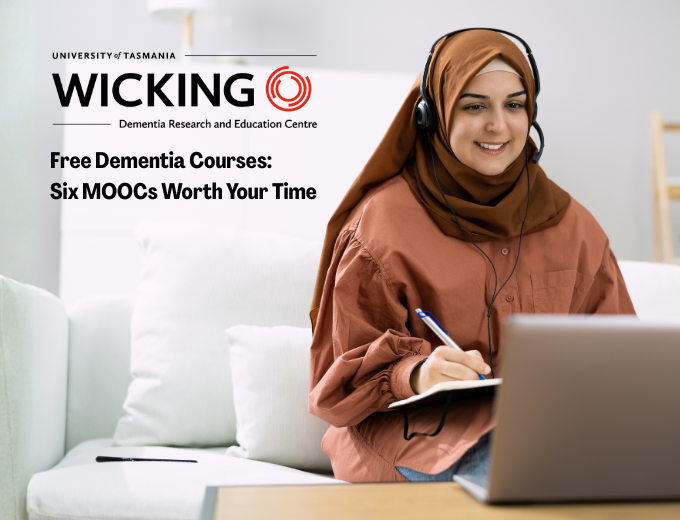
There is a version of this article that just says “free dementia courses, go and enrol”, and you would nod, close the tab, and never think about it again. So let’s start somewhere more useful.
Your expertise is narrow. It has to be. If you spend four years on tau propagation in mouse models, or on the economics of respite provision, or on the electrophysiology of sleep in Lewy body disease, that is where your depth goes. Everything adjacent — the clinical picture, the care pathway, the lived reality, the neighbouring conditions your work keeps bumping into — you pick up in fragments. Conference sessions. A colleague’s talk. Whatever the reviewer made you read. Even those of us who work in genuinely interdisciplinary neuroscience tend to have one deep well and a lot of shallow puddles.
The Wicking Dementia Centre at the University of Tasmania has spent over a decade building something that fills exactly that gap, and giving it away.
What free dementia courses does the Wicking Dementia Centre offer?
Six of them. Every one is genuinely free, self-paced, delivered entirely online, and carries a certificate of completion. No fees, no entry requirements, no final exam.
| Course | Hours | Status |
|---|---|---|
| Understanding Dementia | 21 | Always open |
| Preventing Dementia | 8 | Always open |
| Understanding Childhood Dementia | 17 | Open now |
| Parkinson’s MOOC | 14 | Always open |
| Motor Neurone Disease MOOC | 8 | Always open |
| Understanding Traumatic Brain Injury | 10 | Opens Aug 2026, enrol by 15 Oct |
Understanding Dementia — 21 hours
The flagship, and the reason most people have heard of the centre. It launched in 2013 and has run continuously since — we first pointed readers at it back in 2020, when enrolments stood at 220,000. They have since passed 750,000 across the Wicking courses as a whole. The course takes you through the brain, the diseases that cause dementia, and the person living with the condition. A refreshed version landed in late 2025.
→ Enrol in Understanding Dementia
Preventing Dementia — 8 hours
Risk reduction: cardiovascular health, diet, exercise, cognitive activity, and the modifiable factors that keep reappearing in the Lancet Commission updates. This is the one Wicking are quietly proudest of — it recorded a 53% completion rate, against a MOOC sector average typically below 15%.
→ Enrol in Preventing Dementia
Understanding Childhood Dementia — 17 hours
Seventeen hours on a group of conditions most dementia researchers could not name three of. Built for families, educators, support workers and health professionals, covering how childhood dementia affects the developing brain, early indicators, and the care that best supports children and their families. Draws on lived experience accounts throughout.
→ Enrol in Understanding Childhood Dementia
Parkinson’s MOOC — 14 hours
Developed with the Menzies Institute for Medical Research, with support from the Parkinson’s Research Foundation. Given how much of our field now works across the neurodegeneration spectrum rather than dementia alone — and given how starkly the research gaps in Parkinson’s have been exposed — this one earns its place on a lot of reading lists.
→ Enrol in the Parkinson’s MOOC
Motor Neurone Disease MOOC — 8 hours
Produced with MS Queensland, covering MND from neuroscience principles through to care approaches. If you want a lighter way in first, our podcast playlist on understanding and researching MND covers a lot of the same territory in audio.
Understanding Traumatic Brain Injury — 10 hours
The newest addition, developed with Connectivity, and the only one of the six running to a fixed timetable. It opens in August 2026, enrolments close on 15 October 2026, and the course itself closes on 2 November 2026. Diarise this one rather than bookmarking it.
→ Enrol in Understanding Traumatic Brain Injury
Why early career researchers should take a free online dementia course
Because your grant application has a gap in it. If you are writing about repurposing a cardiovascular drug, or modelling care costs, and your understanding of the clinical progression is honestly a bit thin, a weekend on the Understanding Dementia MOOC will do more for that section than another hour of literature searching.
Because the neighbouring conditions keep turning up. Differential diagnosis, mixed pathology, shared mechanisms, overlapping care needs. If your work touches Parkinson’s or MND at the edges and you have never had structured teaching on either, here it is, for nothing.
Because you will be asked to explain your work to people who are not you. Wicking designed this online dementia training for a broad audience, including adult learners without a science background. Watching how they pitch complex neuropathology to a mixed cohort is a masterclass in presenting your research to a lay audience, which is the thing most of us are worst at. Steal the framing.
Because it is a legitimate CPD line. Clinicians, allied health professionals, charity staff and industry colleagues can all count a completion certificate towards professional development — and given the dementia training gap exposed across care in England, there is a decent argument for pointing colleagues at it too. Be clear-eyed about what it is, though. Wicking’s terms state explicitly that the certificate carries no academic credit and does not indicate an accredited award. It is evidence you did the learning, not a qualification. If you are building out a CPD list, we have also rounded up free online Stanford University courses for researchers.
Because you might be new here. If you have just moved into dementia from another field — and plenty of people do, often mid-career — this is the fastest structured route from “I know the biology” to “I understand the condition”.
Because of the people in the forums. Cohorts include family carers, care home staff, people living with a diagnosis, nurses, students and researchers, from a very large number of countries. Reading what a care worker in Manila or a daughter in Manchester makes of the same material you are reading is not a side benefit. For a lot of researchers, it is the most valuable part.
Are the Wicking dementia MOOCs worth it? The honest caveats
If you are three years into a PhD on a specific mechanism, the module covering that mechanism will feel introductory. That is by design and it is not a flaw — but do not expect to be challenged everywhere.
Twenty-one hours is twenty-one hours. Self-paced does not mean effortless, and Wicking’s completion statistics are impressive precisely because most MOOCs get abandoned. Decide before you start whether you are doing the whole thing or cherry-picking the units you need. Both are reasonable. Only one of them ends with a certificate.
Worth knowing too that the free certificate is not the only certificate. On some courses Wicking offer paid enhanced certificate options alongside it. No course content sits behind that paywall and the free route is the one described here, but the site does not lead with the distinction. The curriculum draws on neuroscientists, clinicians and care researchers, and the courses have been the subject of published research in their own right — including work on whether the material lands equally well for non-native English speakers, which is a question most educational providers never think to ask about themselves.
Which free dementia course should you start with?
If you have never done one: Understanding Dementia, and give yourself six weeks rather than a heroic weekend.
If you want the highest return on the smallest time investment: Preventing Dementia at eight hours, which is also the most useful for public engagement work, because brain health and dementia prevention is what people actually ask you about at parties.
If you want to genuinely learn something new: Understanding Childhood Dementia, unless you already work in it, in which case swap in Parkinson’s or MND.
Frequently asked questions
Can I put this on my CV, and where?
Yes, but put it under continuing professional development or training, never under qualifications. Name the course, the provider (Wicking Dementia Research and Education Centre, University of Tasmania), the hours and the year. Reviewers spot inflated CVs quickly, and a MOOC listed honestly reads better than one dressed up.
Will it count towards my professional revalidation?
Not automatically, because the courses are not accredited by any UK regulator. But the NMC, HCPC and GMC frameworks all let you choose your own CPD activities and justify them with a reflective account, so in practice most people can log a Wicking MOOC as self-directed learning. Check your own framework before you rely on it, and write the reflection while the content is fresh.
Is there an exam, and can you fail?
There is no final exam. Progress is checked through quizzes and activities as you work through the units, and the certificate is issued on satisfactory completion of those, judged by the course team. In practice the barrier is finishing, not passing.
It is an Australian course. Does it translate to UK practice?
The neuroscience, the disease processes and the principles of person-centred care travel without any trouble. What does not travel is the service furniture: how care is commissioned and funded, which professionals hold which responsibilities, terminology, and the legal framework around capacity and consent. Read those sections as a comparator rather than a guide, which is arguably more useful anyway.
Can I reuse the material in my own teaching or PPI work?
Not by default. The content is University of Tasmania copyright. Normal academic referencing with proper acknowledgement is fine, and some individual items carry a Creative Commons licence, but any other non-commercial reuse needs written consent from the academic lead for that course. Worth asking rather than assuming, and they are approachable.
Can I point participants and family carers at it?
Yes, and a lot of people do. The courses were built for a mixed audience, and family carers make up a large share of every cohort. Preventing Dementia is the gentler starting point at eight hours. Do flag that some content covers progression and end of life, which can land hard for someone caring for a person right now.
Six courses. All free. All open to anyone.
If you have taken one of the Wicking MOOCs, we would like to hear how you found it — and whether it changed anything about how you work. Drop a comment below.

 Dr Becky Carlyle
 DEMON Network