 Print This Post
Changing university is rarely just a matter of clearing an office and updating an email signature. If you want to transfer a research grant or fellowship to a new institution, you may also need to move staff, students, equipment, data, contracts and regulatory approvals. Some of those things can follow you. Others may need to stay where they are. This guide covers how a research grant transfer actually works in the UK: the conversations worth having before you accept the job, what each funder requires, what happens to the money, and who needs to agree to what.
In brief
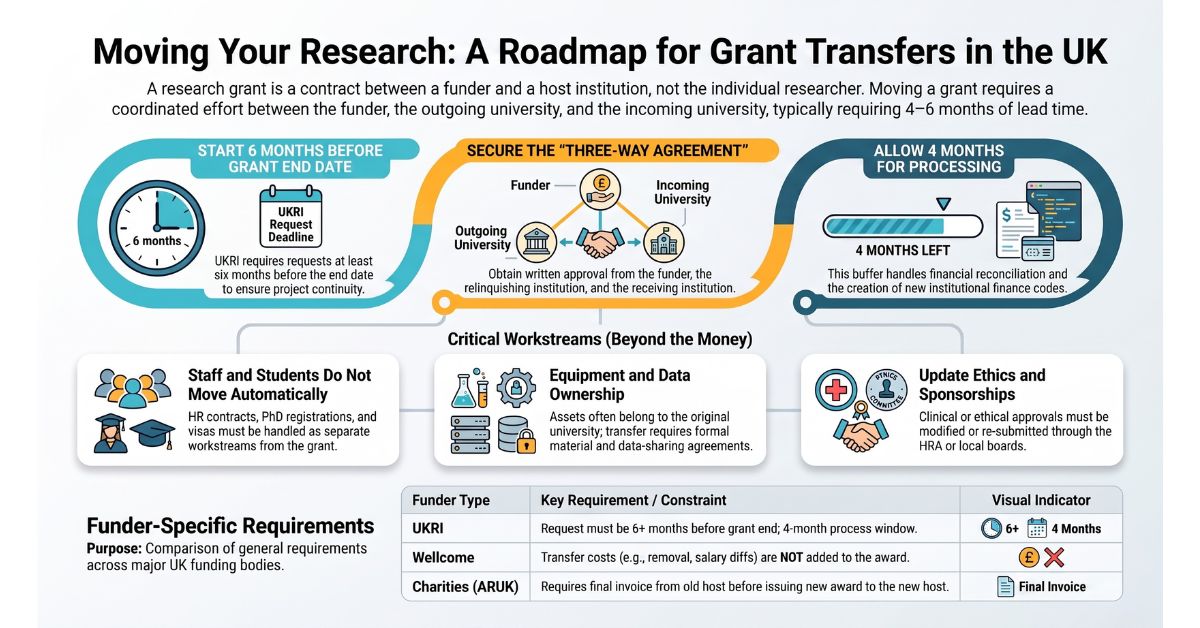
A research grant belongs to your host organisation, not to you personally. Most awards can move with you to another university in the United Kingdom, but never automatically and never quickly. To transfer a research grant you need the funder’s written approval and the written agreement of both institutions. UKRI requires the request at least six months before the grant end date and advises allowing at least four months for the process itself. Fellowships follow the same route, with extra conditions attached and fewer fallback options if agreement cannot be reached. Staff, students, equipment, data and ethics approvals are handled separately. They do not move with the money.
Last checked against UK funder and regulatory guidance on 19 August 2026.
On this page
- Can you transfer a research grant to another university?
- Start the conversation early
- The human side of a grant transfer
- Transferring a UKRI grant
- NIHR, Wellcome and medical research charities
- Dementia funders: ARUK, Alzheimer’s Society and others
- What actually happens during a grant transfer?
- What happens to staff employed on the grant?
- Can your PhD students move with you?
- Equipment, samples and laboratory materials
- Data, intellectual property and research records
- Ethics, sponsorship and NHS research
- Applications already under review
- Moving a UKRI grant overseas
- A practical grant transfer checklist
- Frequently asked questions
Can you transfer a research grant to another university?
Often, yes, but never assume that a grant will automatically move with you.
The first point to understand is that a research grant is not normally money held personally by the researcher. The funder has made an award to, or entered into a contract with, your university, NHS organisation or other host institution. You may lead the research, but your organisation is usually accountable for the money.
Transferring a research grant therefore means more than changing the name of the university on the paperwork. Your current institution may need to close and reconcile the existing award, the funder must approve the change, and your new institution may need to accept a new award or contract. At the same time, separate arrangements may be required for everyone and everything connected with the project.
Whether a transfer is possible will depend on:
- the funder and funding scheme
- whether you are the project lead, co-lead or fellow
- the terms of the individual award
- how much time and money remain
- whether both institutions agree
- whether the new institution is eligible for the funding
- whether the new research environment can support the work
- what will happen to the staff, students and partners involved
- whether the move is within the UK or to another country.
A personal fellowship may be designed to support a named researcher, but it is still administered by a host organisation and the funder may attach conditions to any move. A collaborative project grant may be transferable, or the original university may remain involved and retain part of the funding. An internal university award, start-up fund or departmental pot will usually stay with the institution that provided it.
If only a few months remain, a full transfer may make little sense. The institutions and funder might instead agree that the existing university will complete the award, retain a defined part of the work, appoint a replacement lead or subcontract some activity to the new university. These are decisions to agree, not workarounds to arrange informally.
Start the conversation early
You do not need to announce a possible move before you have accepted a firm offer. Once the move is confirmed in writing, however, contact the relevant teams quickly.
For a typical transfer, that will include:
- the research or post-award office at your current institution
- the equivalent team at your new institution
- your Head of Department or institute director
- the funder, usually through the official institutional route
- co-investigators, project partners and collaborators
- staff paid from the award
- postgraduate researchers whom you supervise
- HR, finance and contracts teams
- information governance, sponsorship and research ethics teams where relevant.
Do not focus only on your largest grant. Make a list of every active award, fellowship, studentship and consultancy or collaboration agreement. Add applications under review, awards announced but not started, final reports still outstanding and projects that have spent their budget but have not formally closed.
Small awards are easy to forget and can cause disproportionate trouble later.
The human side of a grant transfer
The paperwork is the part people prepare for. The conversations are the part that goes wrong.
Start with the asymmetry. For you, moving institution happens perhaps twice in a career and shapes the next decade of your work. For the post-award officer handling your transfer, it is Tuesday. They will process several this year. That gap explains a good deal of the frustration researchers describe, and understanding it changes how you ask for things. Deadlines that feel urgent to you are one item on a list to them, and a polite reminder with a date attached will achieve more than an email explaining how important the grant is.
It also helps to separate who has authority from who has influence. Your Head of Department has no formal role in a funder’s transfer decision and can still delay it by months. Your post-award officer holds no seniority and effectively controls the timetable. The people who can say yes and the people who can slow things down are rarely the same people, and it is worth working out which is which before you start pressing.
Your current institution is unlikely to mind that you are leaving. It will mind about grant income leaving, about outputs that were expected to be returned in the next assessment exercise, about whether the work can be backfilled and about losing a study site or a piece of infrastructure. This is also why you may receive contradictory advice from within the same university. Your department may want to keep part of the project. The central research office may simply want a clean close and a tidy final statement. Neither is acting in bad faith; they are answering to different measures.
That context matters when someone suggests a subcontract, or proposes that the original institution retains a defined part of the work. It is often a sensible arrangement and it is sometimes the only way to keep a project intact. It is also a way to retain income and credit. Ask what is being traded before you agree to anything in a corridor, and get the split written down.
There is an awkward period that no guidance acknowledges. You are told not to announce a move until you have a firm offer, but the person most likely to be asked for a reference is your current line manager. Many researchers therefore spend weeks knowing something their team does not, while being unable to say it. There is no clean answer to this. What helps is deciding in advance what you will say if asked directly, and being honest that you are exploring options rather than denying it outright.
When the move is confirmed, tell the people paid from your award before it reaches a departmental email. This is the single thing that does most lasting damage to a research group. Staff will not expect you to have every answer on day one, and saying that you do not yet know what will happen to a post is far better than silence. Explain what you are asking for on their behalf, what you cannot control, and when you expect to know more. Then keep to that date, even if the only update is that there is no update.
The receiving institution is negotiating too. It wants the grant income and the outputs, and that is your leverage. It is also the only point at which you have any. Once you have signed, the person who promised you laboratory space during recruitment is frequently not the person who allocates it. Space, technical support, access to core facilities, start-up funding and any budget shortfall created by the move should appear in the offer letter or in a written summary attached to it, not in a recollection of an interview.
Finally, transfers stall in a predictable place. Your outgoing research office is closing a file. Your incoming research office is opening one. Nobody owns the space between the two. The practical fix is unglamorous and works: name one person at each institution, introduce them to each other directly, and stop being the relay station through which every message passes.
If you are still weighing up the move itself rather than the admin, our blogs on whether to apply for a lectureship and how to transition to a new lab are the place to start.
Worth remembering
Most grant transfers complete without drama. Universities handle them routinely, and for every award that leaves an institution another one usually arrives. The list of checks below is long because the process touches a lot of separate systems, not because the process usually fails.
The rest of this guide is the practical side: what each funder requires, what happens to the money, and who needs to agree to what.
Transferring a UKRI grant
UKRI allows a research grant to transfer to another eligible organisation if the new organisation can provide a suitable environment for the project. The transfer requires UKRI’s prior written approval and the written agreement of both the institution giving up the award and the institution receiving it.
The current organisation normally submits the transfer request through the appropriate funding system. Requests that were once raised through the Joint Electronic Submission system (Je-S) are now handled in the UKRI Funding Service, so check which system your award sits in before your research office starts looking for the old grant maintenance screens.
The request must explain why and when the transfer is needed and confirm that satisfactory arrangements are in place for the project to continue.
There are several UKRI rules worth knowing:
- A transfer request must be submitted at least six months before the grant’s end date. If less than six months remains, the two organisations must manage the arrangements between them.
- UKRI advises allowing at least four months from the date of the request for the transfer process to be completed.
- The original university must reconcile the award before the remaining funds can be transferred.
- The unspent balance is offered to the new organisation through a new offer acceptance process.
- UKRI will not increase the award because of the move. The receiving organisation must agree to provide any additional resources needed to complete the project.
- If the original institution will continue to do part of the work, the institutions must agree how the activity and related funding will be divided.
How long it takes
Work back from the grant end date, not from your start date at the new university. Six months before the end for the request, four months for the process, and longer again if staff, NHS approvals, equipment or international partners are involved. If your new job starts in three months and the grant ends in eight, a full transfer is already tight.
For a UKRI fellowship, the new university must also confirm its commitment to the fellow. This includes salary commitments, access to suitable resources, career development, training, mentoring and support at least equivalent to that promised in the original application. If you are earlier in that journey, our blog on knowing when to apply for your first fellowship covers what those commitments look like on paper.
If an award has been announced but has not started, a standard UKRI transfer request cannot yet be submitted. The awarding council should be contacted for advice before the award is accepted or activated.
Current details are available in UKRI’s guidance on requesting a change to a project and its full economic cost grant guidance.
What about NIHR, Wellcome and medical research charities?
Do not apply UKRI rules to every other funder. Each funder, and sometimes each scheme, will have its own process.
NIHR funding is generally governed by a contract with the host or contracting organisation. The position can differ between research programmes, career development awards and infrastructure funding, so speak to the relevant NIHR programme team before making commitments. Scheme-specific restrictions may apply. For example, an NIHR Research Professorship may be transferred to another organisation in England with NIHR approval, but not within the award’s first 12 months, and the new organisation must provide a statement confirming its support.
Wellcome also has a formal process for transferring a grant to a new administering organisation. Its published guidance makes clear that transfer-related costs are not added to the award, so removal costs, local salary differences and other expenses need to be discussed with the new institution. Wellcome also has specific provisions for equipment awarded through its grants.
Other medical research charities may take a different approach. Some will permit a transfer if the scientific case remains sound; others may require a new contract, a formal deed of novation or a change of lead applicant. Check the latest award conditions and ask the funder in writing.
Dementia funders: ARUK, Alzheimer’s Society and others
If your award comes from a dementia charity rather than a research council, the rules are usually clearer and shorter than UKRI’s, but they bite in different places.
Alzheimer’s Research UK treats this as a change of host institution and runs it through a specific form rather than an informal email. Three points catch people out. Your current host institution must submit a final invoice before a new award can be issued to you and your new host, so a slow finance office at the place you are leaving can hold up money at the place you are going to. ARUK says the process can take several months and asks you to make contact as early as possible. And if the new host institution is in another country, ARUK asks for the form at least 12 months before the move wherever that is possible.
There is also a rule worth knowing if you are a co-applicant rather than the Grant Holder. If a co-applicant moves institution during the grant, the normal expectation is that the grant stays with the Grant Holder. A portion of the money may be transferred, but only where ARUK, the Grant Holder and the co-applicants all agree. Do not assume your slice of a project grant travels with you because your name is on it.
Alzheimer’s Society awards must be held at a UK-based university, NHS site or other recognised higher research institution, and the Principal Investigator is expected to hold a contract of employment with the host institution that runs beyond the planned finish date. That second condition is the one that quietly blocks moves. If you are heading to a shorter fixed-term contract, or to an organisation that does not meet the eligibility definition, the problem is not the transfer paperwork. It is that the award cannot sit where you are going.
For Race Against Dementia, the Alzheimer’s Association, BRACE and the smaller disease-specific charities, read the award letter rather than the website. Terms vary considerably between schemes, and several of these funders make decisions case by case rather than by published policy. Ask in writing and keep the reply.
One thing is consistent across all of them: none of these charities is your employer. The host institution issues the employment contract and carries the employer’s obligations, which is exactly why the money and the jobs have to be sorted out as two separate pieces of work.
What actually happens during a grant transfer?
The exact sequence differs, but most transfers involve four linked pieces of work.
1. The scientific and operational case
The funder will want reassurance that the move will not damage the research. You may be asked to explain:
- what has been completed so far
- whether the aims, methods or timetable will change
- which members of the team will move
- what will happen to collaborators and study sites
- whether equivalent facilities, expertise and equipment are available
- whether the move creates new risks or delays
- how any interruption will be managed.
If the original application relied heavily on a particular imaging platform, tissue collection, clinical population, animal facility or specialist colleague, simply saying that the project will continue may not be enough. Show how the new arrangement will deliver what was funded.
2. Financial reconciliation
Your current institution must establish what has been spent, what is contractually committed and what remains. This may require a final or interim expenditure statement, an agreed transfer date and a clean division of costs around that date.
Check for costs that have been ordered but not invoiced, staff commitments, partner payments, travel bookings, service contracts and open purchase orders. The figure shown as available in your internal account may not be the amount that can transfer. Our blog on managing a research budget explains why those two numbers so often differ.
The new university will then rebuild the remaining budget using its own systems and cost assumptions. Salary scales, estates charges, indirect costs, VAT treatment and facility fees may differ, as our guide to costing your research sets out. Funders do not necessarily provide more money to cover the difference, so any shortfall should be part of your appointment negotiations.
Fellowships can work differently, and the difference matters. EPSRC, for example, transfers a fellowship at its original value and does not permit re-costing, so the award will not be rebuilt around your new institution’s salary scales and overhead rates. If the new post pays more, or the local estates and indirect cost rates are higher, the receiving organisation absorbs the difference rather than the funder. The new host will also need to provide a statement from the head of department confirming that it is content with the transfer and will support you as set out in the original application. Establish which basis applies to your award before you negotiate, because a fellow and a project lead are not in the same position here.
3. Contracts and agreements
The existing award may be terminated and replaced, or the parties may use a novation agreement to substitute the new institution into the contract. Collaboration agreements, subcontracts, data-sharing agreements, material transfer agreements, confidentiality agreements and access arrangements may also need to be amended or replaced.
This is one reason transfers involving several universities, NHS organisations, charities or commercial partners take longer. The main funder approval is only one part of the legal work.
4. Setting up the new award
Once the funder and institutions have signed the necessary documents, the new university must create a finance code, schedule payments, register reporting dates and arrange access to procurement and other systems. There may be a gap between approval in principle and being able to spend the money.
Agree which organisation will pay each cost during that gap. Do not leave project staff wondering whether their next salary will arrive.
What happens to staff employed on the grant?
Grant funding and employment contracts are related, but they are not the same thing. A postdoctoral researcher or research assistant does not automatically move because the principal investigator moves.
Possible outcomes include:
- the employee stays and continues work at the original university
- the employee is offered a new role at the receiving university
- the two universities decide that employment protections under TUPE may apply
- the role ends and the original employer follows its redundancy or redeployment process
- the person works remotely under an agreed arrangement.
TUPE is a legal and fact-specific question. Researchers should not promise that a team member’s job, salary, continuity of service or pension will transfer. Bring both HR teams into the discussion early and make sure staff can get independent advice, including from their trade union where applicable.
Immigration status can also affect the timetable. A researcher on a Skilled Worker visa who changes employer will normally need a new Certificate of Sponsorship and must update their visa. The UK Government’s current guidance says they should not start the new job until permission has been confirmed. Visa arrangements should therefore be treated as an early task, not an issue for the final week.
Can your PhD students move with you?
Students are not pieces of a grant and the decision is not the supervisor’s alone. A doctoral researcher may prefer to remain registered at the original university, move institutions, change supervisor or use a joint supervision arrangement.
The universities, doctoral training partnership and funder may need to agree:
- where the student will be registered
- who will supervise them
- how tuition fees and the stipend will be paid
- whether their project and submission deadline remain unchanged
- how training requirements will be met
- whether ethics, data access or sponsorship arrangements need changing
- how a Student visa would be affected.
UKRI training grant rules require the receiving organisation to accept the terms attached to a transferring studentship. That does not mean every student can or should transfer. Start with the student’s wishes, then involve the postgraduate research and funding teams at both institutions.
Equipment, samples and laboratory materials
Equipment bought from a grant is usually recorded as an institutional asset. It is not automatically the researcher’s property. Before arranging a van, establish:
- who legally owns the item
- whether the funder expects or permits it to move
- whether it is still needed by staff or students remaining behind
- whether the receiving university can house, insure and maintain it
- who will pay for decommissioning, decontamination, transport, installation and recalibration
- whether warranties, licences and service contracts can be transferred
- how it will leave one asset register and enter the other.
The same care is needed for human tissue, biological samples, cell lines, animals, controlled substances, radioactive materials and other regulated items. Material transfer agreements, import or export controls, licences, specialist couriers and local approvals may all be required. No sample should be packed up informally and taken to the new laboratory.
If you are building a facility from scratch at the other end, our guide to setting up a new lab space covers what the receiving institution needs to have ready.
Data, intellectual property and research records
Taking copies of project data is not the same as taking personal files from a work computer. The original university may be the data controller, a joint controller, a processor, the sponsor or the legal owner of particular records and intellectual property.
Before any data moves, agree:
- what data will move and what will remain
- the legal basis for sharing or transferring it
- which organisation will be controller or processor after the move
- whether consent materials and privacy information cover the change
- whether a data-sharing or processing agreement is required
- how access will be secured, logged and withdrawn
- who will respond to participant requests, incidents and audits
- where the authoritative research record will be retained.
The Information Commissioner’s Office says a data-sharing agreement is good practice and helps organisations demonstrate accountability under the UK GDPR. Moving data outside the UK brings additional rules: making personal information accessible to a separate overseas organisation can count as a restricted transfer, even if the files remain on a UK server. See the ICO’s guidance on data-sharing agreements and international transfers.
Intellectual property needs its own review. Patents, software, databases, confidential know-how and background IP may be governed by employment terms, the grant agreement and contracts with collaborators. A grant transfer does not automatically transfer ownership. Your contracts or research commercialisation team will need to record any licences, assignments or continuing rights.
Ethics, sponsorship and NHS research
Approval obtained through one university or sponsor should not be assumed to follow a researcher automatically.
For studies involving NHS or health and social care settings, a move may change the sponsor, Chief Investigator, insurance, participating organisations, data controller or study documents. These changes may need to be submitted through the Health Research Authority’s modification process before they are implemented. Under the HRA arrangements in force from 28 April 2026, a change of sponsor is classed as a modification of an important detail; it may become a substantial modification if it also changes insurance or study documents beyond the sponsor’s name.
Speak to the sponsor and research governance teams early. They, rather than the individual researcher, should decide which notifications and approvals are required. The HRA provides current guidance on making changes to an approved research project, and our blog on negotiating ethics submissions is a useful primer if this is unfamiliar ground.
The same principle applies outside NHS research. University ethics approval, animal research permissions, tissue governance and local laboratory approvals may need amendment, recognition or a new submission. Pause affected activity until the responsible teams confirm that the necessary permissions are in place.
What if you have a funding application under review?
Applications in progress need attention too.
If you have not submitted, decide which institution can truthfully commit the facilities, employment and support described in the application. If an application is already under review, check the scheme rules and tell the funder through the appropriate institutional contact once the move is official. If funding has been announced but not accepted, ask whether it should be accepted by the original institution, issued to the new one or handled through a formal transfer.
Do not try to solve this by quietly changing an affiliation after the decision. The host organisation is part of the funder’s assessment and contract.
Moving a UKRI grant overseas
Moving country is harder than moving between UK universities. A UK funder may be unable to send public or charitable funding overseas, or only certain parts of an award may be portable.
UKRI’s Money Follows Researcher scheme currently permits eligible project leads to request a transfer to eligible organisations in Austria, Denmark, Germany, the Netherlands or Switzerland. It applies to grants from the seven research councils but not to fellowships. The transfer must take place at least six months before the grant ends.
UKRI says that only directly incurred costs, excluding equipment, are transferred under this scheme, with a stated exception for eligible directly allocated salary costs for the project lead. Payments continue quarterly in sterling. The move must not significantly impair the research.
These rules are specific and may change, so check UKRI’s current overseas transfer guidance before making plans. If you are moving with a team or supervising students who will follow, our guide to moving abroad as a PhD student covers the personal side of the same move.
A practical grant transfer checklist
Before agreeing a transfer date, make sure somebody is dealing with each of these areas.
- Awards — every active grant, fellowship, studentship and internal fund has been identified.
- Applications — submitted, awarded and not-yet-started applications have been checked.
- Funder approval — the correct request has been submitted through the authorised route.
- Institutional approval — both organisations have confirmed what they will relinquish and accept.
- Budget — spend, commitments, remaining funds, partner payments and any shortfall are understood.
- Team — each member of staff has individual HR advice and a confirmed plan.
- Students — registration, supervision, funding, visas and student preferences have been addressed.
- Facilities — the new institution can provide the space, systems, equipment and specialist support promised.
- Equipment — ownership, permission, transport, insurance and asset registers are settled.
- Samples and materials — agreements, permits, shipping and storage are approved.
- Data — controller roles, agreements, access, security and participant information have been reviewed.
- Ethics and sponsorship — all modifications, notifications and approvals are complete before work changes.
- Contracts and IP — collaboration, commercialisation, confidentiality and intellectual property arrangements have been checked.
- Immigration — new sponsorship or visa applications have been completed where required.
- Reporting — responsibility for outstanding reports, outputs, audits and record retention is clear.
- Communication — staff, students, collaborators, partners and study sites know what is changing and when.
Keep a written record of decisions and approvals. A spreadsheet listing each award, responsible contact, required action, deadline and status is often more useful than a long email chain.
Frequently asked questions about transferring research funding
How long does a research grant transfer take in the UK?
Allow several months. For UKRI awards, current guidance says to allow at least four months from the transfer request, and the request must be made at least six months before the grant’s end date. Complex projects involving staff, contracts, NHS studies, international partners, equipment or data can take longer.
Can my current university refuse to release my grant?
A transfer is not solely the project lead’s decision. For UKRI funding, the funder and both the relinquishing and receiving organisations must agree. If a full transfer of a research grant cannot be agreed, the parties may need to consider a change of project lead, continued involvement by the original institution, a subcontract or closure of the award. A fellowship has fewer options, because funding awarded to a named individual cannot be reassigned to someone else unless the award’s terms and conditions specifically allow it.
Will the funder pay the costs of moving the research?
Do not assume so. UKRI does not increase an award following a transfer, and Wellcome states that it does not provide extra funding for transfer costs. Discuss relocation, equipment transport, salary differences, refurbishment and other additional costs with your new institution before accepting the move.
Can I transfer a research fellowship as well as a research grant?
Yes, and UKRI uses the same transfer request route for a fellow as for a project lead. A fellowship carries extra conditions: the new organisation must confirm its commitment to the fellow, including salary, resources, training, mentoring and support at least equal to the original proposal. Some schemes transfer a fellowship at its original value without re-costing, and a fellowship cannot be reassigned to another person. Fellowships are also excluded from the Money Follows Researcher scheme for moves overseas.
Do grant-funded staff automatically transfer with the award?
No. Employment arrangements must be handled separately by HR. Staff may remain, apply for or be offered new roles, or in some circumstances have rights under TUPE. Visa, pension, continuity of service, redundancy and relocation questions all need individual advice.
Can I take research data and samples to my new university?
Only with the appropriate institutional, contractual, ethical and regulatory permissions. Data and samples may be controlled or owned by the original institution, sponsor, biobank or another partner. Agree a documented transfer or access arrangement before anything moves.
Which institution goes on the paper after I move?
There is no single rule, and it is worth agreeing before you leave rather than afterwards. Journals generally expect the affiliation where the work was carried out, often with your new institution shown as a present address. Your funder’s requirements are separate and follow the grant rather than you: award terms normally require the funding to be acknowledged with the grant reference on every resulting output, and the open access conditions attached to the award continue to apply wherever you are now employed. Where a paper is written up after you move, settle authorship, affiliation and acknowledgement wording with your former co-authors and both research offices while everyone is still on good terms.
Does moving institution affect my REF submission?
Yes, and not in the way it once did. For REF 2029, outputs are linked to the institution that supported the research rather than travelling with the researcher, so a paper is normally returned by the organisation where you had a substantive link when the work was done. A substantive link is usually demonstrated by employment of at least 12 months at 0.2 FTE or more, and you do not need to still be there when the output is submitted. Long-form outputs such as books are an exception and may remain portable for up to five years with sufficient justification. The rules have changed between exercises, so ask both research offices where each output will sit rather than assuming.
Can I hold a research grant at two institutions at once?
Not by default. A grant is administered by a single host organisation, which is accountable to the funder for the money. What is possible, with agreement, is an arrangement that achieves something similar: an honorary or visiting contract at one institution, a fractional joint appointment across both, a subcontract from one to the other, or a formal split in which the original institution retains a defined part of the work and its share of the funding. Each of these needs the funder and both universities to agree, and each has consequences for who employs your staff, who holds the ethics approval and who is accountable for the data. None of it should be arranged informally.
What if my new employer is not eligible to hold the funding?
Check this before you accept the job, not after. UKRI funding can only be held by an eligible organisation: universities and other higher education providers, research institutes, NHS bodies with research capacity, public sector research establishments, Catapult centres and approved independent research organisations. A business, charity or overseas employer is not automatically eligible. An organisation can apply to become an independent research organisation, but it must be assessed and authorised first, which is not quick. Charity funders set their own definitions and some require the award to sit at a UK university, NHS site or recognised research institution. If your new employer is not eligible, the realistic options are that the grant stays behind under a new project lead, that part of the work is subcontracted to you, or that the award is closed.
Can I transfer a dementia charity grant to a new institution?
Usually, but through the charity’s own change of host institution process rather than a research council route. Alzheimer’s Research UK requires a form, a final invoice from your current host before a new award is issued, and around 12 months’ notice for a move to another country. Alzheimer’s Society awards must sit at an eligible UK organisation with a PI contract running beyond the grant end date. Check your award letter and ask the funder in writing.
The main lesson: the grant is only one part of the move
The money is often the most visible part of a research transfer, but it is rarely the most complicated. People, data, contracts, students, samples and approvals each follow their own rules. Treating them as separate workstreams makes it easier to see what needs to happen and who has the authority to make it happen.
Start once your move is confirmed, involve both research offices, and get the funder’s position in writing. The administration may still be slow, but it is far less likely to stop the research or leave your team dealing with the consequences at the last minute.
Acknowledgement: This UK-focused guide was prompted by Jonathan O’Donnell’s articles, Transferring your funding and its practical addendum, published by The Research Whisperer. Funder and regulatory information has been checked against UK sources available on 19 August 2026; researchers should always confirm the current terms of their own award.


 Harriet Greene

 Dr Sam Moxon