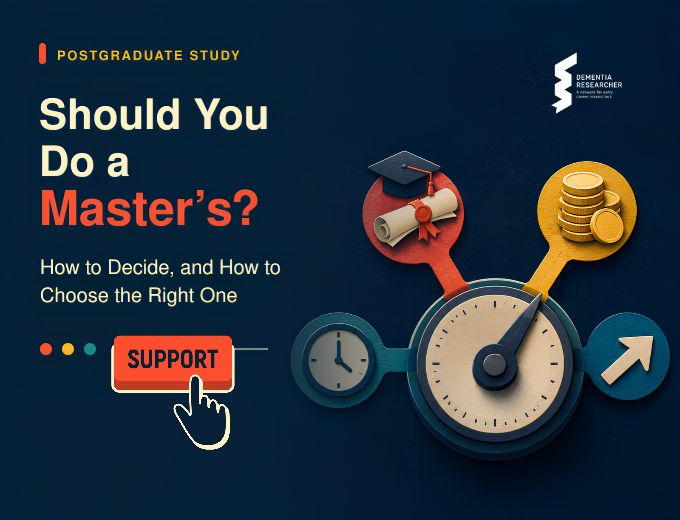
Thinking about a master’s in neuroscience or dementia research? This episode gives a first-hand picture of what that year really involves, from people who have just been through it.
Adam Smith is joined by Amelia Belsey, who is studying for a Master of Research (MRes) at Cardiff University; Ananta Jain, who has just completed an MSc in Neuroscience at Queen Mary University of London; and Margot Michalik, who moved from Aberdeen to Glasgow for an MSc in Integrative Neuroscience and has now started a PhD at the University of Glasgow.
Between them they have studied as both home and international students, and they talk openly about the decisions behind a master’s and what the year takes in time, money and energy. It’s a practical and encouraging conversation for anyone finishing an undergraduate degree, working as a research assistant or thinking about moving into neuroscience research. It shows there’s no single right route, and that a master’s can be the year that makes the next step clearer.
In this episode:
- MSc or MRes: what’s the actual difference?
- Why not go straight into a PhD?
- Turning down a PhD offer, and why it was the right call
- Choosing a course: open days, current students and gut feeling
- What a master’s really costs, and how people pay for it
- Visas, fees and work limits for international students
- Applying for PhDs when your master’s has barely started
- The one thing they wish they’d known
Podcast announcer: The Dementia Researcher Podcast, talking careers and research, sharing conference highlights, and so much more.
Adam Smith: Hello, and welcome to the Dementia Researcher Podcast. Today, we're talking about master’s degrees, whether you really need one, how to choose the right course, and what they're actually like, and whether all that time and effort, and the money, of course, is really worth it. Hello, I'm Adam Smith, programme director for Dementia Researcher, and I'm delighted to be back hosting today's show. If you're finishing your undergraduate degree, working as a research assistant, or thinking about moving into dementia or neuroscience research, there's a good chance you've considered doing a master’s. But where do you start?
There are hundreds of courses, different qualifications, different universities, and some pretty significant costs involved. And perhaps the biggest question is whether you actually need one in the first place. Dementia Researcher has recently published a guide on choosing a master’s, but today I thought we'd hear from people who've actually been through the experience. We're going to talk about why they decided to do one, how they chose, what they enjoyed, what they found difficult, and whether it's helped them get to where they want to go, or hopefully it will help them get to where they want to go.
I'm delighted to introduce Amelia Belsey, who is from Cardiff University, and Ananta Jain, who has recently completed her MSc in neuroscience at Queen Mary University of London. Margot Michalik, who is a PhD student at the University of Glasgow, whose journey has included studying neuroscience at Aberdeen before completing a master’s in Glasgow. Hello, everybody.
Guests: Hello.
Meet the guests
Adam Smith: So before we get started, can I ask each of you to briefly introduce yourselves and tell us what you're doing now and which master’s course you studied? And Margot, why don't you go first?
Margot Michalik: Hello. Thank you for having me. My name is Margot and I have completed a neuroscience with psychology undergraduate degree at the University of Aberdeen. I have then moved to Glasgow to do my master’s in integrative neuroscience, which I have just recently finished. And I have also now started my PhD also at the University of Glasgow.
Adam Smith: Fantastic. Thank you, Margot, and great to have you join us. And Ananta.
Ananta Jain: Hi, I am Ananta and I completed my bachelor's in biological sciences at the Royal Veterinary College University of London. And then I decided to do my master’s in neuroscience at Queen Mary University of London, which I recently completed and I'm awaiting my results. So I hope it goes well.
Adam Smith: I love that. And, and it always confuses people. When you say to people, "I did my undergrad at the Royal Veterinary College," do people immediately assume that you must just work with animals? That's it, you're going to be a vet.
Ananta Jain: Yes, definitely. A lot of people came up to me and told me, "Oh, I didn't know that they did a biological sciences course at RVC." And I'm like, "Yes, yes, they do it."
Adam Smith: Well, thank you very much for joining. And last but not least, of course, we've got Amelia.
Amelia Belsey: Hi, my name's Amelia. My bachelor's degree is from Cardiff University in biomedical sciences, but I specialised into neuroscience in my second and third year, and I'm also completing the Master's of Research in Cardiff as well.
Adam Smith: Great. And so you, was that, were you tempted? We're going to talk about money later, but were you just tempted because you get offered a discount, right? If you stay, if you do your undergrad and then stay at the same place, you, it's a bit cheaper.
Amelia Belsey: It is cheaper. That, that's a, it's a big benefit, but it's not the, the primary reason, to be fair. I was mainly motivated to continue working with the same supervisor.
Adam Smith: That's always a good one. And Cardiff is a great city as well.
Amelia Belsey: Yes, it definitely is.
Why do a master’s in neuroscience?
Adam Smith: Well, thank you all so much for taking time out of your evening to join us. So let's start at the beginning. Before any of you had even applied, one of the things we say in our recent guide is that you should be clear about why you're considering doing a master’s in the first place. It can be a great way to develop skills, change direction or prepare for a PhD, but it is also a kind of really big commitment. So Amelia, let's start with you.
You've already told us that before you started doing your master’s, you kind of came from your undergrad, but what made you decide to that further education and further step was right for you into the master’s?
Amelia Belsey: I've actually been fortunate to do a few independent research projects in different settings. So one was like an internship, one was for my final year dissertation. But more specifically in my dissertation, I was fortunate to work with a really good supervisor and I was motivated to continue that project. So part of the reason was A, to build skills, but a big part of it was to see that project through.
Although I must admit, since it's like an in silico computational project, I'm not sure I will ever finish it, but I at least can continue working on it for the duration of my master’s while building other skills that will help with my career aspirations.
Adam Smith: Yeah. And I guess, I suppose when you were doing your undergraduate, were you working alongside people who were doing their masters in that same lab as well so you could see what they were doing?
Amelia Belsey: As it was mainly like a dry lab thesis, not really actually. I think a lot of my peers did, so that might have helped some people's decisions. But for me, I mainly had contact with one of his PhD students who's doing similar work but in more of a wet lab setting. Again, since it's mainly coding, I was quite independent in working and mainly just had regular meetings with my supervisor and didn't work together with other lab mates that much.
Adam Smith: Brilliant. So while you were still deciding, once you decided to do that master’s, was that the only option you would've considered at that time? Because obviously you can't just suddenly decide. I'm sure from the last year of undergrad, you were probably thinking about what to do. What options were on the table?
Amelia Belsey: So during my last year of undergrad, I applied to actually a few different programmes. Some of them were Master of Science, some of them were Master of Research. I'd also looked at a few different PhD opportunities. Unfortunately, going straight from bachelor of science to PhD is quite difficult and thus my options in PhD projects were quite limited. I was fortunate to have an offer, but I opted to decline it to pursue the MRes, mainly because I was not too keen on the specific team.
I just felt I wasn't a good fit, but also because I'd identified a few areas of improvement I would like to address in myself before beginning a three, four-year long project. And I'm quite fortunate that the course I'm on now actually addresses those directly. So I'm hoping it will put me in a much better position for a PhD application for this year.
Adam Smith: That's quite good. That's quite self-reflective. I'm impressed that kind of recognising that I would actually benefit from that extra year before diving headlong into that three to four year PhD. Thank you very much, Amelia. And Ananta, what motivated you to pursue a master’s in neuroscience and was it always part of the plan or have your interests developed along the way?
Ananta Jain: I would definitely say my interests developed along the way. Like I mentioned, my bachelor's was in biology, but in my second and third year, I did some neuroscience related modules. And what really stemmed the decision of doing and pursuing a career in neuroscience was my bachelor's thesis, which was quite heavily focused on neuroscience.
It also made me realise that I enjoy research a lot and I would like to explore and learn more about neuroscience and see what's out there in the field because I felt like just doing biology, I had just the basics of what neuroscience is about, but I also wanted to know what are different areas of neuroscience that I can go in, such as computational neuroscience, and then there's neurodevelopmental disorders, there's neurodegenerative disorders. So I wanted to learn as well as further hone my research skills. And that's why I thought that a master’s in neuroscience would be the way to go.
Adam Smith: How far along your undergrad kind of path did you decide that? Where were you?
Ananta Jain: I think by the start of my third year when I decided to do a research project in neuroscience as well as doing some of the modules in neuroscience, definitely made me realise that I want to pursue neuroscience. And for me personally, a master’s would be the way to go on about it.
Adam Smith: And so at that point then, just talk me through where do you start when it comes to looking around and deciding which one? Because as I mentioned at the start, there are so many to choose from.
Ananta Jain: I personally did the most straightforward thing. I just put master’s courses in neuroscience in the Google search engine and see what comes about because I was not specifically attached to the fact that I want to remain in London. It was definitely a preference, but I was happy to move if I wanted to as it was just for a year. And then I narrowed it down to my interests and my research interests as well because there are different courses and like Amelia mentioned, there's an MSc and there's an MRes.
So I decided to apply to both and then kind of see how it goes from there.
Adam Smith: Brilliant. Thank you very much. And Margot, so you studied neuroscience with psychology as an undergraduate at Aberdeen, and obviously you've since progressed to PhD. What made you decide to do a master’s in between rather than moving directly from your undergrad to a job in research or into the PhD?
Margot Michalik: So that's a good question. I think I'm not sure if I have a straightforward answer to that. I think there were several reasons for that. So as Amelia mentioned, it is quite difficult, even though it is formally technically possible to go for a PhD straight after undergrad, it can be quite a big jump and PhD is a big commitment. So I also felt like even though I thought I would probably like to do a PhD at some point, I did not feel ready for it at that point.
And I didn't think it would be very reasonable to just jump into a PhD that I wasn't sure about and I wasn't ready for. So I wanted to give myself the opportunity to still stay connected to research and still be within that university environment, but also have the opportunity to maybe fill some gaps in training that I had that I thought would help me to get a PhD and just see what's out there because I also thought that maybe after a year of postgraduate study, I would decide that that's enough for me and I don't want to do it anymore.
And it's easier to make that decision after a year than after then being stuck somewhere for three or four years. So I think that for me was good. And also just, so my undergraduate degree was in neuroscience and psychology, so I thought I would be more interested in the psychology part, but I ended up being much more fascinated by the biological aspects of it and the neuroscience aspect. So I wanted to delve into it a bit more because neuroscience is such a broad and fascinating field.
So I felt like after my undergrad, I was left with more questions than answers, so I wanted to see what's out there research-wise before committing to one project.
Adam Smith: And I think psychology is definitely more competitive, isn't it, when you look at that or it feels like it's more competitive. They're all competitive, it's academia, but particularly in clinical psychology and things, I know people wait ages for those. So, like Ananta and Amelia then, this is something you'd already decided during the last year of your undergrad. It wasn't you didn't finish your undergrad and then take some time or have a gap, you moved straight from one into the next.
Margot Michalik: Yes, I did go straight from one to the next. I was exploring a few options other than the master’s. I was also debating between an MSc or an MRes. I did look at PhDs as well at that point and I did look into jobs as well. But in terms of jobs, I didn't really find anything that I thought was that suitable for me. And also it is a bit more difficult for international students because there's often visa requirements attached.
And actually one of additional reasons for a master’s for me was that to get that visa sponsorships, many jobs that had that sponsorship, they had requirements of higher education such as masters. So I thought perhaps that would give me an advantage.
Visas and studying in the UK as an international student
Adam Smith: Actually, it's not a topic that we'd really got down for the, but I am interested. So how straightforward is the kind of visa process for international students? Is it quick and easy and inexpensive or is it challenging?
Margot Michalik: I would say it can be challenging for sure. It depends, of course, on your circumstances and country of origin. I think for me, at least having EU citizenship, it is still complicated and it is still expensive. But from what I've heard from some of my coursemates from other countries, it can be even worse.
I think it's also when you're an international students, one thing you really need to consider is the timelines because I had to decide whether I should go for a graduate visa after my degree or should I apply for a new student visa because then if I applied for a graduate visa, then that is valid for two years. So if I wanted to do a master’s or a PhD next year, then I would, in a way, waste a year of my graduate visa. So those timelines were something I always have to keep in mind.
Adam Smith: Yeah. And what really attracted you to the UK then as opposed to, because it sounds like it would've been easier had you stayed somewhere else in Europe.
Margot Michalik: Perhaps. I think I just always wanted to study abroad, and I think the UK just has great institutions when it comes to neuroscience and biomedical research. I also wanted to go somewhere that's English speaking because it is quite a lot to learn another language to an extent where you can actually participate in university education in it. So I want to go somewhere English speaking and then I also considered the US. However, that is very far away and also very expensive. And so the UK just felt like a good fit for me.
MSc or MRes: what’s the difference?
Adam Smith: Thank you very much. I'm really glad you did. So you've decided to do a master’s. Now comes the tricky bit, which is choosing the right one. And Ananta did some Googling. Some of you I'm sure will have had all the sales pitches from every university saying you should stay here, you should do this, you should do that. Supervisors encouraging students to stick around. And there are specialist dementia courses. There are broader neuroscience programmes. There are, as you've alluded to it, there are taught MScs, research master’s degrees, and all sorts of kind of combinations.
And two courses with very similar titles can offer quite different experiences. And Ananta, from all your research, I think I'm going to pin a question to you first, which is just to clear things up for anybody who's listening who's not sure, can you tell us what the difference is between all the different degrees between the MSc and the MRes and the masters? Tell us in your words what the difference is.
Ananta Jain: I think the main difference for MSc and master’s by research is the research component and the duration of the research component. An MSc is very similar in terms of structure of your BSc. There are taught modules, you do coursework, you have exams, and by the end of your year, you have a research project that ranges from three to six months depending on the course that you're doing. An MRes is a master’s by research where you may not have any taught modules at all. You might also not have any exams.
So it is a long-term research project from nine to 12 months, and most of your grade comes from your thesis and your oral presentation afterwards. So I think your choice between an MSc and an MRes largely depends on how much your interest in research is and what you want to get out of your master’s.
How to choose the right master’s course
Adam Smith: Whether you like exams, perhaps as well. And so how did you go about choosing yours? What made that course stand out for you as opposed to some of the alternatives?
Ananta Jain: For me particularly, I knew from my bachelor's thesis that I have certain interests. So for example, my thesis was about brain injury, so I was a lot more interested in brain injury, stroke, and other sort of conditions which are largely a part of clinical neuroscience or translational neuroscience research. I also knew that I enjoyed research, but I also knew that I felt like I did not have enough of a foundational background in neuroscience.
So what made me do an MSc at Queen Mary specifically was that I joined a couple of information sessions by the university, and I also went to one of their fairs about careers where they were talking, where there was a stall about the neuroscience courses offered by the university, had a chat with them. And a lot of university websites have this, is where you can talk to virtually to a current student who is doing your course.
So I spoke to someone who just finished the course that I was thinking about applying for at Queen Mary, and a lot of his experience was really good and that was one of the driving forces. And it was also a lot of financial considerations as well. Like you, Margot, I am also an international student and master’s degrees are quite expensive. And specifically Queen Mary was offering a lot of funding opportunities, which I really liked. So that is what made me pick an MSc at Queen Mary specifically.
Adam Smith: Yeah. I mean, and sometimes you just get a good feeling about a place, right? I mean, you said you went and had a look. How many others did you go look at? Did you go and do the kind of campus tours at UCL, for example, or King's or some of those other London ones?
Ananta Jain: So as I was based in London doing my BSc, it was quite easy for me to go to UCL as well. And I had actually done my final year at King's, so I knew what the experience at King's was like as a campus and in terms of research. So it was quite easy for me to go to the careers fair or speak to somebody or get in touch with somebody as I was already based in London, so somebody knew somebody. So it was easy for me to connect with people to determine what I would like.
Adam Smith: Yeah. And so you all did this full-time in the year. That's quite an intensive... I mean, the process you've described there, that's a lot to do in a year. Just how intensive is that year, Ananta?
Ananta Jain: To be honest, it was quite hard because not only were we doing our BSc projects, we were also doing coursework and then figuring out what the next step is, because in terms of our visa, international students have deadlines which are two or three months before UK students or home students when they're applying for master’s courses. And every university has different deadlines and different requirements, and it is very important for prospective students to know when your deadline for your courses are and prepare your application accordingly.
So I think that definitely took a huge chunk of my time to figure out what the next steps are in actually applying for a master’s course.
Adam Smith: Thank you. Amelia, I mean, it sounds like we've already kind of had a little bit of a grounding on some of this because you were just really drawn in by that particular project. You mentioned you did look around others though. What were the main considerations?
Amelia Belsey: Yeah, as I mentioned, I was mainly looking at improving my existing skill set and addressing my weaknesses prior to beginning doctoral study. I must admit, I was not very proficient at statistics during my undergraduate degree, and the MRes at Cardiff specifically is quite intense on the statistics and also bioinformatics training. So that was a very big part of it.
I mean, I'm actually currently, we've basically got a designated statistics month and it's 40 hours scheduled a week of just statistics and bioinformatics, which obviously is a lot to absorb, but it's also with the lecturers and demonstrators being available during those hours, it'd be pretty hard pushed not to stay on track and not to pick up the material.
But what's also quite good about my course and why I ended up picking it as opposed to some of the other courses is specifically that at Cardiff, all of the teaching done within the first term, so like September through December, all of the coursework, so for instance, they ask us to do research proposals, grant writing, abstracts, they're all tailored towards the research project you complete from January onwards. So essentially it is just one very big long research project. You only work on it for six months, but the first three months of prep are all gearing you up to do that.
So I'd looked at Master of Science as well, but as mentioned, it's a lot of taught modules. And I ultimately found in my final year that I definitely wanted to steer away from as much taught modules as possible, mainly because the way that the course at Cardiff was laid out was that the dissertation was completed full-time over a period of six months, and then you go back to your taught classes afterwards before sitting exams. And I do just remember having such a great time doing my research project.
And then we went back to taught lectures and I was just like, "Oh, this is horrible." I just really did not enjoy it compared to the independent research I was able to do during those three months, so it really solidified that decision.
Adam Smith: Yeah. And I feel like, I don't know, would all of you agree? Before you applied for this course, do you think you understood the difference between that kind of MRes and MSc and the fundamental differences in the course? You can all just... You did, you knew that in advance.
Amelia Belsey: I was fortunate actually to have a good friend who is halfway through her PhD that had already gone through the MRes, so she had already advised me on what the core differences were.
Getting research experience alongside a master’s in neuroscience
Adam Smith: And I suppose by that time, you know, coming off the back, well, all of you were coming off the back of your undergraduate. I guess not everybody listening to this will be in that situation. Some of them might have already had a year out working as a research assistant or may have already had a whole career and are now thinking about coming back to education through a master’s programme. But that's an important consideration.
If you're the kind of person who wants some time to sit in a classroom, so to speak, or in a lecture theatre and be taught in that way, the MSc is probably going to be the better route for you. So Amelia, alongside that study, have you had extra kind of work? Have there been opportunities to maybe do some research assistant work or to get some other lab experiences?
Amelia Belsey: Yeah, I mean, the opportunities are definitely there. I'm quite fortunate that the culture at Cardiff is if you ask, someone will be there to help. So my personal tutor, for instance, I'd approached him asking if he knew, because he's also one of the course leads for the MRes, if he knew there would be any opportunities to gain some additional wet lab skills. And he was transparent with me and told me that there are opportunities, for instance, to help out in the demonstrating labs.
However, it's not advisable between September and December due to the course load, just because of how intense it is, but that it is from January onwards. But aside from that, Cardiff is very open and very accommodating for both undergraduate and master’s students. So for instance, in the summer between my second and third year, I was very fortunate to do essentially a four months long research internship at the Medicines Discovery Institute, which is a subsidiary. And I know many of my classmates have done similar mini projects or have continued working with supervisors over the summer.
I've also been fortunate that through conferences at Cardiff, I've met lots of different PIs that have all been very willing to have me in the lab to see what they do and how their research fits into the culture at Cardiff. So there's an abundance of opportunities that you just have to actually reach out and ask.
Adam Smith: Brilliant. Has that been the same for everybody? Have you all had a similar experience? What about you, Margot?
Margot Michalik: Yeah, so I did have some opportunities to get research experience beforehand, not so much during my master’s, but also I have to admit, I wasn't explicitly looking for them because I was quite swamped by the coursework and other things going on, so I used all my research time during my research project, which I really enjoyed. But beforehand, during my undergraduate degree, I did try to take advantage of those options available. So I did a summer internship back in Aberdeen with a lab where I was just...
It was mostly just shadowing people or doing the most basic wet lab skills, but it was quite useful in just finding out how a lab works and being able to attend lab meetings and talk to people. And I think that then helped me get my other internship that I got between my third and fourth year, which allowed me to go to the University of Victoria in Canada. And so it was a programme which is called Mitacs, which funds international students to go and do a summer research project in Canada.
So I really enjoyed that, and I think that probably helped me build my CV when applying for master’s and PhD. Yes, and I was saying, I think similarly to what Amelia said, there's often you don't know until you ask, and there's so many lecturers and researchers who are happy to help and help students get experience. So I would definitely recommend trying, and I wish I tried more probably.
When to start applying for PhDs
Adam Smith: I'm wondering at what point did you start looking for PhDs as you were into your master’s? Has there been any gap between or have you moved straight from one to the other, and how important was the kind of project you'd be involved in influencing that decision?
Margot Michalik: So I started looking at PhDs probably quite early on, so because PhD programmes often have deadlines pretty early in the academic year. So I think around maybe October time I started looking. I didn't put any pressure on myself that I definitely have to apply to something. It was more to see what's out there and to see if there is something that I might be interested in to start making some steps towards that. So I think from October to kind of December, I was applying to them.
And my master’s research project is actually, it's not really that connected to my current PhD project, other than the fact that they both were related to dementia and neurodegeneration research. But my master’s project was more wet lab and more preclinical, whereas my PhD project will mostly rely on neuroimaging and will be from clinical data. But I think, yes, it's just always good to get as much research experience as possible and to experience working in different environments and seeing and attending lab meetings and seeing how these groups work.
Adam Smith: It's very cool, but that does feel really early, doesn't it? I don't know if, Amelia, you're already feeling that pressure that, that no sooner have you started than if you don't want to have a gap, which, I mean, may or may not be a good thing or a bad thing to have a gap, but you've already got to start looking for, if you're going to go for one of those kind of doctoral training centre PhDs or one of the UKRI ones, that you have to apply almost as soon as you start your master’s.
Amelia Belsey: Yeah, you're definitely right with that. I mean, transparently, some of my applications have already been submitted so early. I actually submitted one a couple of days ago, which is crazy, especially because a lot of the applications, they want to know what I'm doing for my master’s. And I'm fortunate enough that obviously I know what my project is already. I've established it, I've started writing the research proposal.
But I know a lot of my classmates, especially that have come from different institutions or even international students, have not yet connected with a supervisor because technically they have till the end of November, and those classmates are going to have a little bit of a problem with their applications. But yeah, it's very early on. Although I will admit from just my research last year, I've noticed that the cycle is highly institutional dependent. So for instance, all of the doctoral training partnerships are out currently.
Most of the London institutions like Oxford, Cambridge are out this time of year, whereas this is just the ones I was looking up, like Bristol and Swansea are more like February through April. It just really depends where you're looking and what you're looking for if you're looking for a standalone PhD or a training partnership. But yeah, it can be really early if you're looking at a few different opportunities. Yeah, you need to get on the ball in September, to be honest.
Adam Smith: And Ananta, are you feeling that pressure now? What are you going to do? You've just finished your master’s.
Ananta Jain: So at the moment I'm taking a bit of a break because I knew that I definitely did not want to jump into doing a PhD because my master’s made me realise that I have varied interests, but I can also combine those interests and do a project that I really want. So what I am doing at the moment is still looking at opportunities and seeing what is best for me.
Because what made me realise by the end of my master’s is that I do not have to do a PhD in order to pursue research as a career if I would like to. So I would also like to look at alternative opportunities before really understanding whether a PhD is what I really want because it is a huge commitment. And for international students, the tuition fee for a PhD is very, very significantly high and getting a fully funded PhD offer as an international student is very, very difficult in the UK at the moment.
And I would like to be fully aware of my decision to do this and go into the application cycle knowing that I have tried everything and a PhD is the step for me.
Research assistant jobs and building a network
Adam Smith: Yeah. And it's great that you kind of recognise that because I was getting worried there. You all seem to be so focused that you've all gone like undergrad, master’s, PhD, career, just some time. Although I can understand why we've run some posts recently on applying for research assistant jobs is that that's kind of a common path, isn't it, that you might have a year maybe doing a research assistant role or doing some work just to try and recoup some of the money you've lost during undergrad before you then take on a master’s, which is a risky time because then I think that's when you can get trapped into earning a salary and not necessarily then come back to education at that point.
But there are literally over, I think we were looking at one job as an example, that one research assistant job had 120 applications for one role. And so it is quite hard to do that. Do you feel, has this helped you also as well build your communities and with your networking, the contacts and the people you've come into touch with? Has it helped set you up in that way, Ananta?
Ananta Jain: I would say one of the best things about doing a master’s in neuroscience is you get to interact with a huge diversity of people. My class at Queen Mary had physicians who were thinking about going into clinical research or some people who have worked in molecular biology or other fields of biology for a couple of years and they've been wanting to pivot into neuroscience. For a lot of the students, it was a stepping stone to doing a PhD.
Some people like me were trying to figure out what sort of research that you can do in neuroscience and really build a foundation into it. So the kind of exposure and the kind of people and the network that you build is very diverse and very different and everybody brings their own experiences. And when you actually work with them, you realise, wow, I never really thought about this that way. And I think that was very enriching during my master’s.
Adam Smith: It's a great way to help you decide, right? It's not like a gap year. It's a year where you genuinely come away with something, a bunch of connections, some more experiences and makes you more certain whether the PhD is the right thing for you or not. And well done for being on that journey now.
How much does a master’s in neuroscience cost?
Okay, so we've already touched on this a little bit. Something that we can't ignore is the cost. I'm going to ask you all to be brutally honest now and we're very polite in the UK.
We don't like talking about money and salaries, but I'm going to ask you all to tell us what it's really like. So master’s degrees can be expensive and that's before we even get round to looking at accommodation and living costs and potential for giving up paid employment to study. Amelia, thinking back to that application process and the funding, how straightforward did you find it and what is it really costing you in real terms to do this master’s?
Amelia Belsey: Yeah, I mean the application process actually wasn't that difficult. It got cleared really quickly. I'm fortunate as I live in Wales, I qualify for the Welsh Student Finance, which I've heard is a lot more generous than the English. That's just from what my classmates have said. So I'm quite fortunate that I can apply for enough that it covers my tuition plus enough to, well, I wouldn't say enough to live on, but a fair amount to go towards living costs. I've worked since before I even started my bachelor's degree and I've not taken any employment gaps for university.
So I've been able to financially support myself and reduce the amount I've needed to take out. But the tuition fees, even with my discount, are like 9,000 pounds, which is not cheap. I think it's just about 11 without the discount. So a lot of people are going to have problems funding that. I know sometimes the university will do part scholarships, but it's never to cover the full amount. So it's definitely something you need to consider. But there are a lot of funding options available. I just can't speak for Student Finance England.
Adam Smith: So 9,000, and that's because you stuck around, you got a discount because you did undergrad and stayed, which is definitely worth considering. I know in some places that discount varies, but you can see why that incentive is there to stick around in the same place. And how do you finance those tuition fees? I mean, can you get loans for that or are you having to pay it?
Amelia Belsey: Yeah, so you can get loans through Student Finance Wales. I'm not sure what the maximum amount is, but I think it's quite significant. You can apply for up to like 19,000. So even if your loans are 11,000, you've got enough left over to act as a maintenance stipend as well. So that's what Student Finance Wales does. And that's not means tested at postgraduate level. So everyone qualifies for or everyone is able to ask for up to that amount. And from speaking to my classmates, that's actually what a lot of people have done.
The majority of my classmates are funding their courses that way, myself included.
Adam Smith: And what are the terms under which we're at right now in terms of paying that back?
Amelia Belsey: It's very similar to undergraduate. So once you're earning over a threshold, then a percentage of it is deducted from your income. The only difference is when you're over that threshold, you're eligible to pay both your undergraduate and your postgraduate. So I think it's actually like six. So you're no longer paying 6%, you're now paying 12%. So it's a significant, you're doubling the amount you're paying when you're beyond the threshold essentially.
Adam Smith: Right. So I know we're not doing MoneySavingExpert now. I'm not Martin, but I was just trying to understand that. So they don't add one sum to the other one. This is a separately two separate loans with their own terms and conditions and you both pay them both back simultaneously rather than adding them together to say, okay, you did owe us 30,000, now you owe 40. It's more like you owe 30,000 and you owe 10,000.
Amelia Belsey: Yeah. Yes, this is okay. So it's two separate loans. You actually have an undergraduate loan and a postgraduate loan and they have slightly different terms and conditions, but yeah, you have to pay both of them back. So I think actually a lot of people end up just paying off the postgraduate first just to get it because it's significantly less usually than the undergraduate loan, but yeah.
Adam Smith: So you can see this is... I mean, how much of the money, just looking to all of you now, how much of the money side was a real consideration when you decided to do a master’s to go, "Can I actually afford to do... Is this a reasonable thing to do?" How much has it bothered you that... Or I guess Amelia, I'll come to you first because obviously, and Ananta and Margot, you've got that slight extra bit of being international students, but how much of the financial element influenced whether you were going to do this or not?
Has it worried you that you're taking on that extra debt?
Amelia Belsey: A little bit. I mean, there were a lot of considerations going into, as I mentioned, as I work on a regular basis, I'm not too concerned about my day-to-day finances. My main concern is actually that I work a considerable amount of hours to be able to support myself. So I actually work two 10-hour shifts a week, so 20 hours, which isn't a lot until you consider that I'm also in classes for 40 hours a week. And then on top of that, I also have to do 10 hours of coursework a week and it starts adding up.
And that's without commuting times or PhD applications, which honestly is its own part-time job by itself. So it's a very long week. I think at the moment I'm averaging like 80 to 90 hours on a good week until January, and then it gets minutely better. But I think this is the case actually for a lot of my peers. Again, most of us are working a considerable amount of hours part-time.
I mean, I know Cardiff University specifically recommends that all of its students, undergraduate and postgraduate or at least masters work 15 hours or less, and it's not always easy to find a job nowadays, especially since the market is so saturated. If you're lucky enough to find a job, you can't always be picky enough to say, "Well, I'm only going to do 10 hours." So the unfortunate truth is that A, many of my peers are taking out these postgraduate loans.
But B, even if you've got the postgraduate loan, unless you've got additional support coming from elsewhere, it's not enough to support you, so you're getting a job and it adds onto your time as well.
Adam Smith: Well, is there an option for you to take on a, I can't remember, the cost of living loan as well to pay it for your accommodation and things? Is that available to you as a loan?
Amelia Belsey: I'm actually not sure. I've not looked into it. I got by in my undergraduate by doing the same thing. So I've held my current position for a year and a half, and before that I was working somewhere else, but a similar amount of hours.
Funding a master’s as an international student
Adam Smith: Thanks, Amelia. So Margot, I mean, obviously you're coming at this as an international student, as we said. How do the costs weigh up for you?
Margot Michalik: Yeah, so it is always an important factor worth considering. I think unfortunately when you're an international student in the UK, it is just going to be expensive one way or the other. I think even applying for visas, even if I didn't do a master’s and want to do a graduate visa, instead that also cost a lot of money, those costs are always there and we usually don't have as many options for funding and loans as home students.
That's not to say that there aren't any, and I think it is still always very important to look for them and see if there's any way you can get those costs at least reduced. But that will, of course, depend on your institution, that will also depend on your country of origin. There are many scholarships, I think, in many universities on course websites, they often have a funding section with available scholarships, so it's always worth checking because you might be eligible for some of them. I think also one of the reasons I wanted to study in Glasgow and study in Scotland...
Well, I really like Scotland in general, but another reason is the fees were not as high as they are in, for example, England. So I know for Scottish students, it's even cheaper because they can get loans or... It's pretty much free from, if I'm not mistaken, but even when you're an international, for example, I was quite drawn to Glasgow because they had the course I liked, but they also offered me this scholarship that was available to international EU students that covered at least parts of the fees, which was already quite helpful.
And I also tried to, well, more during my undergrad because I had a bit more time, but I've also been trying to work part-time and try to make the cost a bit more manageable. But yes, I would definitely say it is a bit more of a tricky situation for international students, but you never know what scholarships there are available, and I think it's always worth exploring them.
Adam Smith: So Ananta, how have you managed that time of investigating scholarships? Have you worked alongside your degree as well?
Ananta Jain: Yes, working part-time as much as I can. So when you are an international student, you are restricted by the number of hours that you can work per week. So when you are an international student that is doing a full-time course, you can work up to 20 hours per week. So more than that, it is not allowed for you to do that. So finding employers who can accommodate that 20-hour work week is quite difficult because they would like somebody who can preferably work more or more flexibly. So finding that is quite difficult.
Also, like Amelia mentioned, we were encouraged and also advised to work less or try not to work during our master’s, as they said that the expected course load is quite significant for a full-time course. And if our circumstances allow us to focus full-time on our studies, because it is quite a lot to cover in one year for a master’s.
Adam Smith: I mean, I know universities often offer employment opportunities back to their own students. Have you found that where you've been at QMUL, for example?
Ananta Jain: Yes, it is quite easier to work part-time perhaps in the student union or in the student union shops or the cafes at your university, also particularly because it's easier to just walk into classes or you don't have to commute to another place and then come back and then look at the costs of that. Because when you're living in London, transport is a huge part of your expenses, unfortunately.
Adam Smith: So I think what we've got from this is that a master’s is doable. It's a lot of work, particularly if, clearly like Amelia, you're having to work 20 hours a week, study, do everything else, and I'm sure that's the same for all of you. It's a lot to do in a year. It's very expensive, but for all of you, you've all seen this as being almost like an essential stepping stone to go on to do what you needed to do.
And none of you have regretted that this was the right thing to do despite this kind of significant financial element to it. Everybody's nodding for those who are just listening on audio and not taking in the video version of this. So that's good to know. I hope anybody who's listening isn't put off by the financial aspect. Clearly they are manageable, but it looks like it's really been worth it.
How a master’s shapes a research career
So another one of the things we highlight in our guidance is that a master’s is more than just attending lectures and getting a qualification.
It can also be that opportunity, as we talked about earlier, to develop practical skills, to make some connections and gain experience and explore what kind of research you really enjoy, which all of you had gotten into off the back of your undergrad degrees. So what I want to know now is from your undergraduate degrees, what did they really prepare you for and not prepare you for? And what's been really useful coming off the back, I guess, of your completing your master’s, Margot and Ananta? So Amelia, did your undergraduate prepare you for your master’s? Are you perfectly primed?
Amelia Belsey: I think at undergraduate level, they kind of tried to prepare you for a range of different pathways. So some of them had, for instance, how to build a CV for industry or how to build a CV for academia, or there was actually dedicated tutorials you could go to for how to do graduate applications, or there would be other alternative ones for industry applications. So I do think at least at Cardiff, they tried to tailor it. Not a lot of the classes were tailored towards masters, but it was more focused on just general skill building in general.
But I will say, I think at master’s level, they definitely geared to prepare you for PhD more so.
Adam Smith: Yeah, absolutely. And Ananta, from your master’s experience, if you like, has it influenced your career ambitions at all? Is there something that you've picked up through your master’s that's made you more committed to want to do the PhD or to consider industry? Or you mentioned that there were other jobs in research you might be interested in.
Ananta Jain: So I think by the end of my undergraduate degree, I was slightly in that confused phase. I like research, but do I like it enough to do it as a career? Do I want to be in academia and specifically in the lab, or would I like something more dry lab or in silico? There were a lot of unanswered questions because like Amelia mentioned, your undergraduate is all about exploring and understanding what is out there, and it takes you through a variety of experiences and different career paths that you can choose.
But my master’s really helped me understand that I really, really like research, and there are certain aspects of research that I enjoy more than other aspects of research. So for example, grant writing and research proposals was something that I was good at, but specifically doing that long-term, it wasn't really for me, quite stressful. So I understood those niche aspects of research that I would like to pursue and some aspects of research that I don't like. And I think it also helped me both broaden my interests as well as develop certain parts of neuroscience that I liked.
So I particularly really like working on neurodegenerative diseases, specifically ALS, and my master’s definitely helped me understand that. What my undergraduate helped me understand was that I like neuroscience, but what specifically in neuroscience and research that I discovered in my master’s.
Adam Smith: Yeah, that's really, really, a really nice answer and very eloquently put as well. I'm glad that you discovered that. And unfortunately, the bit of the job you hate, which is the grant writing, I don't think anybody really likes that, but it does seem like an essential skill. It's great that they put you off an academic career for life by forcing you to learn that early on in your master’s.
But I suppose what that does make you realise there is that there are elements of that academic career that may be less around if you were to follow an industry route, for example, or in teaching or some of these other bits that wrap around outside academic careers.
Do you need a master’s to get a PhD?
So Margot, do you think you'd have been able to take on the PhD that you've done now had you skipped that master’s stage?
Margot Michalik: So I think the master’s was a massive help in securing my PhD. Well, technically, it wasn't a formal requirement to have a master’s for this PhD. I think it did give me a significant advantage, both in terms of just having it on my CV, but also just giving me many very valuable skills.
So for example, one of them is we had this taught module that was about statistics and R, which I was really terrified of doing, but I'm very glad I did because it was very helpful and I now feel confident in those skills, and I think good data analysis and statistics skills are so important in any sort of biomedical related research. So I'm very glad I did that. And then also I think what was probably the most important factor was just being in that university environment and speaking to researchers and people in the field and making connections.
I think that was probably the most valuable because even people in my lab, when I told them I'm interested in applying for PhDs, they were all able to give me some very useful advice, which definitely helped. And even actually, my school would organise those guest speaker seminars where they would invite guests from different institutions to come in and talk about their research. And I actually met my current PhD supervisor in one of those. So you really never know who you're going to meet and how that might contribute to your future.
So I think it's just really important to take advantage of those opportunities that being a master’s student offer, even though they might not seem as important at first, I think it's just worth getting as immersed in the research environment as possible.
Adam Smith: I think I asked that question because I come across... I talk to a lot of researchers, and when we have this conversation about... I think the temptation is there to say, "I know now I've finished my undergrad. I know right now I want to do a PhD, so why do the master’s? It's just going to cost me more money.
I want to do it." But I think the people who then do do that do find that you're at a bit of a disadvantage because there are people who are going to be applying for those same PhD courses who have completed their MRes or have done a master’s.
Advice for anyone choosing a master’s in neuroscience
So we're really getting towards the end now. As ever, my podcasts are always twice as long as everybody else's because I just don't know when to shut up. So I want to finish though with some practical advice.
Imagine someone now listening just finished their undergraduate degree or they've been working a few years and are thinking about moving into neuroscience. They're looking at courses, trying to decide whether to apply and wondering whether this is the right decision. So Amelia, what's the one thing you wish somebody had told you before you started doing your master’s?
Amelia Belsey: Honestly, I think it was just to network a lot sooner than you think you need to. Always, if you can, like a year earlier. Two years ago, I was the same person asking this question, and at the time I was like, "I'm only a second year. It's a bit too early to be networking." But in fact, it was majorly helpful and it's opened so many doors for me, but also I've had so much advice off of people from such a range of background on such a range of different topics that I can't imagine having not acted on.
So definitely building up connections with people as soon as you possibly can.
Adam Smith: Brilliant. Thank you very much. And Ananta, what's the best piece of advice for somebody who's choosing between different courses?
Ananta Jain: I would say make a list of what you want to get out of a master’s because choosing between an MSc and an MRes and a specific institution is really important because it shapes your experience and your year and doing your master’s. Make a list, figure out your priorities, and try to make a set of goals about where would you like to see yourself a year later with your master’s? What kind of skills do you want to develop? Do you want to do more research rather than modules? Would you like to learn more and do research a little less?
Are there any specific areas of neuroscience you would like to explore? Are there specific universities whose research in a specific branch of neuroscience is really good? Are there specific labs or PIs that you really want to work with? So I would say make a list and narrow it down and take it from there.
The most exciting things they learned
Adam Smith: Thank you. And Margot, I was going to ask you a serious question, but I've changed my mind, and I'm going to ask everybody this one now is what's something you discovered during... Because we've been very serious in this. We've talked about money and we've talked about moving and the costs and the value and the importance of education. What's something cool that you learned while you were doing your master’s that kind of made you go, "Wow, I love that. That's amazing." Is there something that blew your mind during your master’s that you learned that you thought was really cool?
Margot Michalik: I think there were many things. As I mentioned before, that's why that master’s degree was really enjoyable for me because I was just made aware of so many areas of neuroscience that I wasn't aware of before. So first of all, it made me fall in love with neuroimaging and MRI, and I just think MRI is extremely cool, and I will now be using it for my PhD. And so I'm very excited, and there's so many cool things you can see on an MRI, and the techniques are getting better and more advanced all the time.
And another thing actually was during my master’s, that was the first time I properly heard about using optogenetics for research. So that actually blew my mind, like exciting neurons inside living organisms with lights. I thought that was insane. And now here we are, and that discovery has won the Nobel Prize. So I thought that was pretty cool, and I was quite happy to be able to explain to people what that means and what that technique was its importance.
Adam Smith: Yeah. Do your family understand anything at all about what you do? This is always the common one. It's like no, unless they're doctors as well.
Margot Michalik: Well, they tried. I think the problem also is that even though I think I know quite a lot about neuroscience, my entire higher education has been in English. So when I try to explain it to anyone in Polish, I actually don't know any words, and it sounds like I don't know what I'm talking about.
Adam Smith: Boy, oh no, that's, that's awful. But I'm, I'm really glad you discovered that, and I agree. MRI is amazing. Even though it's been around for a long time, the more Teslas that they add to that and the... With this addition of machine learning and AI and things that we're adding to that now, it is still so relevant and so cool. I'm going to ask the same question because I can't only ask it to poor Margot and Ananta. Is there something really cool that you discovered in your master’s that just blew your mind?
Ananta Jain: I think two things. First of all, everybody is in the same boat. It doesn't matter if the person sitting next to you has five years of experience in industry, you're all going to be complaining about the assignment that is due at 9:00 AM in the morning. It is very nice to be in an environment where everybody is doing the same thing as you are, and it kind of confuddled me a little bit because a lot of people on the course were physicians, like I mentioned, and to see them struggling through the same problems as I am was quite, quite interesting because they have had a formidable amount of education.
Adam Smith: Amelia, obviously we know you hate statistics, you've made that clear. Was there something you really liked though? I know you've only been doing this for a little while. Is there something that's really surprised you so far?
Amelia Belsey: Yeah. I mean, as a computational neuroscientist, I'm quite fortunate that my research falls at the intersect of many different fields is kind of going off the back of what Ananta was just saying. And over the summer, both presenting my work and volunteering, I've been fortunate to attend a few different events and conferences. One of them was completely out of my field, and it was like the British Society for Strain Measurement, which is definitely not related to my research at all, but I was volunteering there.
It's just very interesting to me how applicable computational neuroscience can be in other fields, but also how these other fields can be applied to my field. And so for instance, at the strain measurement conference, I was specifically learning about digital image correlation, which is something I'd never even heard before, but to them it's their bread and butter. But yeah, just talking to so many different researchers from so many different fields, quite fortunate that I just I have a bit of genetic background, definitely some coding background, some mathematical modelling background, some neuroscience background.
So I fall into like a few different buckets I can all discuss with other researchers. So yeah, it's mainly just been like comparing the potential for collaborations you'd never even think to look for.
Adam Smith: That's really cool. And keeping those options open and keeping it broad as well, it kind of makes it when you are looking for those PhDs, you've got options, right?
Closing thoughts
I'm afraid this is all we've got time for today. This brings us to the end of today's podcast. My thanks to Amelia, Ananta and Margot for sharing their experiences and advice.
I think one of the things that comes through here is that there is, despite all of you having had exactly the same path into masters, I think we have ascertained from your discussion that there are lots of reasons to do this and lots of different paths into a master’s. And there are lots of options open to you.
But I hope from our discussion today between looking at, you know, the cost of it, whether when you know what your future career is, is about the importance of the potential for a master’s, choosing the right course, whether an MRes or an MSc is the right one for you. Hopefully we've helped demystify some of that and give you a bit of an insight as to what the day-to-day looks like and what the potential can be for you.
And if you're thinking about choosing a master’s yourself, we've published a comprehensive guide on our website on whether doing one is worth it, how to choose between courses and the different options available to you. And that's on our, yeah, that's on our website. And we also have a directory of dementia research and neuroscience related postgraduate courses on our website as well. And we've got a directory there, which is at dementiaresearcher.nihr.ac.uk. I hope that came up when you started Googling, Ananta. If not, I need to clearly look at those pages to refresh those.
And if you're still unsure, we have a community app where you can ask questions, reach out to others, ask for some advice, get some tips, and just reach out to talk to other members of the community about their experiences. That's all we've got time for. Thank you so much again. The incredible Amelia, brilliant Margot, and the unstoppable Ananta. I'm Adam Smith, and you've been listening to the Dementia Researcher Podcast. Thank you.
Adam Smith: Thank you.
Podcast announcer: The Dementia Researcher Podcast was brought to you by University College London with generous funding from the National Institute for Health and Care Research, Alzheimer's Research UK, Alzheimer's Society, Alzheimer's Association, and Race Against Dementia. Dementiaresearcher.nihr.ac.uk.
If you would like to join a panel or record a podcast on your own area of research, complete our show form. You can subscribe to our podcasts through your favourite podcast app, just search for 'Dementia Researcher' or follow the links in the footer of this page.
Did you know... all of our blogs are also available as podcasts? Find them here on Apple, and here on Spotify
The views and opinions expressed by the host and guests in this podcast represent those of the guests and do not necessarily reflect those of UCL, Dementia Researcher or its funders.
Join our Supporter Programme and subscribe to our channel in YouTube or in Apple Podcasts for exclusive access to bonus shows, and to gain early access to our recordings.
Share your thoughts on this topic in the comments below.

 Dementia Researcher





 Dr Sam Moxon