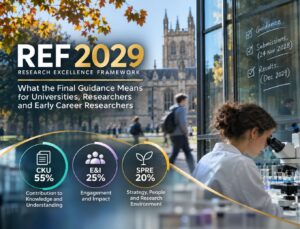
 The final REF 2029 guidance was published on 11 November 2026, setting the rules for the next round of the UK’s Research Excellence Framework. The Guidance on Submissions and the Panel Criteria and Working Methods set out how every UK university will be assessed, with submissions due at noon on 24 November 2028 and results in December 2029. REF results steer around £2 billion a year of research funding, so the way it counts people, papers and culture shapes decisions in your department long before any panel sits down.
The documents are on the REF 2029 guidance pages, alongside the panel criteria and a news release from the funding bodies. This is the final version. Small changes made in November will be added to each section’s change log. Much of this was trailed in earlier rounds of decisions (we covered the first set back in 2023 in The Research Excellence Framework (REF) is Changing), but now it’s settled and universities will start building their submissions around it.
The headline numbers
The REF 2029 guidance keeps three elements but renames and reweights them:
- Contribution to Knowledge and Understanding (CKU), 55%: replaces outputs, and is still based on research outputs.
- Engagement and Impact (E&I), 25%: replaces impact, assessed through impact case studies.
- Strategy, People and Research Environment (SPRE), 20%: replaces environment. Each university writes one institution-level statement, which counts for 60% of every unit’s SPRE score, and each unit writes its own statement for the other 40%.
Outputs must be first made public between 1 January 2021 and 31 December 2028. Impacts must happen between 1 August 2020 and 31 July 2028, and the research behind them can date back to 1 January 2008.
For the first time, all four main panels have agreed shared criteria and quality definitions. The standard needed for each star rating is unchanged, and the guidance says no type of output is to be treated as higher or lower quality than any other.
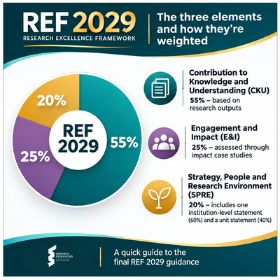
REF 2029 retains three assessment elements, with revised names and weightings. Research outputs account for 55%, impact for 25%, and research environment for 20%.
Papers are no longer tied to names
This is the biggest change in the REF 2029 guidance for individual researchers. In REF 2021 every eligible member of staff had to be returned with at least one output. That minimum has gone. Universities no longer submit lists of staff at all. Instead, the size of each unit (the volume measure) is taken from HESA staff records, averaged across 2025-26 and 2026-27, and the unit submits 2.5 outputs per full-time equivalent.
What decides whether a paper can be submitted is a substantive link between the university and the research. That means an author who made a significant contribution to the output had an eligible employment relationship with the university:
- at least 0.2 FTE for at least 12 months of continuous employment, and consecutive contracts count
- a role that includes an explicit expectation of research, and the guidance is clear this isn’t limited by job title
- that employment existed when the output was first published, or during the period when the research was done (generally two years before publication, or five for long-form work such as books)
Employment that only starts after a paper is published can’t create a link. The expectation is no more than five outputs per substantive link in a unit, and anything above that has to be explained in a new Statement of Representation.
Because outputs no longer need to come from staff counted in the volume measure, the pool of people whose work can count is wider. Postdocs and research assistants usually don’t count towards the volume measure, but their papers can still be submitted if they meet the substantive link test. The same goes for technicians and research support staff whose role includes a research expectation. Papers by people who have since left can be returned too, with one exception: where the link predates publication and the author was made compulsorily redundant. Papers where the only connection is a PhD student who is the sole author, or a visiting or honorary post, are excluded.
What the REF 2029 guidance means for early career researchers
The outputs guidance has no ECR-specific rules. With no minimum per person, there’s no longer anything to reduce for early career researchers in the way REF 2021 allowed. A new special requests process covers unit-level reductions, including equality-related ones. A few things are worth knowing.
Short contracts matter. A string of back-to-back contracts counts as continuous employment, but a single contract of less than a year at 0.2 FTE or more won’t create a substantive link on its own. If you’re on fixed-term contracts, it’s worth knowing that the papers you publish during a contract are the ones that university can return.
Your papers travel differently. A paper belongs, for REF purposes, to the place where you were employed when it was published or when the work was done. A new employer can’t claim a paper you published before you arrived unless the research was carried out there within that window. That’s likely to make a list of REF-able papers less of a bargaining chip on the job market than it used to be.
The people around research get counted. Every unit statement now includes a Statement on the Research Community describing the numbers and types of roles behind the unit’s research, including technical, research management and engagement staff, and career stages from postdoctoral fellows and early career researchers through to senior staff. It isn’t scored, but assessors read it.
Culture evidence will come from you. The unit-level People section asks how units support staff on fixed-term contracts, provide mentoring and career development at all career stages, and give staff a say in strategy. The institution-level statement asks about transparent workload allocation with protected research time, fair progression, and ways to report bullying and harassment. Evidence can include surveys such as CEDARS and PRES, staff surveys and promotion data. If you’ve ever wondered whether filling in those surveys makes any difference, this is one place it does.
Ask to be named on impact case studies. A new optional section lets units list contributors to a case study, including students, impact and engagement professionals and research technical professionals. It isn’t assessed, and names are only published with consent, but it is public recognition.
Open access rules have tightened. For journal articles and conference papers published from 1 January 2026, the manuscript needs depositing within three months of publication. For outputs assessed by Main Panels A and B, which cover most biomedical and health research, embargoes can be no longer than six months, down from 12. CC BY is strongly preferred, though more restrictive Creative Commons licences are allowed. Books and chapters have no open access requirement. Your library or repository team can help, and our open access articles cover the basics.
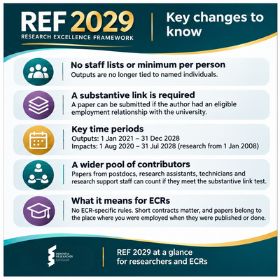
The final REF 2029 guidance changes how universities select research outputs and recognise contributions, with important implications for researchers on short contracts and those in supporting roles.
Impact gets a little easier
Under the REF 2029 guidance, the requirement that the research behind an impact case study be at least 2-star quality has been removed. Panels just need to be satisfied it meets the REF definition of research. Units with fewer than 10 FTE need only one case study, though they can choose to submit two. Case studies are also encouraged to discuss responsible practice, the ethics of how impact was achieved, in place of what used to be called rigour.
People, culture and environment
SPRE was originally planned at 25% before being cut to 20% last December after pushback from research-intensive universities. The rigour criterion has gone, and both statements are now judged on vitality and sustainability. Units can also describe how far they have come since REF 2021, including challenges they’ve overcome.
The institution-level People section asks universities how they maintain a positive research culture, including during periods of change or contraction. That’s pointed, given how many are cutting jobs, and comes as Research England ends its ring-fenced research culture funding from 2027-28. Each statement has up to 8,000 words for its scored sections, and the guidance reminds universities that word limits are “limits, not targets.” Professor Simon Macklin, who chairs the People and Diversity Advisory Panel, put the challenge plainly: “words on a page cannot ensure inclusion or recognition.”
If you get asked to contribute to your unit’s statement, our older piece on how to write a good REF environment statement is still a useful starting point.
What happens next
- By the end of 2026: the REF submission system launches
- Spring 2027: audit guidance published, and the first deadline for special requests
- 2027: universities complete a survey of intent to submit
- 31 July 2028: the impact and assessment periods end
- Noon, 24 November 2028: submission deadline
- 31 December 2028: the output publication window closes (outputs due out after the deadline can be flagged as pending)
- 2029: panels assess submissions, with results in December 2029 and funding from 2030-31
The REF team is running webinars on the final REF 2029 guidance, with details on the REF 2029 website. For most early career researchers there’s nothing to do today beyond depositing your papers on time and asking how your unit is preparing. If you want to make sure work that doesn’t fit neatly into a REF submission still gets recognised, have a look at the Hidden REF.




 Adam Smith



 LSE Impact Blog

 Nature Careers Blog