Academics are measured in many ways, but important aspects of academic life, such as mentoring the next generation of researchers, resist measurement. Commenting on the proposal for an M-index to measure contributions to academic mentorship, Brian D. Earp, Mohammad Hosseini, Sebastian Porsdam Mann and Kristi Holmes, suggest such measures run the risk of gamification and of displacing the qualities they seek to incentivise.
This article is shared from the LSE Impact blog, the article gives the views and opinions of the authors and does not reflect the views and opinions of the Impact of Social Science blog (the blog), nor of the London School of Economics and Political Science or Dementia Researcher. Shared under the Creative Commons Attribution 3.0 Unported (CC BY 3.0) the original publication can be found at https://blogs.lse.ac.uk/impactofsocialsciences/2026/10/22/will-a-m-index-to-measure-academic-mentorship-create-more-problems-than-it-solves/
 Generative artificial intelligence (GenAI) is transforming how research is done. Advanced large language models can now draft manuscripts, synthesise literatures, debug code, and suggest interpretations of results in a fraction of the time it would take an unassisted human. But this speed-up is not universal. While GenAI dramatically compresses text-based and computational work, it does not equally benefit the slower relational work at the heart of many forms of research.
Consider a research nurse building trust with participants in a clinical trial over several months, an anthropologist conducting fieldwork while being deeply embedded within a community, or a supervisor guiding a postdoctoral researcher through a career crisis. Although these activities may be indirectly supported by AI tools (for example by reducing various administrative burdens), their core relational dimensions cannot be accelerated.
This poses a problem for how we evaluate researchers like those just mentioned. Productivity metrics like the h-index and raw publication counts were already imperfect proxies for meaningful contributions. As GenAI speeds up some tasks but not others, those proxies become even less reliable. Researchers whose core work is relational or field-based may appear less productive, not because they contribute less, but because their contributions are less easily translated into countable outputs.
How should the research community respond to this new dynamic? One possibility is to expand what gets counted, and develop new metrics that capture contributions traditional indicators miss. A recent attempt to do this, focused on mentorship, offers a test case for this approach.
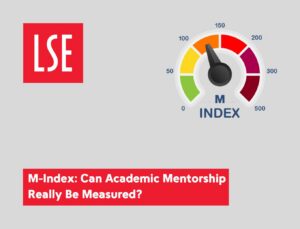
The “Mentorship Index”, or M-index, was developed and introduced by Jean Fan at Johns Hopkins University. Although this is not the first attempt to develop a bibliometric measure of academic mentorship, the introduction of M-index at a time when GenAI is transforming research and posing questions about what remains distinctively human in research, gives us a chance to explore it more critically.
The M-index is based on a simple calculation: it counts how often a scientist appears as last author on a paper whose first author has fewer than X publications (the default is ten). The last author position is typically occupied by researchers who play the senior or mentoring role, where the first author is usually relatively junior. The idea is to create a numerical signal for something that has often received less weight in formal evaluations: the work of developing junior researchers.
If successful, initiatives like the M-index might redirect evaluative attention away from sheer individual productivity and toward the people-facing work that holds research communities together. Currently, that shift in emphasis is needed. But does the M-index capture what it aspires to?
There are reasons for caution. First, last authorship in some disciplines signals the person who runs the lab or secured the funding, not necessarily the person who mentored others or invested directly in a junior colleague’s development. Moreover, the M-index presupposes an author-ordering convention (junior first, senior last) that holds in some fields but not others, making cross-disciplinary applicability unlikely.
Second, despite its admirable aims, the M-index still tracks volume and not depth or quality. Consider a principal investigator who has the resources to hire numerous postdoctoral researchers and pushes them to publish as much as possible without providing meaningful mentorship or guidance. They could easily outscore one who carefully works with their mentees and focuses on rigour and integrity. Similarly, a researcher who takes on fewer people in order to invest more deeply in each relationship (by spending time reading drafts, talking through setbacks, helping junior researchers find their independent voice) may end up with a lower M-index for their trouble.
Third, as with any metric that acquires evaluative weight in a competitive environment, there is the risk of gaming. Gift first-authorships bestowed on junior researchers by senior authors, for instance, could inflate the latter’s M-index score. Once a number is tied to performance evaluation, individuals may optimise for that number instead of the thing it was supposed to measure. As Fan herself puts it, invoking Goodhart’s Law, “when metrics become targets, they cease to be good metrics.”
Some of the limitations of the M-index could be addressed with relatively straightforward refinements. For example: normalising by career length to allow fairer comparison across career stages, restricting comparisons to candidates within similar fields, or importing data from contributorship statements to verify whether the last author actually played a supervisory role. But even a technically improved M-index would still face a deeper problem.
The problem is a mismatch between what the M-index is designed to value and the kind of instrument it is. Mentorship is qualitative. It happens in the context of a specific relationship, and it evolves over time. It requires identifying another’s needs, deciding when to be firm and when to give the other space, dealing skilfully with disagreements, and doing so across a relational dynamic that neither party fully controls. None of that is captured by a co-authorship record. The same things that make mentorship valuable make it hard to quantify.
If a number is nevertheless provided, it may be tempting to rely on it, possibly to the exclusion of more reliable indicators. An overstretched tenure committee, for instance, might lean on a candidate’s M-index score when pressed to reach a decision, rather than take the time to investigate more thoroughly.
Nevertheless, the M-index has certain strengths: it is openly available and uses open data, allowing anyone to consult it and providing an opportunity to consider mentorship as an important contribution worthy of reward. If used as one source of information, among others, it could provide a useful angle. But other information is indispensable.
What, then, does evaluation of mentorship require? The most informative evidence is unlikely to come from the mentor’s own self-appraisal: researchers can now use GenAI to create exaggerated or misleading but superficially plausible self-promotional prose on demand. Written testimonials from mentees may face a similar problem, especially if anonymity cannot be guaranteed. If they depend on their supervisors for references, funding, or visa, there could be costs to candidness. A better approach might involve direct, confidential conversations with collaborators and former trainees.
Of course, such in-depth engagement is hard to scale, and it can’t be sped up by AI. But that is as it should be. If mentorship is valuable because it requires presence, judgment, and sustained human attention, it would be strange if our best methods for evaluating it could digitally bypass those very things.
None of this is an argument against metrics in general, or against the impulse behind the M-index. It is a cautionary suggestion that mentorship cannot be adequately captured by any single bibliometric indicator. If such indicators gain traction, there is a risk that they’ll become substitutes for the deeper engagement that meaningful assessment requires. We have already seen this with the h-index. While the M-index is insufficient to assess mentorship, it deserves some credit for highlighting mentorship as something that should be on the evaluative agenda. The challenge now is to ensure that that agenda is taken seriously enough that a number does not become a shortcut.
About the authors
Brian D. Earp, PhD, is Director of the Oxford-NUS Centre for Neuroethics, AI and Society and is Associate Professor of Biomedical Ethics (and of Philosophy and of Psychology, by courtesy) at the National University of Singapore. With Sebastian Porsdam Mann and colleagues, Earp has published extensively on the ethics of AI in relation to academic research and integrity.
Mohammad Hosseini is an Assistant Professor at Northwestern University Feinberg School of Medicine, Department of Preventive Medicine. He is a guest lecturer of research ethics and integrity, a co-editor in chief of Accountability in Research and a member of the Global Young Academy. His work focuses on ethics of employing AI tools in research and understanding their implications on integrity, transparency, and societal impact of research.
Sebastian Porsdam Mann is an Assistant Professor at the Centre for Advanced Studies in Bioscience Innovation Law (CeBIL), Faculty of Law, University of Copenhagen. His research spans bioethics, artificial intelligence, and law, with a focus on the ethical and societal implications of emerging technologies, particularly their applications in scientific research and healthcare.
Kristi Holmes is Associate Dean for Knowledge Management and Strategy, director of Galter Health Sciences Library, and professor of Preventive Medicine (Health and Biomedical Informatics) at Northwestern University Feinberg School of Medicine. She serves on the leadership teams for the Northwestern University Clinical and Translational Sciences Institute (NUCATS) and the Institute for Artificial Intelligence in Medicine (I.AIM). Her work focuses on the discovery and equitable access to knowledge through highly collaborative computational and social initiatives on local, national, and international levels.

 Dementia Researcher
 Nature Careers Blog

 Dr Becky Carlyle
 Dr Yvonne Couch