Policy engagement opportunities are fragmented and unevenly visible, which can lead to unequal access. Considering research by Overton to structure the existing data on policy engagement opportunities, Céire Wincott shows how this can systematically reveal existing inequalities, but also create new avenues for connecting research to policy.
This article is shared from the LSE Impact blog, the article gives the views and opinions of the authors and does not reflect the views and opinions of the Impact of Social Science blog (the blog), nor of the London School of Economics and Political Science or Dementia Researcher. Shared under the Creative Commons Attribution 3.0 Unported (CC BY 3.0) the original publication can be found at https://blogs.lse.ac.uk/impactofsocialsciences/2026/09/15/the-visibility-problem-in-academic-policy-engagement/
 Researchers are increasingly expected to contribute to policymaking through various engagement mechanisms. Yet in practice, finding these opportunities can be difficult. Opportunities are fragmented across government websites, institutional mailing lists, professional networks and newsletters, with little consistency in how they are advertised or archived. Many researchers encounter opportunities only through existing relationships or informal channels, meaning participation can depend as much on visibility and connection as on expertise itself.
This creates more than just inefficiency. When engagement opportunities are difficult to discover systematically, participation may become concentrated among researchers and institutions that are already well-connected to policymaking spaces. Academic policy engagement is therefore not simply a question of research quality or willingness to engage, but also of information access: who sees opportunities, where they are surfaced and how easily relevant expertise can be identified and connected to policy needs.
What is often missing from discussions of academic policy engagement is the role of infrastructure. While considerable attention is paid to encouraging researchers to engage with policy, far less attention is paid to how engagement opportunities themselves are organised, documented and made visible.
This matters because engagement opportunities are not surfaced consistently across policy systems. Some governments publicly advertise consultations, fellowships and research priorities in relatively structured and searchable ways, while others rely on decentralised or invitation-based processes that are difficult to track systematically. The result is an uneven landscape of visibility, where opportunities are substantially more discoverable in some contexts than others.
These differences have implications beyond individual participation. Fragmented documentation makes it difficult to compare engagement practices across countries or policy domains, identify gaps between policy demand and research expertise, or analyse how governments seek external knowledge. Without structured information on engagement opportunities, an important part of the relationship between research and policymaking remains difficult to observe.
At Overton we wanted to explore what becomes possible when policy engagement opportunities are treated as data. We developed Overton Engage, a structured database designed to collect and standardise publicly documented academic policy engagement opportunities across countries, policy organisations and engagement types.
The database brings together opportunities that are typically scattered across a wide range of sources, including consultations, Areas of Research Interest (ARIs), learning agendas, fellowships, funding calls and expert advisory committees. Each opportunity is enriched with structured metadata, including policy domain, country, requesting organisation and engagement type. This makes it possible to systematically search, compare and analyse opportunities across different policy contexts.
Alongside the database, we developed a semantic matching system which links engagement opportunities to relevant academic research based on the similarity between opportunity descriptions and publication records. Rather than relying solely on keywords or manual searching, the system is designed to help identify researchers whose expertise may align closely with specific policy needs.
Once engagement opportunities are collected systematically, it becomes possible to analyse policy demand itself: not just what governments publish, but where they actively seek external expertise. In our analysis, engagement opportunities were unevenly distributed across policy domains. “Economic Affairs” accounted for the largest share of opportunities, followed by areas such as “General Public Services” and “Environmental Protection”, while domains including “Defence” and “Recreation, Culture and Religion” were comparatively underrepresented.
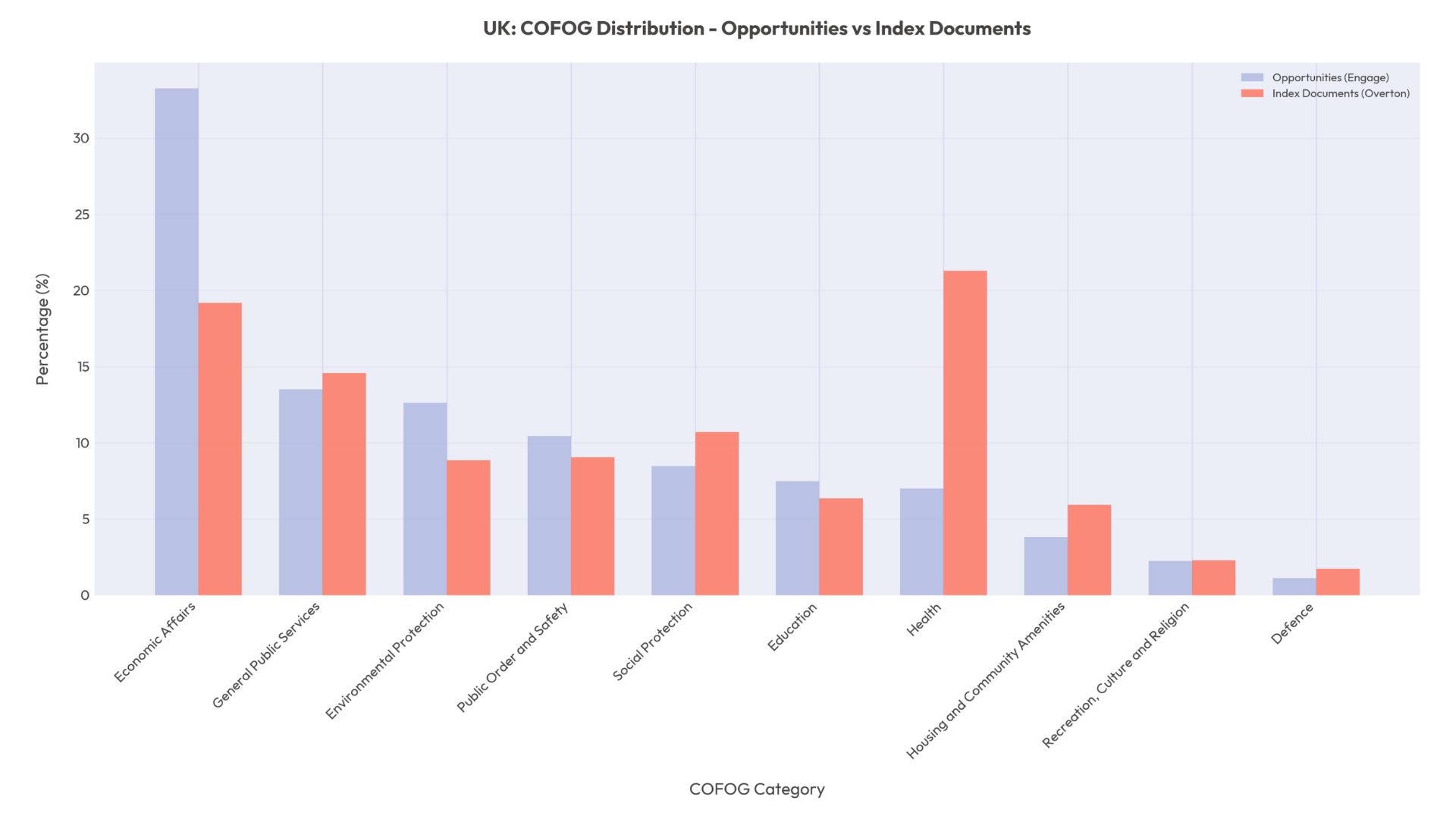
Fig.1: Distribution of policy engagement opportunities across different policy areas.
Different types of engagement opportunities also showed distinct patterns across policy areas. Consultations tended to be spread across a broad range of domains, reflecting their role as reactive mechanisms for gathering input on proposed policies or legislation. By contrast, Areas of Research Interest (ARIs) and learning agendas were more concentrated in “Economic Affairs” and “Health”-related topics, suggesting a more agenda-setting function which signalled longer-term evidence needs. Fellowships and internships represented another distinct form of engagement, embedding researchers directly within policymaking environments rather than inviting external contributions from a distance. Together, these patterns suggest that different policy domains rely on different mechanisms for engaging academic expertise.
Because the database includes opportunities from multiple countries, it also becomes possible to compare how different policy systems structure engagement. An illustrative comparison between the UK and Australia showed both similarities and divergences in consultation priorities. In Australia, consultations were more concentrated in “Health” and “Environmental Protection”, both focused heavily on “Economic Affairs” and UK consultations showed relatively greater emphasis on “Social Protection”. These differences likely reflect varying policy priorities, institutional structures and approaches to public consultation, but they also demonstrate how engagement opportunities can provide insight into how governments seek external expertise.
The matching analysis also revealed that institutional size is not the only factor shaping alignment with policy opportunities. While larger research-intensive universities tended to match a larger number of policy opportunities, smaller specialist institutions often performed particularly strongly within specific policy domains. For example, the London School of Hygiene and Tropical Medicine showed exceptionally high coverage of “Health”-related opportunities. This suggests that research specialisation can compensate, at least partly, for lower overall publication volume when aligning academic expertise with policy demand.
More broadly, this work highlights the importance of infrastructure in shaping academic policy engagement. Efforts to strengthen evidence-informed policymaking often focus on encouraging researchers to engage more actively with policy. However, engagement also depends on whether opportunities are visible, accessible and systematically connected to relevant expertise. Improving the discoverability of engagement opportunities could help widen participation beyond researchers and institutions already embedded within policymaking networks.
The findings also suggest that engagement opportunities are valuable not only as pathways for participation, but as a source of data in their own right. Collecting and standardising these opportunities makes it possible to examine how governments seek external expertise, how engagement priorities differ across policy systems, and where mismatches may exist between policy demand and available research capacity.
Publicly documented opportunities capture only part of the wider academic-policy landscape. Nevertheless, making them more visible and systematically analysable may help support a more accessible, transparent and evidence-informed relationship between research and policymaking.
About the author
Céire Wincott is a data analyst at Overton, where she works on understanding how research, policy, and evidence interact at scale. With a background spanning STEM research and policy engagement, her work focuses on using large-scale data and AI-driven approaches to explore research impact, evidence use, and the connections between research and decision-making. Before joining Overton, she completed a PhD in Chemical Biology.


 Dementia Researcher



 Nature Careers Blog