 Print This Post
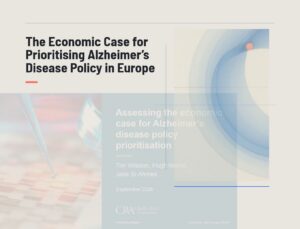 Alzheimer’s Disease Policy – A new economic analysis estimates that France, Germany, Italy, Spain and the UK could save €182 billion over the next decade by prioritising Alzheimer’s disease policy, but only if diagnosis, health system capacity and access to new treatments move forward together.
Assessing the economic case for Alzheimer’s disease policy prioritisation, published by Charles River Associates (CRA) and funded by Biogen, builds on CRA’s 2025 report on what Alzheimer’s policy could learn from cancer. One lesson from oncology was that hard evidence on the economic burden of disease, and the return on investing in it, helped keep cancer high on political agendas for decades. The authors argue that the equivalent case for Alzheimer’s has never been properly made.
To make it, they modelled the socioeconomic burden of Alzheimer’s disease across the five countries from 2026 to 2036 under two scenarios: no change in policy, and a scenario in which widespread, active and effective policy makes timely diagnosis and treatment with disease-modifying therapies routine.
A burden set to nearly double
The model puts the total socioeconomic burden of Alzheimer’s across the five countries at €552 billion in 2026. That figure combines four elements: the monetised loss of quality of life for people with the disease, direct medical costs, social and home care costs, and the impact on informal carers through lost work and lost leisure time.
The cost per person climbs steeply as the disease progresses, from around €24,900 a year for mild cognitive impairment (MCI) to around €95,100 for severe Alzheimer’s. MCI still accounts for the largest share of the total (46%), simply because two-thirds of people are at that stage.
With the number of people affected expected to rise from 14.8 million to 18.3 million, the annual burden is projected to reach more than €1 trillion by 2036 if nothing changes. The authors note this is likely an underestimate, as it leaves out patients’ own lost productivity, pensions and the wider effects on carers’ wellbeing.
What policy action could change
The policy scenario assumes treatment slows progression for people with MCI and mild Alzheimer’s, the groups current disease-modifying therapies are licensed for. Over time that keeps more people in the earlier, less costly stages.
By 2036, the model estimates there would be more than 430,000 fewer people living with severe Alzheimer’s, and 1.4 million more people still at the MCI stage, than without policy action. Annual savings start small but build to €60 billion a year by 2036, reaching €182 billion in total across the decade. That is roughly a full year of Italy’s health spending, and works out at a return of €1.82 for every €1 invested. Scaled across the whole EU, the authors suggest the figure could be around €239 billion.
Germany, with an estimated four million people with Alzheimer’s, gets its own case study, with a potential benefit of €50 billion over ten years.
The cost of waiting
The timing matters as much as the policy. If meaningful action were delayed until 2030, cumulative savings by 2036 would fall to €61 billion. If action started now but stalled, with only 30% of eligible people eventually benefiting rather than 80%, the total would be €65 billion. Either way, around two-thirds of the potential benefit is lost.
Where the UK stands
The report finds policy action across the five countries is patchy. Germany is furthest along, with a funded national strategy of more than 160 measures. Italy has a funded plan but uneven regional delivery, France has folded dementia into a wider neurodegenerative diseases strategy, and Spain’s 2019 to 2023 plan was widely criticised for having little practical impact.
In the UK, the picture is split. Scotland, Wales and Northern Ireland have dementia plans with dedicated funding, but England’s strategy ran out in 2020 and has not been replaced. The government’s 10 Year Health Plan for England includes a commitment to a blueprint for improving dementia care, though the details are still to come. Alzheimer’s Research UK’s recent Ready for a Cure report makes a similar case from the research side.
Reading the numbers with care
This is a modelling study funded by a company that makes Alzheimer’s treatments, and it is worth reading with that in mind. The headline figures rest on several assumptions that are open to debate:
- Coverage: the share of people with MCI or mild Alzheimer’s benefiting from treatment is assumed to rise from 0.1% in 2026 to 80% by 2036. Current uptake in Europe is a long way from that.
- Efficacy: treatment is assumed to cut progression by 30%, in line with the first approved drugs, rising to 50% by 2036 on the expectation that the pipeline of more than 130 drugs will deliver better options.
- Treatment cost: rather than using real drug prices, the model sets the cost of treatment at 30% of the benefits it creates, with a further 15% for delivery costs such as infusions and monitoring.
- Valuing health: the largest single component of the burden is the monetised loss of quality of life, valued at €80,000 per quality-adjusted life year using the HM Treasury Green Book. With NICE’s lower threshold, the savings are smaller.
The authors are open about this and test alternatives in the appendix, and the savings remain positive across their scenarios. But the gap between modelled access and the reality of drugs such as lecanemab, which NICE did not recommend for NHS use, is a reminder that the scenario describes what could happen, not what is likely to happen under current conditions. For early career researchers, the appendix is also a useful worked example of how disease burden models are built and stress-tested.
What the report calls for
The analysis points to three areas where action is most urgent:
- Diagnose people at scale, early enough to treat. The benefits depend on catching people at the MCI or mild stage, which the authors say will need a major expansion of blood-based biomarker testing.
- Expand infrastructure and capacity, including specialists, memory assessment services, PET, MRI and CSF analysis, which many health systems currently lack.
- Put access and reimbursement frameworks in place that capture the full range of benefits, alongside funding approaches that can absorb the upfront costs.
The report also acknowledges that comprehensive policy would go further than diagnosis and treatment, covering prevention, data infrastructure and support for carers.
A conversation worth having
Whatever view you take on the assumptions, the report makes a point that is hard to argue with. The cost of Alzheimer’s is already enormous and growing, most of it falls on families and social care rather than hospitals, and decisions made in the next few years will shape what the bill looks like in 2036. As the World Alzheimer Report 2026 also argued, the systems needed to get research into practice take years to build.
The report’s two-page infographic summary is also available.




 Dr Emma Law

 Alzheimer's Association