
 Print This Post
New findings presented at the Alzheimer’s Association International Conference 2026 suggest that measuring and reducing tau could play an increasingly important role in the future diagnosis and treatment of Alzheimer’s disease.
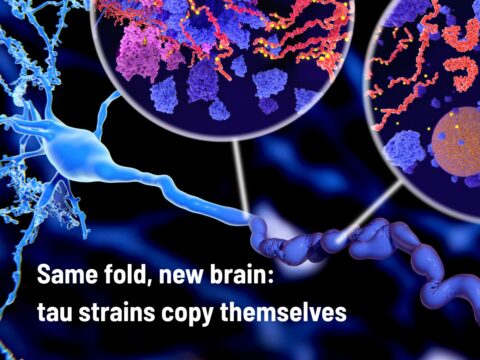
Two separate studies have placed renewed attention on tau, a protein that normally helps maintain the structure of nerve cells. In Alzheimer’s disease, abnormal forms of tau accumulate inside brain cells, forming tangles associated with neuronal damage and cognitive decline.
One study investigated whether an experimental treatment could reduce tau production and slow the progression of early Alzheimer’s disease. The other examined whether levels of a particular form of tau in the blood could help identify cognitively healthy people at greater risk of developing impairment years later.
Experimental treatment reduces tau
Results from the Phase 2 CELIA trial provide early evidence that directly lowering tau may affect the course of Alzheimer’s disease.
The trial evaluated diranersen, an experimental antisense oligonucleotide treatment developed by Biogen and Ionis Pharmaceuticals. Rather than targeting tau after it has accumulated, diranersen is designed to reduce the instructions used by cells to produce the protein.
The study included 416 people with mild cognitive impairment due to Alzheimer’s disease or mild Alzheimer’s dementia. Participants received one of three dosing regimens or a placebo over 18 months. The treatment was delivered intrathecally, through an injection into the fluid surrounding the spinal cord.
Across the three doses, diranersen reduced total tau in cerebrospinal fluid by an average of 50% to 65%. A substudy involving 131 participants also found reductions in brain tau pathology measured using PET imaging.
The lowest dose, administered every six months, produced the strongest clinical results. Compared with placebo, it was associated with a 26% slowing of decline on the Clinical Dementia Rating–Sum of Boxes, alongside larger differences on some measures of cognition.
However, the trial did not meet its primary endpoint. Researchers had expected higher doses to produce greater clinical benefits, but this dose-response relationship was not seen. The treatment also did not separate from placebo on one measure of daily functioning.
These inconsistencies mean that the findings need to be interpreted cautiously. The results have not yet established that diranersen is an effective treatment, and a larger Phase 3 trial will be needed to confirm whether reducing tau produces meaningful and sustained benefits.
The treatment was reported to be generally well-tolerated. The most frequent adverse events included pain associated with the procedure, symptoms following lumbar puncture and temporary episodes of confusion. Biogen plans to take diranersen into Phase 3 development.
Blood test may help estimate future risk
A separate study, published in JAMA, examined whether plasma p-tau217 could help estimate the risk of future cognitive impairment among people who did not have symptoms when tested.
Researchers combined data from several longitudinal studies involving nearly 2,700 older adults. Participants were grouped according to their blood p-tau217 levels and followed over time.
Within five years, the estimated risk of developing cognitive impairment was 12% among those with low p-tau217 and 38% among those with very high levels. At ten years, the corresponding estimates were 40% and 78%.
The ten-year figures should be treated with particular caution because only 5% of participants had been followed for longer than a decade. The study populations were also drawn from established research cohorts and may not fully represent people seen in routine healthcare.
Importantly, p-tau217 is not a precise countdown to the onset of dementia. Some people with elevated levels may never develop symptoms, while cognitive impairment can arise for reasons other than Alzheimer’s disease. Age, other health conditions, genetics and lifestyle may all influence an individual’s risk.
The test is therefore not ready to be used on its own to tell cognitively healthy people whether or when they will develop dementia. Its near-term value may be in research, particularly for identifying people who could take part in prevention trials before symptoms appear.
Why the findings matter
Most of the disease-modifying Alzheimer’s treatments developed so far have concentrated on removing amyloid from the brain. Tau is more closely associated with neuronal damage and the progression of cognitive symptoms, making it another important treatment target.
Together, these studies demonstrate two possible uses for tau: as a biomarker that could help estimate future risk and as a biological target for treatments intended to slow disease progression.
Both approaches remain under investigation. The blood-test findings require validation in larger and more representative populations, while diranersen must demonstrate its safety and effectiveness in Phase 3 trials.
Nevertheless, the results add to growing evidence that tau may become central to how researchers identify, monitor and potentially treat Alzheimer’s disease.
Further information:
Read the JAMA blood biomarker study and the CELIA Phase 2 results.


 Alzheimer's Association





 Alz Forum