 Print This Post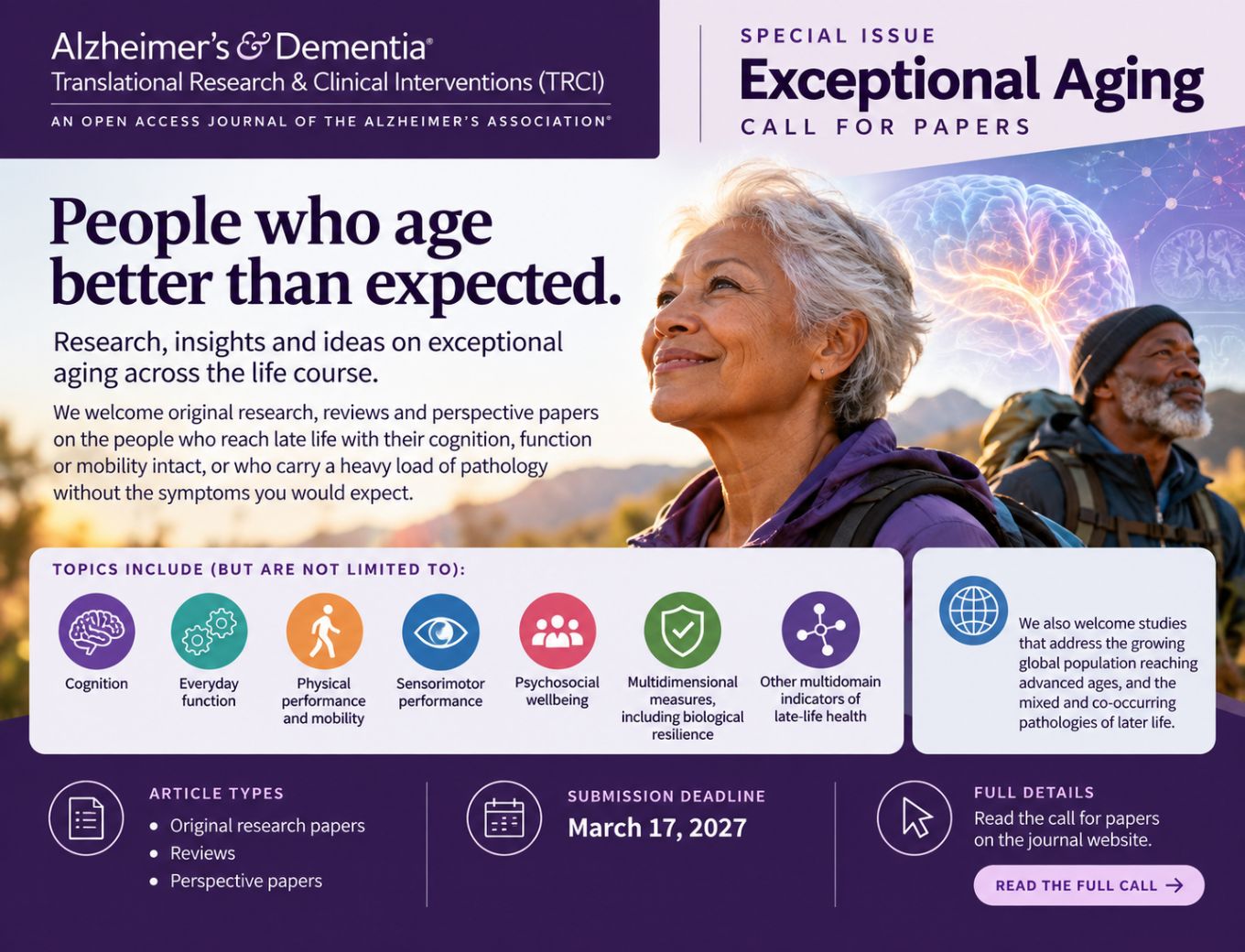
Alzheimer’s & Dementia: Translational Research & Clinical Interventions (TRCI) is putting together a special issue on exceptional aging, and it wants original research, reviews and perspective papers. If your work looks at the people who reach late life with their cognition, function or mobility still intact, or at why some brains carry a heavy load of pathology without the symptoms you’d expect, this is a natural home for it.
TRCI is the Alzheimer’s Association’s open access journal for research that bridges the lab and the clinic. This issue focuses on exceptional aging phenotypes in later life, the people doing better than their age (and their pathology) would predict, and on the fast-growing number of people worldwide who are now living into advanced old age.
What’s in scope
The editors particularly welcome work on exceptional aging across:
- cognition
- everyday function
- physical performance and mobility
- sensorimotor performance
- psychosocial wellbeing
- multidimensional measures, including biological resilience
- other multidomain indicators of late-life health
They also want studies that deal with the growing global population reaching advanced ages, and with the mixed and co-occurring pathologies that commonly come with later life. That’s a big tent. Cohort studies of the oldest old, brain bank and neuropathology work, biomarker studies of resistance and resilience, and population-level research could all fit. If you’re new to this literature, our ISTAART Relay Podcast with the Reserve, Resilience and Protective Factors PIA and Connor Richardson’s year in review of reserve and resilience research are a good way to get your bearings.
 What you can submit
- Original research papers
- Reviews
- Perspective papers
Perspectives are worth a look if you’re earlier in your career. They don’t need a new dataset, and they’re a chance to make a case for where the field should go next. A good review always takes longer than you think, so if that’s your plan, our literature review resources will save you some legwork. And if this would be your first paper, Dr Clíona Farrell’s account of her first time through the publication process is an honest look at what to expect.
Before you submit
TRCI is fully open access, so accepted papers carry an article publishing charge. Check the current fee on the journal website, and ask your library whether your institution has an agreement with Wiley that covers it, as many UK universities do. Submissions go through the journal’s usual peer review.
Full details are in the call for papers on the journal website. If you’re not sure your paper fits, send the editorial office a short outline first: adjeditorial@wiley.com.
Submission deadline: March 17, 2027.


 Dementia Researcher