 Print This Post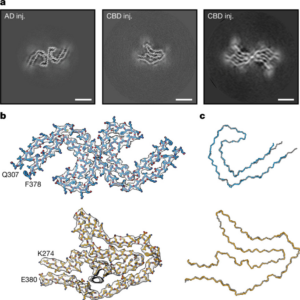
Cryo-EM structures of mouse tau filaments seeded with Alzheimer’s and corticobasal degeneration tau, overlaid on the human filament structures
When tau filaments taken from the brains of people who died with Alzheimer’s disease or corticobasal degeneration (CBD) were injected into ordinary mice, the mice’s own tau went on to build filaments with exactly the same atomic structure as the human seeds. It is the strongest evidence yet for a central plank of the prion-like tau hypothesis: that each disease’s tau fold behaves like a distinct strain and keeps its identity as it spreads.
The work comes from Sofia Lövestam, Aki Shimozawa, Airi Tarutani and colleagues, led jointly by Masato Hasegawa at the Tokyo Metropolitan Institute of Medical Science and Michel Goedert and Sjors Scheres at the MRC Laboratory of Molecular Biology in Cambridge. It was published in Nature on 30 September and is open access, alongside a News & Views commentary from Kayleigh Mason-Chalmers and Jose Rodriguez at UCLA.
The missing piece of the prion-like idea
Prions cause disease by templating: a misfolded protein forces normal copies of itself into the same bad shape. Different misfolded shapes produce different prion strains, each with its own incubation time, lesion pattern and clinical picture. Tau, amyloid-β and α-synuclein have long been thought to spread through the brain in a similar way.
Over the past decade, cryo-electron microscopy from the Goedert and Scheres groups has shown that tau adopts a different fold in each disease, with one fold per disease across more than 20 tauopathies. Separately, injecting tau from human brains into mice was already known to trigger tau pathology that spreads from the injection site. What nobody had shown was the link between the two: that the newly formed filaments in the recipient carry the same structure as the seed. Earlier cryo-EM work on transgenic tau mice found filament structures that did not match any seen in human disease, and a recent α-synuclein study found that seeded filaments only partly kept the structure of what was injected.
What the team did
The researchers extracted insoluble tau from the frontal cortex of five people with Alzheimer’s disease and six with CBD, and injected it into the striatum of young wild-type mice. They then waited nine to twelve months.
By then, phosphorylated tau inclusions had spread from the injection site into the cortex, corpus callosum and other regions. Antibodies specific to mouse tau lit them up, while a human-specific antibody gave no signal, and a time-course showed the injected human tau had disappeared within a week. So the filaments that built up were made entirely of the mouse’s own protein.
The two seeds produced recognisably different diseases. Alzheimer’s seeds gave tau pathology confined to neurons and their processes. CBD seeds gave pathology in both neurons and glia, including coiled bodies in oligodendrocytes and plaque-like inclusions in astrocytes, which is the pattern pathologists see in human CBD. Biochemically, the CBD-seeded tau also showed the 37 kDa band that is a signature of the human disease.
Same fold, atom for atom
The decisive result came from cryo-EM. In the Alzheimer’s-seeded mice, 83% of filaments were paired helical filaments, solved to 3.6 Å and essentially indistinguishable from the Alzheimer fold seen in human brains. In the CBD-seeded mice, most filaments were single protofilaments, solved to 3.4 Å and matching human type I CBD filaments even more closely. A smaller population of doublets looked like type II CBD filaments, although the resolution was too low to be sure.
This works because mouse and human tau share an identical sequence across the stretch that forms the ordered core of both folds, so there is no species barrier for these two strains. There is one for others. Adult mice only make four-repeat (4R) tau, so folds that need three-repeat tau, such as the Pick’s disease fold, cannot be copied in wild-type mice. Folds from other mixed or 4R tauopathies, including chronic traumatic encephalopathy and progressive supranuclear palsy, should be, and mice expressing both isoform types could take on the rest.
Why this matters for dementia research
The most practical consequence is a model. Many tau mouse lines rely on overexpressing mutant human tau, and their filaments do not look like those in people. Here, an ordinary wild-type mouse reproduces disease-specific human tau structures and the cell types they target. That makes it a tool for asking how a particular fold is taken up by cells, recruits normal tau and moves between connected regions, and for testing therapies aimed at a specific strain rather than at tau in general. Anyone who has wrestled with how well animal models reflect human disease will see why that matters.
The CBD results also add weight to the idea that the fold itself, rather than just where tau is injected, decides which cells are affected, including glia. That links to wider questions about the role of astrocyte tau in dementia, and to work charting how tau changes as Alzheimer’s progresses.
What it does not show
Prion-like does not mean infectious. Prion diseases pass between individuals and progress quickly, while there is no evidence that tauopathies spread from person to person in everyday life. The only reported exception involves people who received cadaver-derived growth hormone contaminated with Alzheimer’s seeds, decades ago. It is also not known whether tau seeds given outside the brain could cause neurodegeneration.
The mice also appeared healthy despite their tau inclusions. They may not live long enough to develop symptoms, or the amount of pathology may be too small. So the study speaks to how tau spreads, not to how it kills cells, and whether propagation and toxicity are separate stages, as they appear to be for prions, remains open. The authors say serial passage experiments, moving seeded tau from one mouse to the next, are needed to fully characterise these strains. It is also worth noting that the experiments used only male mice, and cryo-EM was done on pooled material from two brains per seed type.
Finally, this kind of work depends on brain donation. Part of the human tissue came from the Manchester Brain Bank, which is supported by Alzheimer’s Research UK and Alzheimer’s Society through the Brains for Dementia Research programme.
Lövestam, S., Shimozawa, A., Tarutani, A. et al. Prion-like transmission of human tau strains in the mouse brain. Nature (2026). https://doi.org/10.1038/s41586-026-11061-x (open access). Image: Fig. 3 from the paper, reproduced under a CC BY 4.0 licence.
See also the accompanying News & Views: Mason-Chalmers, K. & Rodriguez, J. A. Harmful tau spreads like self-propagating prion proteins. Nature (2026).
 Alz Forum
 Professor Louise Serpell



 UK DRI