It’s an exciting time in our Department. We have a new Big Boss, and it’s Richard Wade-Martins, a name that will be familiar to many Dementia Researcher readers. It just so happens that before Richard took the top role, I had “agreed” to become Academic Co-Lead for EDI in the Department. It sounded like a lot of work, particularly when I knew that people I hugely respect had tried and failed to significantly move the needle previously. Luckily it has become clear in the last 2-3 months, that Richard is deeply invested in making the place we come to work every day a better place to spend so much of our time. And so, having begrudgingly taken the old EDI role, I now find myself in a place of exciting opportunity, co-leading our new People & Culture Committee and trying to figure out what meaningful changes we can make to people’s time.
Of course, like almost all Departments around the UK, we’re skint, and so the main question is how we make these changes when there’s not many resources to do so. And we have to make sure we set realistic expectations, as it’s a tough time in UK science, and we can’t promise jobs for ever for everyone who wants them. What we hope to do is improve their time with us, and work to better equip them for academic or diverse careers afterwards.
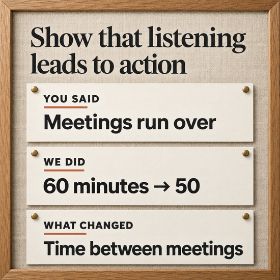
Small, visible changes can help rebuild trust at work. Becky gives an example: if meetings regularly overrun, changing the default length from 60 to 50 minutes creates breathing space between appointments.
Research culture starts with data
Before you can transform the way people feel about their place of work, you have to know what their problems are. It’s not enough to sit in your self-selected committee and decide, you need actual data. We have a really helpful Annual-ish Staff & Student survey, and this highlighted a whole bunch of issues for the Committee to get their teeth into, but many of them focused around a lack of transparency in decision making processes. We’re probably not alone here, with decisions about funding, promotions, and space often seeming somewhat mercurial and arbitrary. Moreover, this feeling was not contained to our academics, and was resulting in people disengaging from great initiatives already in place (annual Career Conversations) and from joining Working Groups that aim to improve things.
But I’m rushing ahead – the great thing about having this data, is that it also gives you a framework for evaluation. I’m not saying you can run the perfectly controlled experiment, changing one thing at a time and surveying the response, but you can observe trends over time as you start to change small things. Evaluation of the measures you’re taking is important, and according to one independent report from UKRI, only occurs in around a third of culture-focused initiatives.
You said, we did, it improved
Evaluation also helps with your transparency. When you have a group of people who have disengaged, it really helps to be able to say “We heard you say this”, “So in response we did this”, followed by “and it improved X by 20%”. Not every initiative will produce a neat number, but asking the people involved whether it actually helped can reveal where you’ve inadvertently messed up, whether you’ve missed your original goal and even, shock horror, when people are happy with what you’ve done. It’s all too easy if you really care about something to only speak up when it goes wrong, but it’s important for the motivation of all involved that we don’t underestimate the power of being told you are doing a good job.
Being able to offer a scenario like this once a month in your department newsletter, even if it’s about something that feels vanishingly small, should start to move the needle. For example, perhaps you receive a message in the anonymous feedback box that Working Group meetings keep over-running the hour-long time slot they have, making someone late for a meeting with their supervisor. You can now go through the process:
You said: “Our working group meeting always runs five minutes over, which makes me late for my next meeting.”
We did: We changed the default meeting length from 60 to 50 minutes.
It improved: People had more time to get between meetings, make a cup of tea, or simply have ten minutes without being in a meeting.
Small wins build trust
You can see that after a few of these are placed into a regular mailout, people will hopefully start to believe that it’s worth speaking up about the little things, because there’s a chance that something might be done about them that will improve their day to day. The other hope, is that people start to believe that it’s possible to address the bigger things, which might need consultation, more time, or the dreaded financial resources. Once you’ve set this framework for transparency, you will hopefully start to get buy in from a wider range of views than your highly motivated volunteer group.
Task and Finish groups for research culture
When we’re thinking about the bigger problems, a more structured, longer-term approach may be needed. Rather than making our central committee and overall committee structure enormous, with representation from every category of staff in our large department, we are choosing to use a combination of standing working groups and shorter term “Task and Finish” groups. This way, we have a small set of broad membership groups which meet every month to discuss ongoing projects in specific areas, and can also launch flexible, short-term projects that identify a problem, consult the people affected, implement a solution and then disband. Nobody needs another standing committee whose main achievement is scheduling its next meeting. The central committee can manage long-term evaluation of these groups, and receives regular reports from the standing working groups.
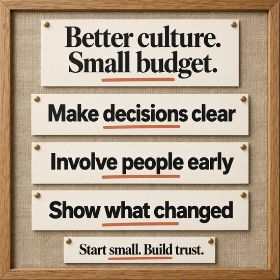
Improving research culture does not always need an expensive programme. Make decision-making criteria clear, involve affected people early enough to shape changes, and report back on what happened. Start with practical improvements.
When policy helps, and when it doesn’t
One of the main tasks of this committee and these groups will be to evaluate whether we need a new policy or guidelines for a process. If we do, we need to make sure the people affected by it are involved early enough to actually shape it, not at the final draft stage when everyone else has already had their input.
Policies can be extraordinarily helpful when done well, providing a framework to help someone unfamiliar do something the “right way” (i.e. advertise a job to the broadest possible audience of people), or to use as a basis for specific feedback about why someone may have failed to meet promotion criteria. But this last option also highlights a difficulty; policy must be sufficiently flexible to account for the huge amount of diversity in career paths and fields, whilst being sufficiently specific that people can measure themselves against it and derive actionable information.
There will always be some subjectivity in this career, but having received the feedback “keep doing what you’re doing” before in one of these conversations, this level of vague response that doesn’t address which criteria you’d “failed” on, is worse than no feedback at all.
Have a think about the last time you felt wronged by an arbitrary decision – would you feel better if there had been a policy to refer to? Perhaps your student asked for £300 to go to a conference, and their request was refused, while the student across the hall was funded. Perhaps you were told to give up a lab space for another group, but the bench has sat empty since you cleared it up six months ago. With a policy, the outcome may still have been negative for you, but knowing in advance what the criteria were, who made the decision and why can make the difference between “I don’t like this decision” and “this decision is unfair”.
Do you need a new policy at all?
Crucially, we should also ask whether we need a new policy at all. We all already have too many forms, committees and approval processes, and the last thing we want to do is make people’s working lives more bureaucratic in the name of making them better. Sometimes the best intervention might be a clear principle, publication of a principle that already existed, a change in practice, or even getting rid of an existing rule.
Improving research culture without a budget
I guess that leads to my main point, that hopefully we don’t need a mega budget and shiny newfangled wellbeing programmes to make some substantive changes. We need to give people ways to speak openly, demonstrate that someone is actually listening, and most importantly, show that speaking up can lead to action. Some of that might cost no more than a few biscuits and a good cup of tea. We hope that this will build the trust, and the engagement that gives us a better chance of tackling the big things together. Ask me again in a year or two whether this actually worked. Hopefully, I’ll show you the data to prove it.

Dr Becky Carlyle
Author
Dr Becky Carlyle is an Alzheimer’s Research UK Senior Research Fellow at University of Oxford, and has previously worked in the USA. Becky writes about her experiences of starting up a research lab and progressing into a more senior research role. Becky’s research uses mass-spectrometry to quantify thousands of proteins in the brains and biofluids of people with dementia. Her lab is working on various projects, including work to compare brain tissue from people with dementia from Alzheimer’s Disease, to tissue from people who have similar levels of Alzheimer’s Disease pathology but no memory problems. Becky is also a mum, she runs, drinks herbal teas and reads lots of books.

 Dr Yvonne Couch
 LSE Impact Blog
 Dementia Researcher

 Nature Careers Blog