Print This Post
 Ask ten academics what the Academic Promotion Criteria actually are at their institution, and most will hesitate before answering. Push further and someone will mention a colleague who got promoted last year that nobody in the department could quite explain. This isn't one university being badly run, it's how the process works pretty much everywhere in UK higher education.
You will have seen this happen. Someone gets their chair, or moves up to Senior Lecturer, and your first reaction isn't always "well deserved." Sometimes it's relief for them, and sometimes, if you're honest, it's closer to "I've done more than them, why aren't I getting promoted?" Both these reactions are normal, and both are a sign of how little people understand about what academic promotion criteria actually are, and how to get promoted yourself.
This article isn't going to pretend promotion is a clean process with an obvious formula. It isn't. But academic promotion criteria do exist, with clear patterns behind them, and there are concrete things you can do, starting years before you ever fill in a form, to put yourself in a strong position.
In brief
Academic promotion criteria are real, but they vary a lot between institutions, and even within departments within the same institution. However, the academic sector's own research shows the process is nowhere near as objective as it's often presented. The reality is that you probably need to build a case over years, not in the six months before a deadline, and papers and grant income are no longer the whole story: supervision, teaching, leadership and public contribution formally count too, especially under the narrative CV model funders are pushing.
Clinical, lab-based and qualitative researchers experience this process differently, and it pays to know how before you build a case. You also don't have to want promotion at all; Senior Lecturer and Reader are legitimate places to build a career, not just staging posts. And when it doesn't work out first time, that's normal, not a verdict on your ability.
On this page
We have tried to approach this topic in a logical order. It starts with why promotion feels so opaque and what the academic promotion criteria actually ask for, including how they apply differently if you're clinical, lab-based, or qualitative. Then we ask the question worth considering: "are you sure you actually want this?"
After that comes the practical part: what to do years before you apply, what to do in the six to twelve months before, and the admin, covering timelines, panels, referees, and what happens if it doesn't work out.
It finishes with top tips from colleagues working in dementia research, and answers to the questions people actually ask.
Why promotion feels so opaque
A colleague down the corridor makes Principal Investigator. You've had more papers out this year than she has, your last grant dwarfed hers, and you've had three PhD students finish while she's still shepherding her first through to viva. You're still exactly where you were twelve months ago.
Part of what's happening here is genuinely structural, not just bad luck or office politics. Research into how academics and the HR managers who design reward systems perceive fairness found a real perception gap. Academics report a sense that promotion and development support come down to "face fitting." People who chase research income at the expense of teaching get rewarded. Those who pick up the teaching load get nothing for it. The whole system runs on inconsistent, department-specific interpretation of criteria that panels are meant to apply uniformly.
A separate review of the barriers facing teaching-and-scholarship academics made the same point from a different angle. Research output is easy to count (citations, grant totals, journal rankings), while teaching and scholarly impact are much harder to quantify. Promotion criteria for anyone not purely research-focused end up vaguer as a result, and departments and supervisors apply them far less consistently.
You're not imagining this. It's a documented, sector-wide problem. Wellcome's landmark 2020 survey of the research community, What Researchers Think About the Culture They Work In, was the largest of its kind. It found that a complex network of incentives from funders and institutions pushes towards quantity of outputs and narrow concepts of impact, rather than the fuller range of contribution promotion frameworks now claim to value. Wellcome is currently commissioning a follow-up study to see how much has actually shifted since 2020, which tells you something in itself about how far there still is to go.
It varies enormously by institution too
It's easy to underestimate how much this varies if you've only worked at one place. Criteria, thresholds, even what a title means, shift from university to university. Some newer universities promote more readily and actually write their criteria down properly. Some older, research-heavy institutions keep the bar high and the process murky. Move between them and a title can go backwards even on a better salary, simply because the ladder underneath has changed shape. A "have I done enough" comparison against someone at a different university might not be a fair comparison at all. It could be two different games with different rules.
All things considered, that doesn't make the process arbitrary, or not worth engaging with. But you should go into the process with realistic expectations: some of this is standardised, and some of it just depends on your institution, your department, and the panel you happen to draw that year.

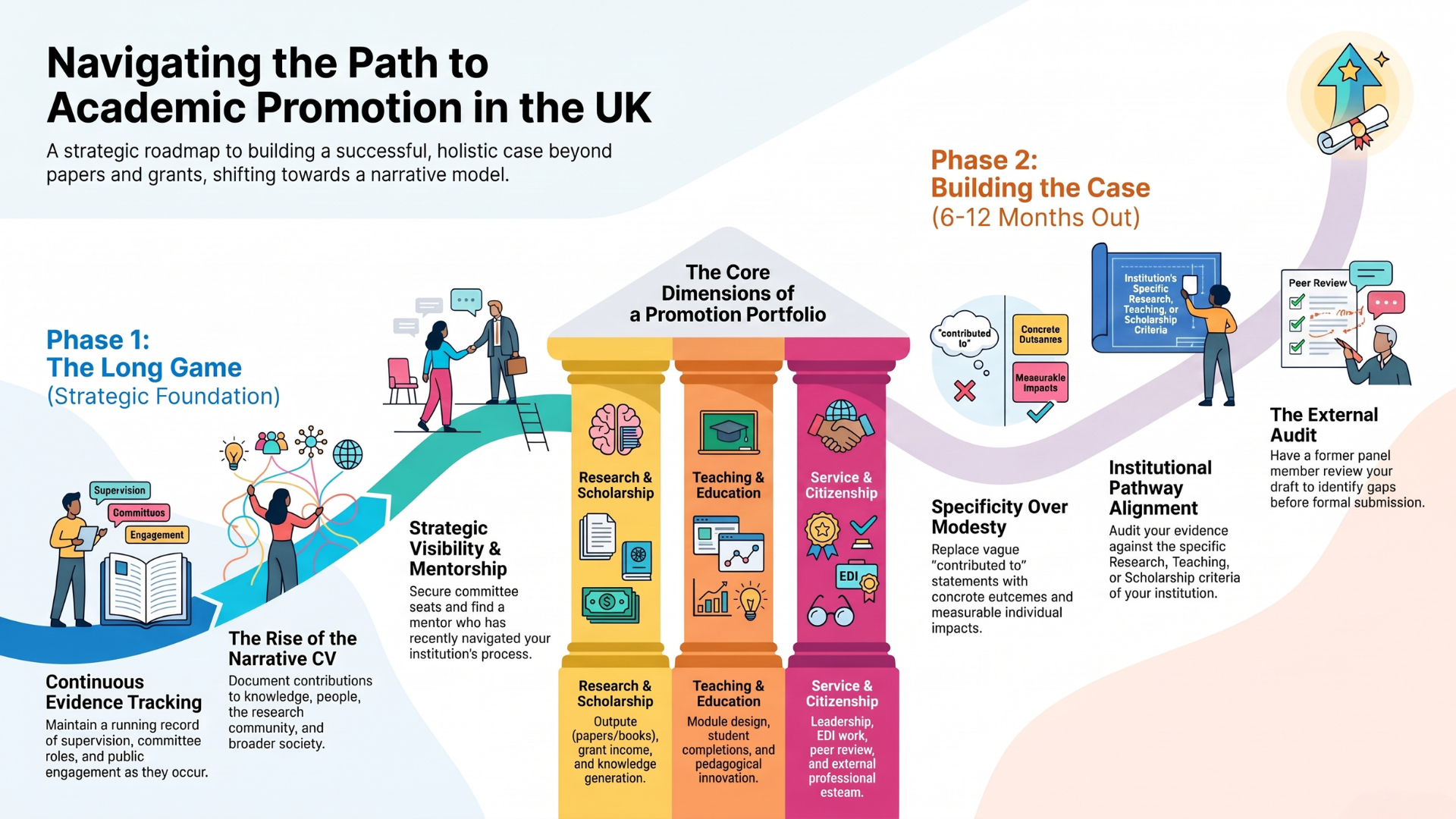
A strong promotion case is built over years, not during the final few weeks before the deadline.
Academic Promotion Criteria & What panels are actually looking for
Find your own institution's framework document and read it properly. It will likely sort you into a pathway (Research, Teaching and Research, or Teaching and Scholarship, sometimes called Education-focused), scored on research or scholarship, teaching, and "service" or "citizenship," things like departmental contribution, leadership, and external esteem. Strength in one or two of those areas, and not thin coverage everywhere, is what actually makes a case.
How this plays out in practice
Glasgow's framework is a good illustration of how granular this gets. To move from Senior Lecturer to Reader, on the Research and Teaching pathway, you don't just need to satisfy the Senior Lecturer criteria. You need to meet three specific criteria from a defined set covering outputs, impact and other dimensions, and demonstrate that you've met the bar for either outputs or impact specifically. UCL's framework explicitly recognises "the plurality of academic careers," inviting candidates to build a case from a range of activities across academic and university life rather than a single template. Cardiff's procedure spans everyone from Teaching and Research staff to clinical academics and Research Fellows. It builds in adjustments for people whose roles don't map neatly onto a standard case.
The practical takeaway: read your own institution's framework as if it were a job spec, not background reading. If your university runs promotion workshops, make sure you attend those too. When doing this, note which dimensions are compulsory, which can be traded off against each other, and where the panel is explicitly told it can discount an area if you've had a clear reason to focus elsewhere (parental leave, a heavy admin role, a secondment). Most people apply having skimmed the framework once, years ago. Reading it properly, right before you build your case, is one of the simplest things you can do that most people don't bother with. You should also review the criteria on a regular basis, as they can change from one year to the next.
It's not just papers and grants
This is where the sector is actively shifting, even if practice hasn't fully caught up with policy everywhere. The narrative CV is deliberately displacing the traditional academic CV, a publication list and a grant total and not much else. The Royal Society developed it, known nationally as the Résumé for Research and Innovation (R4RI), and UKRI, Wellcome and NIHR have adopted it for funding decisions. It asks you to describe your contribution across four areas: generating knowledge, developing other people, contributions to the wider research community, and contributions to broader society. Several universities are now piloting the same structure for promotion cases, not just grant applications. The process of building your narrative CV can be useful when it comes to thinking of the elements you might want to include in your case for promotion.
Supervision counts now. So does mentoring, giving talks, reviewing for journals, running training, public engagement. None of that used to show up on a case built purely on papers and grants. It does now, at least on paper. Outputs and income still anchor a research pathway case, but check your framework if you've been ignoring the rest of it, because panels are increasingly told to look for it.

Modern promotion frameworks increasingly recognise contributions to people, research culture and society alongside traditional outputs.
Does this look different if you're clinical, lab-based, or qualitative?
Our readers span all three, and the answer is yes.
If you're a clinical academic
Your case sits on top of a joint appointment between a university and an NHS trust. The Follett Principles govern it, treating your clinical and academic duties as one integrated role rather than two separate jobs. Promotion frameworks scale expectations to your actual academic time, not a full-time researcher's workload. Cardiff, for instance, adjusts the volume of outputs for sessional clinical commitments and wants clinical practice translated into academic contribution, not measured against a full-time researcher. Get both your university and your clinical line manager involved in building the case, and give the panel an actual number for your fractional academic time. Don't make them guess it.
If you're lab-based or working with quantitative methods
Panels largely built the standard promotions framework with you in mind. Papers, grant income and citation-based esteem indicators map fairly directly onto what panels ask for. That's precisely why the "it's not just papers and grants" shift above matters even for you: supervision and service still need deliberate documentation, because they're easy to under-report when your outputs already look strong on paper.
If you do qualitative or social science work
Panels didn't build the assessment system with your outputs in mind. A 2022 study of REF2021-submitted articles found something blunt: papers using words like "interview" or "qualitative" scored lower on average across several subject panels, regardless of the actual quality of the work. Earlier research backs this up. Interviews and case studies get cited less than quantitative papers no matter how good they are, and some assessors read qualitative findings as less generalisable just because of the method. Monographs face a different problem: there's no citation-count equivalent for a book, so evaluators fall back on publisher reputation instead.
Most frameworks say quality beats volume, which is true on paper. What that actually means for you: you'll need to spell out, in the application itself, why a single case study or a set of twelve interviews mattered, because a panel skimming a citation count won't see it the way they would for a paper cited two hundred times.
Do you actually want this?
Think carefully and pause on this one. If you are reading this article, you have probably already decided you want to apply for a promotion. However, we want to question the assumption that promotion is simply what "doing well" looks like.
Professor is not a universal endpoint. Some people want the title because it changes how they're treated on panels, by journals, by their own institution when it comes to resourcing. Others see it as the ultimate end point of their career, or just want the pay increase, which is substantial and hard to argue with, and tied, as with the job description work we've written about before, to formal grading structures rather than just goodwill.
But plenty of people stay at Senior Lecturer or Reader by choice, not because they failed to clear a bar. A chair usually means more meetings, more management, and less time actually doing the research or teaching that got you into this in the first place. If depth in the lab, the clinic, or the classroom is what you actually value, a role that pulls you away from it isn't a promotion in any sense beyond the title and the pay rise. Before you apply, you should consider how your work will change beyond the job title.
Consider this question before you build a case: are you doing this because it reflects work you've already done and want recognised, or because you feel you're supposed to want it? Both are fine answers. Only one of them means you should actually go through the process this year.
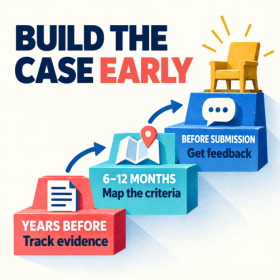
A strong promotion case is built over years, not during the final few weeks before the deadline.
The long game: what to be doing years before you apply
You don't usually build a promotion case in the six months before a deadline. You build it, or don't, over years, mostly through decisions that don't feel like "promotion strategy" at the time. There will always be exceptions: Dr Connor Richardson's honest account of applying, getting turned down, and going again a year later is a good reminder that some people only start thinking seriously about promotion once a colleague does it first, and still get there.
Track everything as you go, not retrospectively
Keep a running record of supervision (formal and informal), talks and invited seminars, peer review activity, committee and panel membership, public engagement, and teaching innovations. Note anything that changed as a result of your work too: a policy influenced, a practice changed, a colleague's career you helped move forward. Two years out, you will not remember the details well enough to write a convincing case. This is boring advice, and almost nobody does it consistently. That's exactly why it pays off.
Get visible in ways that don't feel optional but often get treated as such
Presenting at conferences, sitting on grant panels, reviewing for journals, contributing to professional networks and learned societies, and getting involved in university life: these build the "wider research community" and "external esteem" evidence that panels explicitly look for, and they're the first things to get dropped when you're busy. If you're at capacity, protect a minimum viable amount of this rather than cutting it entirely. Our Make Your Mark podcast on elevating your academic visibility goes into this in more depth.
Supervise deliberately, and keep evidence of outcomes
Panels want to see not just that you supervised students, but what happened to them: completions, their subsequent careers, cases where you clearly developed someone's independence as a researcher. This is precisely the kind of contribution narrative CV frameworks are built to capture, so don't let it live only in your memory. Dr Kamar Ameen-Ali's blog on supervision versus mentorship and Dr Yvonne Couch's on supervising PhD students are both good reads if you're building this side of your case.
Have the conversation early, more than once
Tell your line manager or head of department that promotion is something you're working towards, well before you intend to apply. This does two things. It puts you on their radar for opportunities, a committee seat, or a chance to lead a module that builds your case. And it means the eventual conversation about "are you ready" isn't happening cold. Most frameworks explicitly build in a discussion with your line manager before you submit. Arriving at that conversation for the first time in the same cycle you want to apply puts you on the back foot.
Find a mentor or sponsor who has actually been through your institution's process
Ideally recently, since criteria and panel expectations shift. A good mentor will tell you honestly whether a case is strong, and help you calibrate against successful examples. This matters more than people expect: a good mentor also advocates for you in rooms you're not in.
The six to twelve months before you apply
This is where the long-game evidence gets turned into an actual case, and where most of the practical mistakes happen.
Read the current criteria again, properly, not from memory
Frameworks get revised. What was true when a colleague was promoted three years ago may not be true now.
Map your evidence against the dimensions before you write a word of narrative
Build a simple table: each required dimension down one side, your evidence against it on the other. Gaps will show up immediately, and a gap eight months out is fixable (a new committee role, a talk booked, a review commitment). A gap discovered in the week before submission isn't.
Write your own version before you ask anyone to co-write it
Handing a line manager a blank template and asking them to build the case for you is tempting. Panels notice the difference, though, between a case written in someone's own voice with specific detail behind it, and one that reads like generic praise written by committee, or something you asked AI to write for you. Write the first draft yourself. Bring people in to sharpen and challenge it afterwards.
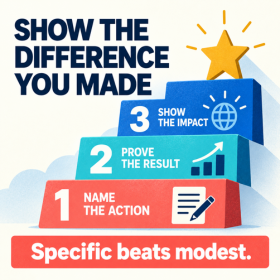
Strengthen your promotion case by explaining what you did, what changed and why it mattered.
Be specific, not modest
Modesty kills more applications than weak evidence does, and I know this is hard: we're used to being team players, so we tend to talk about "we" rather than "I." A colleague who redesigned an entire second-year module shouldn't be writing "contributed to teaching" on the form, because saying it plainly feels like showing off. It isn't. It's the difference between a panel seeing what actually happened and a panel seeing nothing at all. Some of this is imposter syndrome operating exactly as it always does, and it lands harder on women and on anyone from a background where self-promotion was never encouraged. If a line worries you, show it to a mentor before you cut it. Cutting it because it feels boastful is usually the actual mistake.
Use the narrative CV structure even if your institution hasn't formally adopted it for promotions
Organising your evidence around knowledge generation, developing others, contribution to the wider community, and broader impact is a genuinely useful way to notice what you've been undervaluing, even if you then translate it back into your institution's own template.
Get outside eyes on it before submission
Ideally someone who has sat on a promotions panel, not just someone sympathetic to you. A panel member's read on what's missing beats a friendly colleague's reassurance that it looks fine.
The admin
Meeting your academic promotion criteria is only half the job; the admin process around it varies by institution, but the shape is fairly consistent.
Timelines
Most universities run an annual cycle with a fixed submission window, often built around the academic year, and panels meet at faculty level first, then centrally. Build your case on the assumption that the deadline is real and immovable, because it usually is. There's rarely a mechanism for late submission just because you ran out of time.
Panels and process
A departmental or faculty panel sees the case first. Then it moves up to a college or university-level panel, people who've never met you and know you only from the paperwork. Professorial cases usually bring in external assessors at that second stage too. Newcastle, by contrast, decides the whole thing on the written application, no interview at all, proof that "the process" isn't one process. Check what yours actually involves rather than assuming.
Referees
Higher-level cases, especially Professorial ones, often require external references. Give people you're asking plenty of notice, and brief them properly. A vague request produces a vague, unhelpful reference. Tell them specifically what the case is arguing and what you'd like them to speak to.
If it doesn't work out
Missing out first time round happens to a lot of people, and it isn't a verdict on your ability, even though it still stings. Ask for feedback if a framework doesn't offer it automatically. Get it in writing. Use it on the next attempt rather than treating a no as the end of the road. Career uncertainty piling on top of a promotion knockback is its own problem, and we've covered that separately. If a panel genuinely got the process wrong, most universities have a formal route to challenge the decision, a different conversation entirely from ordinary disappointment, and one your union or staff rep can help with.
The bottom line
Promotion in UK academia is genuinely uneven and opaque in places. Approach it with your eyes open about both of those things. But "opaque" doesn't mean "unknowable." Read your own institution's academic promotion criteria properly. Start keeping evidence of your contribution years before you need it. Be honest with yourself about whether you actually want the role a promotion would give you, not just the title. And when you do build a case, be specific and be generous to yourself about what you've actually achieved, because nobody else is going to write that case for you.
If the promotion requires you to have supervised students, or to have won big grants, and neither is an option for you, talk to your line manager about what can be done about that.

My tip is to ask someone who has been through it successfully to share their documents with you, you may realise that something that you think isn't important really is!

Know your institution's criteria and self-audit against them in good time, using tools like Vitae to plan how to fill any gaps. Use internal systems like appraisal, and seek out mentors through schemes aimed at your specific circumstances, whether that's women, people returning after parental leave, or people from minoritised ethnic backgrounds. Don't rely only on white male mentors: however well-meaning, they often haven't had to navigate the same barriers, so they may not see the ones in your way. Write about your outputs and their impact, not just the activities you did in service of others. Have a rough sense of where you want to be in the short, medium and long term, so you know which opportunities to chase and which to turn down. And if you're knocked back, get feedback, make a plan, and go again.

Get as many people as possible to read your application and give feedback - you need to sell yourself in a way which can be uncomfortable but they can tell you where you are underselling yourself.

Talk to someone more senior who you know well and trust to give you their honest opinion on your cv. They may say too soon, or was wondering when you’d apply! They will give you good advice on presenting your cv well.
Make sure you clearly explain how you fit the published criteria. The committee need to see the fit clearly.
As I write this in 2026 University finances are under pressure and many are trying to to reduce salary costs and some freezing promotions and pay rises. Try not to take it too personally if you don't get promoted the first time, ask for feedback and clarity on your priorities to ensure you focus for next year. Then, say no to extra things to make time and space to aim to accomplish the things you really need to support your application.

Try to fight every urge to be remotely humble. Write as if you’re describing somebody else.
And don’t be disheartened if you get knocked back. The applications lay out a lot of criteria but in my experience come down to money in and funding you’ve brought in
Common questions about academic promotion
How does the academic promotions process work?
In outline: you build a case against your institution's published academic promotion criteria, discuss it with your line manager, then submit it within an annual window. It's assessed by a departmental or faculty panel first, then a university-level one, sometimes with external assessors for senior cases, before a decision comes back. See the admin section above for the detail on timelines, panels and referees.
What criteria do panels use to assess promotion applications?
Most UK academic promotion criteria assess you against several dimensions at once, typically research or scholarship, teaching, and service or "citizenship" (leadership, external esteem, departmental contribution), organised under a career pathway (Research; Teaching and Research; Teaching and Scholarship). You'll usually need to show strength across most dimensions, with particular strength in one or two. See what panels are actually looking for above for how this plays out at specific universities.
How do I know if I'm ready to apply?
Pull up the actual framework document and go through it line by line against your own case, not just the one or two things you already know you're good at. Solid coverage across most of the dimensions, with one genuinely excellent, makes a real application. One dazzling area and thin evidence everywhere else means that conversation with your line manager needs to happen now, not after the rejection letter.
How many papers do I need to have published?
There's no universal number, and be wary of anyone who tells you otherwise. A UK study of accounting and finance academics promoted to professor found an average of nine papers in established journals, five of them at the highest quality level, within a portfolio of around 20 outputs. That figure is discipline-specific, though, and won't transfer to lab science, humanities monographs or clinical research. Your own framework is the only number that matters; if it doesn't state one, ask your Dean or HR what recent successful cases looked like.
Do I need to have supervised PhD students to be promoted?
For Reader and Professor, usually yes: a sustained record of successful supervision is the most common single criterion across UK promotion frameworks. Worth knowing, though: a review of 70 universities' criteria found most frameworks reward the number of completions rather than the quality of supervision itself. A track record of students finishing on time counts for more in a case than glowing feedback from students who are still mid-PhD.
How many grants, or how much funding, do I need to have won?
Panels care more about independence and impact than the total figure. A £30k grant you ran solo, with a clear result to show for it, beats a £2m programme grant where you were fourth author on the bid. Put the smaller, cleaner grant first in your case, not last. If income generation is the weak point, tell your line manager months before you submit, not as a footnote in the application.
Is there an interview as part of the process?
It depends entirely on your institution. Some universities build a formal interview into the panel stage, particularly for Professorial cases; others, like Newcastle in Dr Connor Richardson's account, decide purely on the written application with no interview at all. Check your own framework rather than assuming either way, and if there is one, treat it like an external job interview: prepare specific examples, not just a recap of your application.
Do I need to become a professor, or is Senior Lecturer or Reader a legitimate place to stay?
Professor is one marker of seniority, not the only one, and it comes with trade-offs in what your day-to-day work looks like. Plenty of academics build excellent, sustainable careers at Senior Lecturer or Reader level by genuine choice.
What if my institution doesn't have a clear promotions framework, or I can't find it?
Ask HR or your department directly rather than assuming there isn't one; most universities publish one, even if it isn't easy to find on the intranet. If your institution truly has nothing formal, ask colleagues who've been promoted recently what they submitted, and push your line manager for specifics rather than accepting "just put in a strong case."
Can I apply for promotion without my line manager's support?
Most frameworks technically let you self-nominate, but a panel notices a missing or half-hearted line manager statement straight away, and it counts against you. Ask your line manager directly why they won't back you. Their answer tells you whether to go ahead anyway or fix something first.
What's a narrative CV, and do I need one for my promotion case?
The Royal Society developed this CV format, and UKRI, Wellcome and NIHR now use it. It asks you to describe your contribution across knowledge generation, developing others, the wider research community and broader society, rather than just listing papers and grants. Some universities now use it for promotion cases directly; even where yours doesn't, the structure is a solid way to notice contributions you'd otherwise leave out.
How can I demonstrate that my work has made a difference?
Be specific rather than modest, and back the claim with a concrete outcome rather than a description of the activity. "Contributed to teaching" shows nothing. "Redesigned the second-year methods module, which raised satisfaction scores from X to Y and has since been adopted by two other programmes" is a case. The same applies to supervision, policy influence or practice change: name what actually happened as a result, not just that you were involved.
Does teaching count as much as research towards promotion?
On a Research pathway, teaching still counts, but papers and grant income will carry more weight in the panel's actual scoring. Move to a Teaching and Scholarship pathway and that reverses: teaching is the main event. The framework document says which pathway applies to you. Read that section, not the general guidance.
What counts as academic leadership and citizenship?
More than most people assume: committee and panel membership, module or programme leadership, EDI work, mentoring colleagues (not just students), organising conferences or seminar series, and departmental or faculty leadership roles all typically count. UCL's framework explicitly treats institutional citizenship as one of its assessed dimensions. Several universities specifically tell their panels to allocate citizenship roles openly and fairly, rather than letting them fall to the same people by default. Who gets asked shapes who can build a case on it.
How many times can I apply if I'm unsuccessful?
There's no cap. Reapply once you've actually acted on the feedback, not by resubmitting the same case a year later with a new date on it.
What if I think my case was rejected unfairly?
Get the detailed feedback first, in writing. Most rejections come down to gaps in the evidence, not bias, however it feels at the time. If a panel visibly applied the criteria inconsistently, that's exactly what the formal appeal route is for. Talk to a union or staff rep before you file it.
Do I need external referees even for a Senior Lecturer application?
Not usually. Professorial cases bring in external references more often. Earlier-career promotions tend to rest on your own evidence and the panel's own judgement. Frameworks differ here, so check yours.
How long does the whole process take, from decision to outcome?
Submit in November, and you might not hear anything until July. That's the shape of most universities' single annual cycle: autumn or winter submission, a spring panel, confirmation over summer. A case built in the six weeks before the deadline is a case built too late.
Are promotion processes fair for part-time staff, clinical academics and people who have taken career breaks?
On paper, most frameworks build in real adjustments. York's principle judges part-time staff on the same quality but a proportionate quantity of output. It explicitly recognises they may have had less opportunity for academic citizenship. Cardiff and Aston both let applicants disclose personal circumstances, including career breaks and clinical sessional commitments. Doing so adjusts the volume of evidence expected, without lowering the quality bar. In practice, though, the fairness research cited earlier in this piece suggests policy and lived experience don't always match, so don't assume the adjustment will happen automatically. Disclose your circumstances clearly in the application and raise it directly with your line manager beforehand.
Will I get a pay rise?
Yes, usually, because promotion moves you up the national HE pay spine, the same grading structure the job description piece covers. Lecturer to Senior Lecturer is normally a clean jump to the bottom of the next grade, worth a few thousand pounds. Professor pay works differently: it's often negotiated one-to-one rather than fixed on the spine, and the range between institutions can run from the high sixties into six figures. Ask HR for the actual number on your grade before you apply. Don't guess.
This article is general information about the UK context and not legal or HR advice. Promotion frameworks, criteria and processes vary by institution and change over time, so check your own position with your line manager, your HR or People Services team, or your union. Checked against UK sources available in September 2026.



 Rebecca Williams