As someone with lived experience of service use, I care deeply about inclusivity and access, both at the clinical and research level. It was during an MSc lecture at UCL from Dr Tiffeny James on equity in dementia care that this crystallised into something more concrete. The lecture highlighted that older LGBTQ+ adults have unique risks and needs associated with dementia, for example, experiencing barriers to accessing dementia care or disclosing their sexual orientation or gender identity due to fear of discrimination: yet this community is often underrepresented in dementia research, policy, and practice.
There is minimal data on the prevalence of dementia within LGBTQ+ populations, but the ‘Bring Dementia Out‘ awareness project estimates that around 68,000 LGBTQ+ people may be living with dementia in the UK (Dementia UK, 2023). However, in a recent blog on Dementia Researcher, Dr Connor Richardson highlighted that existing studies have typically included white female participants, which tells us little about gay men or transgender people, or about any intersection with other protected characteristics such as race. He stressed the need to build research studies from the ground up that are actually designed to capture LGBTQ+ populations.
The more I learned, the clearer it became that there was an important gap in the evidence base. I knew I wanted my MSc thesis to explore the experiences of LGBTQ+ people living with dementia accessing care, and so I contacted Tiffeny who agreed to supervise me for my thesis, alongside Professor Naaheed Mukadam.
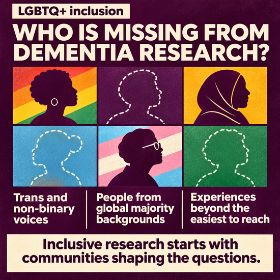
Research into LGBTQ+ dementia care must reach beyond the most accessible participants and involve underrepresented communities from the outset.
Recruitment challenges
Conducting research into equitable dementia care for LGBTQ+ people within the scope of an MSc project presented some barriers. I had initially hoped to speak directly with LGBTQ+ people living with dementia, but this required NHS Research Ethics Committee (REC) approval, a difficult challenge given the time constraints of the project. As such, I opted to speak with the family or friend carers of these individuals, a study which required university ethical approval instead.
I recruited family and friend carers through volunteer sampling, social media and word of mouth. I contacted a wide range of organisations supporting LGBTQ+ people, people with dementia, or both. In total, I reached out to upwards of 150 services and received responses from fewer than 20, some of which were unable to share my research. I largely encountered bounced-back automated emails from services that had closed down (including Opening Doors, the UK’s largest charity for older LGBTQ+ people, which closed in February 2024), or false participants responding to my adverts hoping to make a quick buck. Thankfully, some services did respond, and I was able to recruit three people to take part.
When I set out to interview people for the research, I hoped to capture a range of LGBTQ+ experiences. Once I looked at who had actually taken part, it became clear that the sample had gaps. There were no trans or non-binary voices or participants from global majority backgrounds. However inclusive our intentions, our findings couldn’t speak to those experiences.
I kept working on recruitment beyond the MSc, and even a year later had recruited only one more participant. That told us the problem wasn’t just a lack of time. It pointed to something deeper about how, and with whom, we were trying to do the research.
What can be learned from these challenges
We can’t repair our sample, but we can be open about its limitations and learn from them. The time constraints and remit of an MSc project made it hard to build the relationships and trust that reaching underrepresented groups takes. If people from underrepresented communities had helped shape our research questions, recruitment strategy, and study design from the start, perhaps we might have spotted our blind spots sooner and built the kind of trust a short-term project struggles to create.
The barriers we met in our study may actually mirror the barriers many people face in accessing care. A study about inequity that struggles with equitable recruitment is, in a sense, evidence of the problem it describes. Within an already underrepresented community, we encountered greater barriers involving trans, non-binary, and global majority participants. These are the groups whose experiences are least likely to shape the evidence base, and so least likely to shape the services built from it. When we only hear from people who are easy to reach, we end up with findings that quietly treat their experiences as universal.
Even a small sample can show us what is missing, raise questions that larger studies have overlooked and point towards what a more inclusive approach would need to look like. Yet low sample sizes are often exactly what stands between this kind of work and publication. Journals tend to favour larger samples, and small studies can be dismissed as unrepresentative. That standard makes sense for some research questions, but it can also penalise work with groups who are most underrepresented, often because of the same exclusion the research is trying to address.
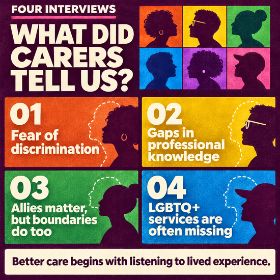
Four interviews with family and friend carers identified barriers to equitable dementia care, alongside the importance of knowledgeable, respectful healthcare professionals.
What were the findings?
Despite the limitations of our study, the interviews generated important and illuminating themes. We conducted semi-structured interviews with four family and friend carers of LGBTQ+ people living with dementia. Participants were three family carers who were partners of people living with dementia (two cisgender men, one cisgender woman; all identified as gay, White British, aged 65-74 years) and one friend carer (identified as cisgender male, heterosexual, Black British, aged 25-34 years). Interviews took place on Microsoft Teams and were analysed through reflexive thematic analysis.
While most participants in our study described equitable access to diagnosis, one family carer reported that their partner was initially misdiagnosed due to a perceived lack of professional knowledge about HIV-associated neurocognitive disorders.
Family carers described anticipated or previous experiences of discrimination as a barrier to accessing services, mirroring existing research. One family carer described experiences of microaggressions from a neurologist that they perceived as being due to their identity. They suspected that injections given to the person living with dementia were more painful than they should have been. This perceived homophobia led them to stop seeing that neurologist.
While allies within the healthcare system were described as a key facilitator of equitable care, the need for boundaries was also highlighted:
“She was absolutely lovely, but she was kind of overwhelmed that this was her first gay couple she’d ever encountered in her work […]. I don’t feel that it’s my job – as a carer in that crisis situation I was going through with my husband, to enlighten somebody about what it’s like to be a gay couple.”
– Family carer
Family carers also talked about a lack of LGBTQ+ specific services: either due to existing services being closed down; LGBTQ+ services never having existed in their area; or general services not understanding and meeting the needs of LGBTQ+ communities.
Conclusion
Although these findings are unlikely to appear in a peer-reviewed journal, we hope that by sharing them here, we can honour the participants’ experiences and contributions, while adding to the grey literature on equitable access to dementia care for LGBTQ+ people. These findings cannot fill the gaps in the evidence base on their own, but they can help make those gaps visible. If dementia services are to meet the needs of LGBTQ+ people living with dementia, we need research that not only includes these communities, but is designed with them, so that their experiences can begin to shape the evidence, policy and care intended to serve them.
With thanks to Dr Tiffeny James and Professor Naaheed Mukadam for their comments on revisions of this blog.

Simran Kainth
Author
Simran Kainth is an Assistant Psychologist working in the NHS. Her MSc dissertation at UCL explored the experiences of LGBTQ+ people living with dementia accessing care. Simran is passionate about health inequalities, barriers to healthcare and how lived experience can contribute to research and clinical practice, and hopes to become a Clinical Psychologist.

 Adam Smith




 Heather Wilkinson