 Ask ten people in dementia research how they got there and you’ll get ten different answers. People arrive from the lab, the clinic, social care, psychology, data science, the charity sector and plenty of other places. They take career breaks, change direction, go part-time, move between universities, the NHS and industry, and sometimes end up somewhere they never planned to be.
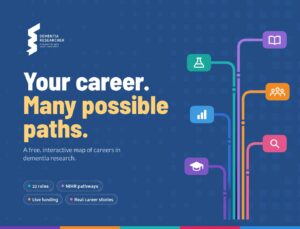
That’s the reality, but most careers advice still looks like a ladder. So we’ve built something different. Today we’re launching the Dementia Researcher Career Framework, a free, interactive map of careers in dementia research, bringing together roles, routes, funding and real career stories in one place.
What the Career Framework does
The framework has three views, and you can switch between them at any time.
Career pathways. At launch the map covers 22 roles across seven career stages, from an apprenticeship or undergraduate degree through to professor, director and research leadership. It includes the roles that often get left off careers charts: research assistants and technicians, clinical trials roles, lab and facility managers, research and technology specialists, and research careers in charities, funders and health services. Pick a role to see what it involves, where people tend to go next and the career stories linked to it. If you’re not sure where to start, use Find my current role to highlight where you are now, then explore what could come next. Select a stage heading to see the skills that matter at that point.
NIHR clinical research pathway. A separate map follows the NIHR Academy routes for doctors and dentists, health and care professionals, methodologists and local authority researchers. Select an award to see the details, along with any career stories from people who have held it. The map focuses on England, and we’ve flagged that Scotland, Wales and Northern Ireland run their own schemes.
Funding. This view is about funding to develop your career: studentships, fellowships, training awards, career transitions and support for returning to research. Live calls are pulled straight from our funding calls directory, so they stay up to date. Alongside them you’ll find schemes funders have supported in recent years, because a scheme that ran last year may well open again, and it helps to know it exists before it does.
Real careers, not just boxes
A map can show you the possible routes, but it can’t tell you what it’s like to take them. That’s why the framework is built around career stories from people working across dementia research. Look for the person icon on a role and you can read how someone got there, what helped and what they’d do differently.
The stories cover a wide range of people, from PhD students and research assistants to clinical academics, professors and people who have built research careers outside universities. You can read Anna Volkmer’s move from speech and language therapy into research, Joanne Bush on bringing social work into dementia research, David Whiteside on building a clinical academic career and Tamlyn Watermeyer on following curiosity. Many of the stories in the tool have a longer version on our website, and you’ll find them all under our career case studies.
Each role also links to live vacancies on the Dementia Researcher jobs board that match it, so if a route looks right for you, you can see who’s hiring now.
Who it’s for
The framework is for students, researchers and people moving into research, across laboratory science, clinical care, qualitative and social research, technology and research support. It’s useful if you’re:
- thinking about whether research is for you, and what your first step might be
- part way through a PhD or postdoc and wondering what comes next
- a clinician or health and care professional looking for a route into research
- considering a move out of academia, or back into it after a break
- supervising or mentoring others and want something to point them to
There’s no single right route. The arrows on the map show possible moves, not required steps.
Why we built it
Careers come up more than almost anything else when we talk to early career researchers. The questions are usually the same: what jobs are out there, what do I need to get there, who funds that stage, and has anyone done it the way I’m thinking of doing it? The answers exist, but they’re scattered across funder websites, university pages and word of mouth, and that tends to favour people who already know who to ask.
The framework builds on the interactive structure of an archived national career framework, which we’ve adapted and rebuilt for dementia research. The roles, stories and funding entries will keep being reviewed and added to as the tool grows.
Thank you
This wouldn’t exist without everyone who took the time to share their career story with us, and to read and approve their write-ups. Thank you. Thanks also to our funders, the National Institute for Health and Care Research (NIHR), Alzheimer’s Association, Alzheimer’s Research UK, Alzheimer’s Society and Race Against Dementia, and to UCL, which hosts Dementia Researcher.
Add your story
We want the framework to reflect the full range of people working in dementia research, so we’d love to hear from you. You can share your story from the button at the bottom of the tool, or go straight to the right form:
- NIHR route, if your career includes NIHR funding, training or support. We’re particularly keen to hear from people who have worked their way through the NIHR funding programmes.
- Non-NIHR route, if your career has followed another path into dementia research.
Tell us what you think
This is the first version, and we know it won’t be perfect. If something’s missing, wrong or confusing, or you’ve got an idea for what it should do next, please send us your feedback. And if you find it useful, please share it with your colleagues, students and networks. There are share buttons built into the tool to make that easy.
Common questions about the Career Framework
Click a question to see the answer.
Is the Career Framework free to use?
Yes. It’s free and open to everyone, and you don’t need to create an account or sign in.
Is it only for academic careers?
No. Alongside academic roles, it covers research assistants and technicians, clinical trials roles, lab and facility management, research and technology specialists, and research careers in charities, funders and health services.
Is it only relevant if I’m in the UK?
The career stories come from people working in the UK, and the NIHR pathway focuses on England. The career stages and roles will be familiar in many countries, and the funding view includes international schemes as well as UK ones. Always check a scheme’s eligibility on the funder’s own page.
How up to date is the funding information?
Live calls come straight from the Dementia Researcher funding directory, so they update as calls are added and close. The tool also shows schemes a funder has run in recent years that may open again. Deadlines and eligibility can change, so always check the funder’s page before you apply.
Does it work on my phone?
Yes. On a smaller screen the map changes to a list you can scroll through, with the same roles, stories and funding. It works best on a laptop or desktop, though, where you can see the whole map and follow the routes between roles.
How can I add my career story?
Use the “Share your career story” button at the bottom of the tool, or the links in the section above. We write up each story and send it back to you to approve before anything is published.
Best on a laptop or desktop. The career map is big, with lots of routes to follow, so it’s easiest to explore on a larger screen. It works on phones and tablets too, where the map becomes a list you can scroll through, but you’ll get the most out of it on a computer.
Working or studying in dementia research? Share your career story and help someone else find their way.





 NIHR
 LSE Impact Blog
 Nature Careers Blog