 Print This Post
 Hundreds of research papers have shown that AI can read brain scans to help diagnose and predict dementia, yet very few of these tools are being used in memory clinics. A new expert consensus from the DEMON Network sets out what needs to change, with eight agreed statements covering what the tools are for, how they should be tested, how clinicians should be brought on board, and how patient data should be protected.
The study, called Neuro-AIM, was published in npj Digital Medicine on 14 October and is open access. It was led by joint first authors Dr Natasha Clarke (Université de Montréal) and Mathias Huybrechts (University of Antwerp), and jointly supervised by Dr Timothy Rittman (University of Cambridge) and Dr Rose Bruffaerts (University of Antwerp). The work was coordinated by the network’s Imaging Working Group, and the author list includes Dr Jay Amin (University of Southampton) and Professor David Llewellyn (University of Exeter).
Lots of research, little use
The case for AI in memory clinics is easy to make. The authors note that around three-quarters of dementia cases worldwide are never diagnosed, rising to 90% in low- and middle-income countries, and that disease-modifying therapies could add a heavy load of screening and monitoring to already stretched services. MRI is used routinely in dementia diagnosis, and AI tools that read it have shown real promise in research. But promising results in research cohorts have not turned into widespread clinical use.
Part of the problem, the team argues, is that nobody has written down what a good tool for this setting looks like. Their own search found 18 published guidelines and 12 policy or legal frameworks on AI in healthcare. Five applied to neuroimaging, and none was written for the specific needs of memory clinics.
How the consensus was reached
The team used a Delphi process, where experts answer several rounds of anonymous questionnaires and see the group’s views between rounds, so nobody is swayed by the loudest voice in the room. The panel had 16 voting members: six clinicians in neurology, neuroradiology and old age psychiatry, six academic researchers in neurology and AI neuroimaging, and four people from industry. A two-person independent committee ran the process, and a patient and public involvement representative helped shape the questions. Fourteen panel members completed all three rounds.
Agreement above 70% counted as strong consensus and 50–69% as moderate. Six of the eight final statements reached strong consensus and two reached moderate consensus.
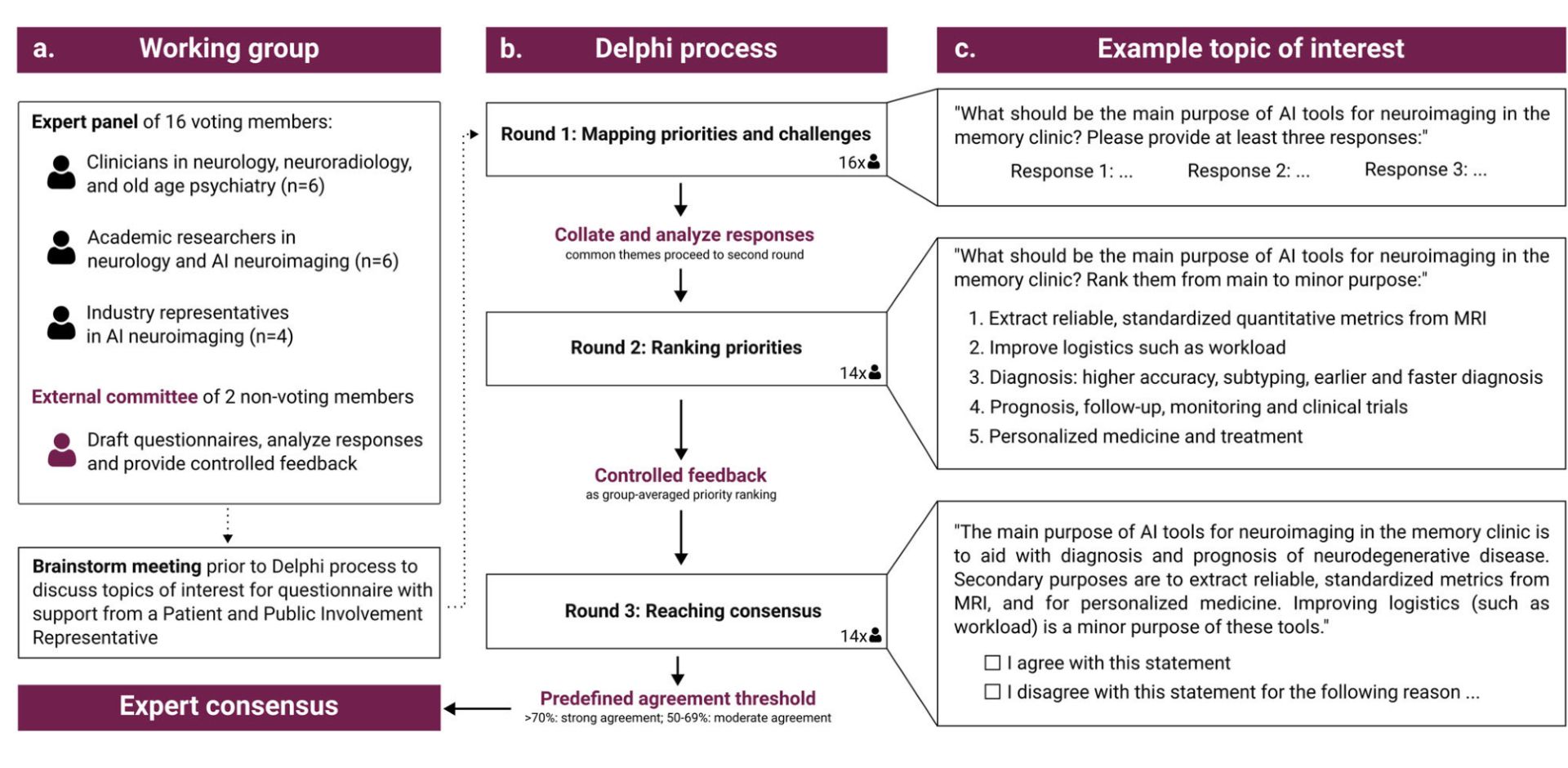
The three-round Delphi process behind the Neuro-AIM consensus. Fig. 2 from Clarke, Huybrechts et al., npj Digital Medicine (2026), reproduced under a CC BY 4.0 licence.
What the experts agreed
Purpose. The main job of these tools is to help with diagnosis and prognosis (85.71% agreement). Extracting reliable, standardised measures from MRI and supporting personalised medicine came next, while easing clinician workload was ranked a lower priority. The biggest barriers were performance at the level of the individual patient and whether a tool still works on real-world data from different scanners and sites (71.43%). A lack of uniform evaluation metrics was the smallest barrier.
Quality. Training and validation data must come from completely separate cohorts and be diverse and representative (78.57%). Size and quality matter, but slightly less. The panel was pragmatic about ground truth. Only 7% thought autopsy-confirmed diagnoses should be required, because that would limit tools to small, unrepresentative datasets. On how to judge a model, the panel moderately agreed (57.14%) that sensitivity, area under the curve and specificity matter most, with accuracy at the bottom of the list because it can be misleading when groups are unbalanced.
Clinicians and clinics. The highest agreement of the study, 92.86%, was on training. Clinicians need to understand a tool’s limitations, what it is meant to be used for and how to interpret its outputs, more than the theory behind it. Building clinicians’ trust was seen as the factor with the biggest impact on adoption (78.57%), with dementia clinicians, AI experts, imaging analysts and radiologists all involved early in design. Hospitals will also need computing infrastructure and staff to run and maintain the tools.
Privacy and ethics. Sharing patient data with third parties and the risk of data leaks or attacks topped the privacy concerns (85.71%). Re-identification is a real issue for brain MRI, because structural scans capture facial features. The authors point to federated learning, where models are trained at each site without pooling the data, as one route forward. On ethics, the panel moderately agreed (64.29%) that the lack of proven added value in clinic and the cost of misclassification are the biggest concerns. That worry is backed up by a recent review cited in the paper, which found published clinical validation evidence for only four of 17 regulatory-approved MRI volumetric tools.
The panel was split on consent. Just over half (57%) thought patients should give informed consent before an AI tool is used on their scan, while the rest felt it was not needed as long as the tool meets regulations and a clinician makes the decision.
Why it matters
The panel was clear that these tools should support clinical judgement, not replace it, and warned that relying on AI could erode clinicians’ own skills. The statements give developers, memory clinics and funders a shared checklist, and early career researchers building AI models get a clear message: diverse, independent validation data and real-world testing count for more than headline accuracy on a single research cohort.
Limitations
The panel came entirely from Europe (13) and North America (3), despite an international call, and most worked in academic settings. The authors say the results may not transfer directly to resource-limited settings or low- and middle-income countries, where MRI scanners, trained staff and fast internet are scarcer. People with lived experience of dementia helped design the questionnaires and write the paper but did not vote. Four panel members came from industry, and several authors declare links with AI and pharmaceutical companies.
The DEMON Network is funded by Alzheimer’s Research UK, and the study was also supported by the NIHR Cambridge Biomedical Research Centre.
Clarke, N., Huybrechts, M., Amin, J. et al. From research to clinical practice: Expert consensus on Neuroimaging AI tools for the Memory clinic (Neuro-AIM). npj Digital Medicine (2026). https://doi.org/10.1038/s41746-026-03296-9 (open access).




 Dr Chloe Fawns-Ritchie


 Dr Yvonne Couch