
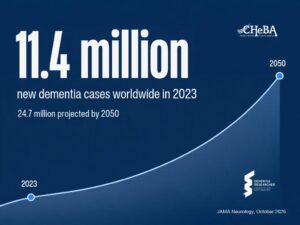
 Most global dementia figures describe how many people are living with the condition. A new meta-analysis in JAMA Neurology counts something harder to measure and more useful for planning: how many people develop it each year. The answer for 2023 is 11.4 million new cases worldwide, rising to a projected 24.7 million a year by 2050. They are not evenly spread. Incidence is higher in women than in men, and higher in low- and middle-income countries than in high-income ones.
The study was published online on 12 October and comes from the Cohort Studies of Memory in an International Consortium (COSMIC), coordinated by the Centre for Healthy Brain Ageing (CHeBA) at UNSW Sydney. The lead author is Dr Ashleigh Vella, a post-doctoral research fellow at CHeBA, with Scientia Professor Perminder Sachdev as senior author. Scientia Professor Henry Brodaty is among more than forty co-authors drawn from the contributing cohorts.
What they did
The team pooled individual participant data from 22 longitudinal population-based cohorts covering 18 countries or territories across six continents. After exclusions, 38,418 adults aged 60 and over, all free of dementia at baseline, went into the analysis. Baseline recruitment ran from January 1990 to December 2011, follow-up data were collected to the end of 2021, and the analysis itself was done between June 2024 and June 2025.
Every contributing cohort diagnosed dementia clinically rather than by self-report or registry code: seventeen used a consensus panel of physicians, three a single physician, and two an algorithm applied to a neuropsychological battery against clinical criteria. Eighteen used DSM-IV, three DSM-III-R and one ICD-10.
Across 287,632 person-years at risk, 3,001 participants developed dementia. Rates were calculated with Poisson models carrying inverse-probability censoring weights to handle drop-out, then pooled in a two-step meta-analysis and standardised to the 2023 global age and sex structure.
That last point is what separates this from the figures most people quote. Global Burden of Disease estimates largely model prevalence and infer incidence from it, which folds in mortality and how long people live with the condition. This study measured new cases directly, in cohorts, using a single analytic pipeline.
What they found
The age- and sex-standardised global incidence was 9.7 new cases per 1,000 person-years at risk (95% CI 7.89 to 11.97). Applied to the 2023 population, that is roughly 11.4 million new cases of dementia in a single year.
Women had a standardised rate of 10.6 per 1,000 person-years (95% CI 8.61 to 13.11) against 8.6 for men (6.94 to 10.72), a significant difference (P < .001). There is a nuance here that is easy to lose: in the crude rates, the sex difference disappeared (20.9 in women, 18.8 in men, P = .65). The gap emerges once the age structure is standardised, which is the point the authors make about longevity not being the whole story.
Low- and middle-income countries had a standardised rate of 13.6 per 1,000 person-years (9.67 to 19.24) against 8.3 in high-income countries (6.57 to 10.54), P = .02. Again the crude rates were similar, so the difference is in how the age structures compare.
By world region the standardised rates were 13.1 for Latin America, 13.0 for Asia, 9.9 for North America, 9.1 for Africa, 8.3 for Europe and 7.6 for Oceania. None of the differences between regions reached significance, and the authors are firm that these are cohort-derived figures, not representative national or continental estimates.
Standardising to the projected 2050 age and sex structure gives 11.7 per 1,000 person-years, or about 24.7 million new cases a year. Sensitivity analyses shifting age- and sex-specific rates by 10% and 20% in either direction put the range at roughly 22.2 to 29.6 million.
Heterogeneity was high (I² = 90.4%) and almost entirely at study level rather than country level.
Why women, and why poorer countries
The paper does not answer this, and says so. It offers candidates. For the sex difference: Alzheimer’s disease is more frequent in women, and the authors point to disproportionate educational and occupational opportunity, sex-specific factors such as early menopause and oestrogen exposure, and cardiometabolic factors including body mass index and physical activity.
For the income gradient: lower educational attainment in low- and middle-income countries, and diverging risk-factor trends. Smoking, cholesterol and blood pressure have fallen in many high-income countries while obesity, hypertension, cardiovascular disease and stroke have risen in some low- and middle-income ones.
One exploratory finding supports this. The association between lower education and higher dementia incidence was significantly stronger in low- and middle-income cohorts than in high-income ones (interaction rate ratio 1.65, 95% CI 1.23 to 2.53, P = .001). The authors flag it as exploratory, given how differently education systems harmonise across countries.
In the UNSW release, Dr Vella summed it up: “What stands out is that dementia incidence is not evenly distributed.” Professor Sachdev added that the findings “highlight the urgent need to strengthen dementia risk reduction and health-care capacity globally”, and Professor Brodaty that “population ageing means we cannot simply wait for people to develop dementia and then respond”.
What this is useful for
An incidence benchmark does a different job from a prevalence headline. Prevalence tells you how many people need support at a given moment. Incidence tells you the rate at which new cases arrive, which is what diagnostic pathways, memory clinic capacity, screening programmes and trial recruitment pipelines actually have to absorb. If you are costing a service model, arguing for diagnostic capacity, or writing the background to a fellowship application, this gives you a directly measured figure with confidence intervals attached rather than one derived from a model.
There is also a research-capacity argument sitting in the methods section. Six of the 22 cohorts came from low- and middle-income countries, and the Middle East is absent altogether. The regions where population ageing is fastest are the ones with the thinnest longitudinal data, and the paper puts numbers behind that case. Anyone building a grant around cohort infrastructure in an under-represented setting now has a citable gap.
It also sits usefully alongside the World Alzheimer Report 2026, which looked at where clinical trials are and are not happening. The two gaps are much the same gap.
Limitations

Dr Ashleigh Vella
The cohorts were recruited between 1990 and 2011, but the results are framed as 2023 estimates with 2050 projections. The projections assume age- and sex-specific incidence stays constant, so they describe demographic ageing rather than any change in underlying risk, in either direction. Sensitivity analyses comparing early and late cohorts found no significant difference, but that assumption is doing real work.
Geographic coverage is still patchy. There are no Middle Eastern cohorts, and few from Africa, Latin America and Oceania. Most country-level figures rest on a single cohort and are not nationally representative. Cohorts of this kind also tend to under-represent people living in institutions, people of lower socioeconomic status, and some ethnic and rural populations, so country rates may be study-specific rather than national.
Diagnostic criteria varied, and the clinical thresholds behind a dementia diagnosis do not translate identically across languages, literacy levels and cultural expectations of daily functioning. Some of the variation between cohorts may be measurement rather than real difference. Heterogeneity was high, and country income classifications are not static, which complicates the income-stratified projections to 2050.
The research was supported by the US National Institute on Aging (award R01AG057531), alongside the many national funders of the contributing cohorts. Several authors declare research grants or personal fees from pharmaceutical companies; the full disclosure list is in the paper.
Vella, A.S., Visontay, R., Lipnicki, D.M. et al. Global Incidence of All-Cause Dementia: A Meta-Analysis. JAMA Neurology (2026). https://doi.org/10.1001/jamaneurol.2026.3540 (subscription). UNSW Sydney news release: Global dementia study reveals 11.4 million new cases in 2023.






 Dr Connor Richardson




 Alzheimer's Association



 NIHR