
 Print This Post
I play amateur rugby. Not well, and not often enough to stop my back complaining the morning after, but I play. I also spend my working life doing dementia epidemiology. So every time a new paper lands linking my sport to neurodegenerative disease, I end up reading it twice. Once as a researcher pulling the methods apart. Once as the player who got cleared out at a ruck on Saturday and wondered whether that was a problem.
You will have seen the headlines. Former players twice as likely to develop dementia. Fifteen times the risk of motor neurone disease. Brains of ex-internationals full of a pathology first described in boxers. Read only that and you would never set foot on a pitch again.
But headlines are not evidence. The actual evidence is messier, more interesting and more useful than the coverage suggests. So does rugby cause dementia? Let me walk you through it.
Why this is so difficult to study
Start with the fundamental problem. Dementia appears decades after whatever caused it. A man playing first-class rugby in his twenties in 1975 will not be diagnosed until his seventies, if at all. And you obviously cannot randomise teenagers to a lifetime of head impacts. So everything we have is observational, and observational dementia research carries real risks of bias and confounding. Hold onto that; it matters later.

Who was studied matters. Connor Richardson explains why findings from elite rugby players cannot simply be applied to occasional amateurs. Limited evidence does not establish an absence of risk.
What the major studies on rugby and dementia found
The strongest evidence comes from studies linking historical playing records to national health data. Whole populations rather than volunteers, which gives them external validity that smaller convenience samples never achieve.
The landmark rugby paper came from Professor Willie Stewart‘s group in Glasgow in 2022. They followed 412 former Scottish internationals against 1,236 matched men from the general population for a median of 32 years. The hazard ratio for neurodegenerative disease was 2.67, with a confidence interval of 1.67 to 4.27. That is the source of the doubled dementia risk and the striking fifteenfold motor neurone disease figure.
Last year New Zealand published something considerably larger. Nearly 13,000 men who played provincial level or above between 1950 and 2000, compared against 2.4 million who did not. Their answer was a 22 percent higher risk. Hazard ratio 1.22, with a tight interval of 1.14 to 1.30, strongest for Alzheimer’s disease at 1.61. Nothing significant for Parkinson’s disease or motor neurone disease. And the raised risk only emerged once players reached their seventies. Provincial players, many of them amateurs, carried a raised risk too, though a smaller one than those who played at international level.
So one study reports a near tripling and the other reports a rise of roughly a fifth. Both are well conducted. Both are real. That gap is essentially the whole story, and I will return to it.
Football tells a similar tale. The FIELD study in 2019 found former professionals were around three and a half times more likely to die of neurodegenerative disease.
Reading this as an epidemiologist
Three things give me pause.
The first is how cases are counted. Every one of these studies depends on dementia appearing on a death certificate, a hospital record or a prescription. We have known for decades that neurodegenerative disease is badly under-recorded on death certificates. If high-profile former internationals are more likely to be investigated, diagnosed and correctly coded than an ordinary member of the public, you can generate an association out of surveillance alone. None of these studies can fully exclude that.
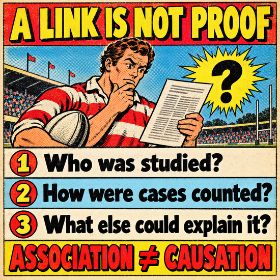
An association deserves attention, but interpreting it means asking how the study was done. Connor Richardson considers who was included, how diagnoses were recorded and what other factors could influence the findings.
The second is my favourite part of the story, because it runs counter to intuition. Both the Scottish rugby and the footballer cohorts showed lower all-cause mortality up to around age 70. Elite athletes are fit. They are not dying of the cardiovascular disease and cancers that kill the rest of the population. But you have to be alive at 75 to be diagnosed with dementia at 75. So some of what looks like elevated dementia risk may simply reflect these men surviving long enough to reach the age when dementia occurs, while their less fit peers died of something else first. Competing risks do not explain away the whole signal, but any honest reading has to account for them.
The third is the point that actually reassures me. Relative risk is not absolute risk. A hazard ratio of 2.67 sounds alarming, but the Glasgow study rested on 47 cases among players against 67 in the comparison group. Small numbers produce unstable estimates, which is precisely why a study with thirty times as many players found a far more modest effect. The New Zealand figures put it plainly. In all, 6.5 percent of players developed a neurodegenerative disease compared with 5.2 percent of the general population. A genuine difference, but not the catastrophe the headlines imply.
What about the rest of us?
This is the question I actually care about, and the honest answer is that almost none of this research is about players like me. Every strong study recruited internationals, professionals or first-class players, men with twenty-year careers of elite-level collisions. The exposure that matters is cumulative head impact, and a club player’s lifetime dose is a fraction of a Test forward’s.
When researchers have looked specifically at amateurs, the picture softens considerably. A large systematic review in 2023 found no convincing evidence of increased neurological risk in former amateur athletes, and noted that many of the professional studies suggesting harm were poorly controlled and at high risk of bias. The autopsy work points the same way, with CTE risk climbing with each additional year of playing career. Less exposure, less risk.
So, does rugby cause dementia?
Holding two true things at once, which is where epidemiologists usually end up. Elite, career-long participation in collision sport does appear to raise dementia risk, and the dose-response relationship makes that difficult to dismiss. But the absolute risk is moderate, the studies have real methodological weaknesses, and the evidence for occasional amateur players is thin to absent.
I am not giving up the game. What I am doing is taking seriously the measures that reduce exposure for everyone. Less contact in training. Proper concussion management rather than returning players too early. The tackle height changes the community game is already trialling. None of it costs us much, and it targets the one exposure we can genuinely modify.
Rugby has given me a great deal more than a sore back. I will keep playing. I will also keep reading the papers twice.

Dr Connor Richardson
Author
Dr Connor Richardson is a Neuro-epidemiology Research Associate at The University of Edinburgh. His research interests lie in using advanced statistical modelling and machine learning to measure dementia risk. Connor blogs about his research, Equality, Diversity and Inclusion and sometimes his Pomapoos.


 Dementia Researcher
 Dr Connor Richardson
 Professor Louise Serpell
 Alzheimer's Association


 DEMON Network