
 Print This Post
The FDA clearance in August 2026 of Roche’s Elecsys pTau217 blood test, developed in collaboration with Eli Lilly, has been widely discussed as a major milestone for Alzheimer’s disease diagnosis. Designed to support the assessment of amyloid pathology in people aged 55 years and older with symptoms of cognitive decline, the test provides clinicians with a blood-based tool that can help determine whether Alzheimer’s-related brain changes are likely or unlikely to be present. Importantly, it is not intended to be a stand-alone diagnostic test but rather part of a broader clinical assessment pathway.
For healthcare systems, the implications relate to future diagnostic pathways, service redesign and access to emerging disease-modifying treatments. For early career researchers (ECRs), however, the implications may be even more profound. The clearance of pTau217 represents a signal that blood-based biomarkers are moving from the research environment into routine clinical practice. As this transition occurs, it has the potential to reshape research priorities, study design, recruitment strategies, funding expectations and career development opportunities across dementia research.
A Field in Transition
For many years, Alzheimer’s disease research has been organised around a relatively small number of biomarker approaches. Amyloid PET imaging and cerebrospinal fluid (CSF) analysis have become central tools for identifying the biological changes associated with Alzheimer’s disease and for defining study populations.
These technologies transformed research by allowing investigators to move beyond symptom-based diagnoses and towards biologically defined disease states. However, they also introduced significant challenges. PET imaging is expensive, specialist equipment is not universally available, and large-scale imaging studies require substantial infrastructure. CSF testing, while highly informative, involves lumbar puncture procedures that some participants may find burdensome or unacceptable.
As a result, recruitment into biomarker-defined studies has often been slow, costly and concentrated within specialist research centres. This has influenced not only which studies could be undertaken, but also who was able to participate in them.
The emergence of blood-based biomarkers raises the possibility of changing this model fundamentally. The FDA clearance of pTau217 reflects growing evidence that blood measurements can provide clinically meaningful information about underlying Alzheimer’s pathology, with high agreement reported against established measures such as amyloid PET.
For ECRs entering the field today, it is therefore important to recognise that research conducted over the next decade may look very different from research conducted over the previous one.
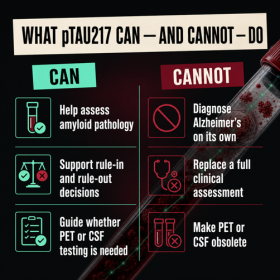
The pTau217 blood test can support assessment and guide further testing, but it is not a stand-alone diagnostic tool and does not replace clinical evaluation, PET or CSF.
Recruitment May Never Be the Same Again
One of the most immediate implications concerns participant recruitment.
Historically, many Alzheimer’s studies have employed a recruitment pathway that involved screening large numbers of individuals before identifying a relatively small number with confirmed amyloid pathology. Often this required PET imaging or CSF testing for substantial numbers of participants, creating significant financial and logistical burdens.
Blood biomarkers offer a potentially more efficient alternative.
Researchers may increasingly use pTau217 testing as a first-line screening tool to identify individuals who are likely to be amyloid positive before moving to confirmatory investigations. Rather than replacing PET imaging, blood biomarkers may allow researchers to target PET more effectively.
This has important implications for grant applications and study feasibility. Funding panels are increasingly interested in deliverability, recruitment performance and value for money. Protocols that can demonstrate efficient screening approaches may become more competitive, particularly for large-scale cohort studies and clinical trials.
Studying Disease Earlier Than Ever Before
A second important implication relates to the study of preclinical and prodromal disease.
One of the most challenging aspects of Alzheimer’s research has been identifying people before substantial cognitive decline occurs. Amyloid accumulation may begin many years before symptoms become clinically apparent, yet identifying such individuals has traditionally required expensive imaging programmes and significant research infrastructure.
Scalable blood biomarkers may help address this challenge.
As testing becomes more accessible, researchers may be able to identify biologically defined at-risk populations earlier and at greater scale. This has important implications for prevention research, risk-reduction studies and investigations into the earliest phases of disease development.
For ECRs, this opens opportunities to ask questions that were previously difficult to address:
- How early can biological changes be detected?
- Which factors influence progression from biomarker positivity to symptoms?
- Can interventions alter disease trajectories?
- How should information about biomarker status be communicated to individuals?
As treatment strategies move towards earlier intervention, these questions are likely to become increasingly significant.
Population Research Could Expand Dramatically
Blood biomarkers may also transform population-level dementia research.
Historically, biomarker studies have often involved selected populations recruited from specialist centres. The practical realities of PET scanning have made it difficult to conduct biomarker-driven studies at scale across broad populations.
A blood test changes that equation.
Researchers may increasingly be able to incorporate biomarker assessment into:
- Longitudinal ageing studies
- Population health research
- Primary care cohorts
- Community-based studies
- Rural and remote research programmes
For countries such as Scotland, with strong traditions of population-based research and data linkage, this may present substantial opportunities. Blood biomarker information could potentially be combined with longitudinal health records, demographic data and outcome measures in ways that were previously impractical.
The result may be a shift away from highly selected research cohorts towards studies that better reflect the populations encountered in routine clinical practice.
Clinical Trials Are Likely to Evolve
The development of disease-modifying Alzheimer’s therapies has increased the importance of confirming underlying pathology before treatment.
Consequently, identifying eligible participants has become an increasingly costly component of clinical trial delivery.
Blood biomarkers offer the prospect of streamlining this process. The FDA-cleared pTau217 assay supports both rule-in and rule-out assessment of amyloid pathology, providing positive, negative and intermediate result categories to inform further investigation.
Future trials may increasingly adopt a staged approach:
- Blood biomarker screening
- Confirmatory PET or CSF testing
- Enrolment into therapeutic studies
This model has the potential to reduce costs, improve efficiency and minimise unnecessary investigations.
For ECRs interested in clinical trials, translational medicine and therapeutic development, understanding how blood biomarkers fit within future recruitment pathways is likely to become an important skill.
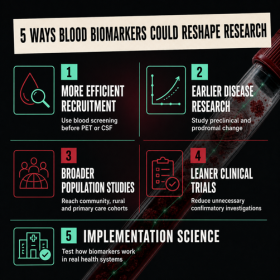
Blood biomarkers could make recruitment more efficient, enable earlier and broader research, streamline clinical trials and create new questions for implementation science.
The Rise of Implementation Science
One of the most interesting consequences of successful biomarker development is that some of the most important research questions are no longer primarily laboratory questions.
As blood-based biomarkers move towards clinical practice, attention increasingly shifts towards implementation.
For ECRs, some of the most impactful dementia research over the next decade may focus not on discovering new biomarkers, but on understanding how existing biomarkers can be used effectively in real-world health systems.
Why PET Still Matters Alongside the pTau217 Blood Test
It would be a mistake to interpret the emergence of pTau217 as signalling the end of PET imaging.
PET remains one of the most valuable tools available for understanding Alzheimer’s disease biology. It continues to play an essential role in biomarker validation, disease modelling, therapeutic trials and mechanistic neuroscience research.
Indeed, the FDA clearance of pTau217 was itself built upon evidence demonstrating concordance with amyloid PET imaging. In many research settings, PET remains the reference standard against which newer biomarkers are compared.
The lesson for ECRs is not to abandon imaging expertise, but to use imaging more strategically.
The strongest future studies are likely to integrate blood biomarkers and imaging rather than treating them as alternatives. Blood-based biomarkers offer scalability and accessibility, while PET continues to provide unparalleled biological precision.
Practical Recommendations for Early Career Researchers
As the field evolves, ECRs should actively consider how to future-proof their research programmes.
Design for a Hybrid Biomarker Future
Avoid assuming that a single biomarker modality will dominate throughout the lifetime of a study.
Where feasible:
- Collect blood biomarker samples.
- Retain PET or CSF when scientifically justified.
- Build flexibility into recruitment strategies.
- Plan for evolving clinical standards.
Studies that can adapt to changing practice are likely to have a longer shelf life.
Focus on Questions That Will Matter in Five Years
Perhaps the most important recommendation is to ask:
Will this research question still be important when the study reports?
The biomarker field is changing rapidly. Research focused on improving diagnosis, treatment access, patient outcomes and service delivery is likely to remain relevant regardless of which individual biomarker eventually becomes dominant.
Looking Ahead
The FDA clearance of Elecsys pTau217 does not immediately transform dementia research, nor does it remove the need for PET imaging or other established approaches. What it does signal is that blood-based biomarkers are entering a new phase of clinical credibility and practical applicability.
For early career researchers, this should be viewed as an opportunity rather than a disruption. The emergence of blood biomarkers offers possibilities for larger studies, earlier disease detection, more efficient recruitment, broader participation and entirely new areas of implementation research.
The researchers most likely to thrive over the next decade will not be those who view PET and blood biomarkers as competing technologies. Instead, they will be those who understand how these tools can be combined to answer meaningful scientific, clinical and societal questions.
In many ways, the era of proving that blood biomarkers can detect Alzheimer’s disease is drawing to a close. The next challenge, and perhaps the most exciting one for today’s early career researchers, is determining how these biomarkers can be used to improve research, reshape healthcare systems and ultimately improve the lives of people affected by dementia.

Dr Emma Law
Author
Dr Emma Law is Strategic Manager for the Neuroprogressive and Dementia Network in Scotland. Emma has 13 years experience as a Clinical Trials Network Manager and over 35 years experience as a Nurse, many of which were spent in the delivery of Clinical Research Trials. Emma completed her PhD and is passionate about giving people living with dementia and their carers access to participate in research.
Neuroprogressive Dementia Network


 Dr Yvonne Couch
 Dr Ajantha Abey
 Beccy Owen
 Dementia Researcher