 Print This Post
Giving my first seminar was something I have been nervous about since before I even started my PhD. But by the time I stood up to present, I realised that good preparation had transformed those nerves into excitement. Here are a few things that helped me prepare and, ultimately, enjoy the experience. If you’re preparing to give your first seminar, I hope some of the things that helped me will help you too.
When I was asked to give a seminar, my immediate reaction wasn’t excitement – it was panic. I wasn’t worried about standing up in front of people so much as the thought that someone would ask me a question I couldn’t answer, or that I’d discover I didn’t know my own project as well as I thought I did.
Looking back now, after giving my first seminar, I realised I’d got it completely the wrong way round. The seminar wasn’t a test of how much I knew. Instead, it became one of the best opportunities I’d had to really understand my results. I want to say that nerves are not necessarily a bad thing.
It’s completely normal to have some nerves – it shows that you really care about your work!
At the point I gave my seminar, I was around a year into my PhD. Like many first-year PhD students, I’d been working on multiple aspects of my project at the same time. Although I knew each experiment well, I’d rarely stopped to look at everything altogether. Preparing my seminar forced me to do exactly that.
The first thing I did was bring all of my data so far together, and get all of my figures in the same place. At first, I thought this was just another job on my to-do list. Instead, it turned out to be one of the most useful parts of the whole process. Seeing all of my results together helped me appreciate how much progress I’d actually made in a year. More importantly, it made me ask questions about the mechanisms underlying my results, and then reading papers to find the answers really deepened my understanding around my data. As an unexpected bonus, it also gave me a real head start on writing my first-year report, which was due a couple of months later. By organising the figures, reviewing the literature, and also thinking about the narrative of my project, I’d already done much of the groundwork needed for writing it.
Work out the story first
The idea of telling a story was probably the biggest skill I learnt. Research rarely happens in a neat, logical order. We repeat experiments, troubleshoot protocols, and sometimes spend weeks on something that doesn’t work. Giving a seminar isn’t a chronological order of your PhD. It’s an opportunity to guide your audience through a scientific question, explain why it matters, and show how each experiment helps to answer it. Before I even opened PowerPoint, I spent time thinking about the story. I wrote down the background to my project, the gaps in current knowledge, and how each experiment contributed to answering those questions. Once I knew the story I wanted to tell, building the presentation became much easier.
Researchers in our neuroscience department use a huge range of techniques. It was important for me to take into consideration that not everyone in the audience will have carried out extracellular field recordings or whole cell patch clamp recordings. Explaining complicated lab techniques I feel is an important part of being a researcher, and I found that being able to talk through how I take electrophysiological recordings and what they allowed me to investigate incredibly helpful for my own understanding.
One thing I also learnt was that the less text I included on my slides, the more naturally I spoke. Rather than writing a script, like I’d done in my undergraduate degree, or using presenter mode, I became familiar with talking through my figures. When it came to giving the seminar, this allowed me to look around the room and to speak to the audience directly, in a more engaging way.
Practise, then practise again
Of course, none of this happens without practise. This might sound obvious, but practise really is key! Practising out loud as much as I could was the most valuable thing I did. My mum acts in pantomimes, and she always tells me to practise these things until I’m sick of them, and that’s exactly what I did. By the time the seminar came around, I knew my slides and figures so well that I could focus on speaking to the audience instead of worrying about what came next. Presenting to friends and also to my lab group was a great way to build my confidence, and to get really helpful feedback on my presentation before the seminar.
I think it’s a common view when starting your journey in academia, one that I certainly had, is that receiving questions at the end of a seminar can often mean criticism. It is important to learn that questions don’t necessarily mean criticism. On the contrary, it means that people are interested in your work! The questions weren’t there to catch me out. They were great opportunities to discuss my results, and some of the questions I received gave me a new perspective on my own experiments, and made me think of things I haven’t thought of before. I left the seminar with great ideas for future work.
So, if you’re about to give your first seminar, remember this: you don’t need to know everything. None of us do. But if you’ve taken the time to understand your own work, think carefully about the story you’re telling, and prepare well, you’ll probably discover what I did, that giving your first seminar is actually an enjoyable experience!
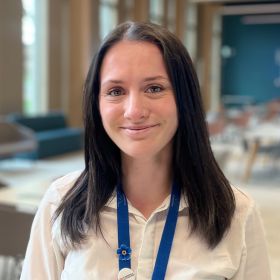
Beccy Owen
Author
Beccy Owen is a PhD Researcher at the University of Warwick, exploring how tau pathology disrupts neuronal ion channels and brain network activity in Alzheimer’s disease. As part of the Midlands Integrative Biosciences Training Programme, her work uses electrophysiology to better understand the molecular drivers of neurodegeneration. Originally from the Welsh countryside, Beccy’s passion for dementia research was shaped during her postgraduate studies and through personal experience with a family member living with the condition. She will be sharing her journey, insights, and lessons learned throughout her PhD here on the blog.

 Dr Chloe Fawns-Ritchie
 Dementia Researcher
 Dr Yvonne Couch
 Dr Clíona Farrell
 Beccy Owen
 Rahul Sidhu
 Dr Emma Law
 Dr Ajantha Abey