 Print This Post
I recently had the pleasure of attending the Alzheimer’s Society’s annual early career researcher retreat. I have to admit that beforehand, I was feeling quite apprehensive about the idea: networking doesn’t come particularly naturally to me, and the idea that I might not know anyone did not fill me with joy. My assumptions were right, and there really weren’t too many familiar faces. However, I met some fantastic people, and had some really life-giving conversations, so in the end was truly glad to have gone.
It’s easy for me to forget that the world of dementia research is almost infinitely broad, and that others’ work can look very different to my own. In my own department, dementia research is largely focused on the care and support provided through primary care, with a lot of us being predominantly qualitative researchers. It was great, at the retreat, to chat to researchers working across the spectrum, be that in social sciences, blood biomarkers or animal studies.
In acknowledgment of the different domains in which we work, the retreat avoided alienating one approach or other, with a very welcome focus on researcher wellbeing – something that would be applicable to all of us.
During one of the sessions, the audience were asked a question: Who believes that they have achieved a good work-life balance? A fair number of people raised their hands, of which I was one. My thinking at the time was that I definitely have a good work-life balance: I am able to prioritise my family when I need to, and my work when I need to. I can be there to drop off my toddler to childcare each morning, and I can be there for bedtime each night. I can still play football, or play music, and every now and then go to the theatre or the cinema. All of that, and I love my work – surely that’s a good life, and a good balance?
Even as I’m writing these words, I’m frankly embarrassed by my own delusion on the subject.
In some ways, yes, I have managed to create an ecosystem where I can do all the things I want to do. However, without realising it, I can see that my boundaries have become more and more porous, with all the different aspects of my life becoming increasingly enmeshed.
With my hand still in the air, I realised it wasn’t true. If I truly had a good work-life balance, would I be checking my emails throughout the day while I’m looking after my toddler? Would it be the first thing I do after he goes to bed, and on the way to work, and at the weekend? I can genuinely say I have received one email that could ever be considered urgent in the last year, so why has this become such a compulsion?
Emails are one thing, but annual leave is quite another. At my institution PhD students are encouraged to take the same amount of leave each year as staff – a total of 33 days. In the 11 months since returning to work, I have taken a grand total of six days – and four of those are because the university was closed. Taking leave has just felt so hard to justify when I struggle to fit in the hours I need to each week.
I mentioned the annual leave thing to my supervisors this week, who were suitably horrified and questioned why on earth I was making my life harder than it needed to be. Reflecting on it now, I can see that I have been tired, and it is that tiredness that has led to my boundaries becoming so blurred. I have said yes to too many things recently – said yes even to things I actively do not want to do and which offer very little advantage. At the same time, I have become less and less available to friends, because even replying to a message on WhatsApp looks suspiciously like the straw that will break the camel’s back.
Can I really pretend this is a good work-life balance?
I’m glad that I attended the retreat, if only to get me thinking a little more about the art of saying no, and of setting boundaries, and of revisiting what is important. Following a very explicit directive from my supervisors, next month I will take two weeks of leave, and we will actually take our first holiday as a family of three. Returning from leave will mark the start of the final year of my PhD – and hopefully, with a little bit of work, the start of a new, more balanced, chapter.

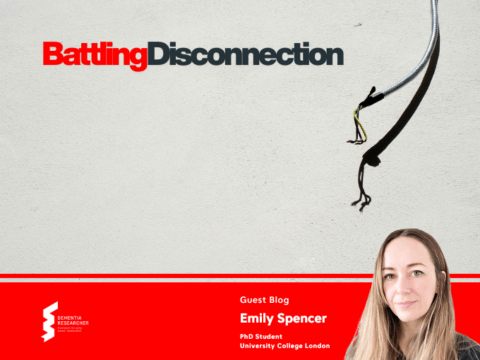
Emily Spencer
Author
Emily Spencer is a PhD Student at University College London looking at improving how GPs communicate with people with dementia and their family carers about their future care. Emily previous had a 5 year career break to pursue a career as a musician, and has previously undertaken research on improving the care people with dementia receive from their GP practice, as well as end-of-life and palliative care provision in the community. Emily is also a new mum and will be writing about her experiences navigating motherhood and a research career.

 Rebecca Williams
 Dementia Researcher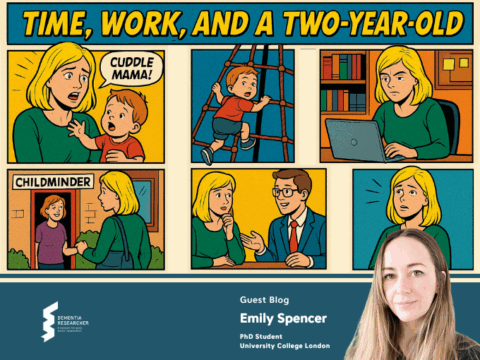

 Nature Careers Blog