 Print This Post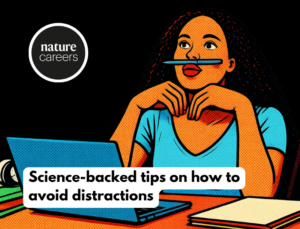
Struggling to stay focused in the lab? Attention researchers offer some advice.
Smartphones and other digital technologies are a constant potential source of distraction. According to a 2025 survey by Reviews.org, an online resource that reviews mobile services and Internet providers, on average, US adults check their phones 186 times per day, or roughly once every five minutes (see go.nature.com/4b4zgje). They also spend 5 hours each day using smartphones, which amounts to 76 days of screen time per year, with Generation Z (those born between 1997 and 2012) and Millennials (those born between 1981 and 1996) spending the most time scrolling on their phones.
Over the past two decades, these has been increased interest in whether people’s ability to focus on a single task has deteriorated. People often report that they think their attention span has shortened (see go.nature.com/4dfz8yc). But data that definitively show a drop in attention are sparse.
“Every year that passed, things that are so important to me, like reading books, having proper long conversations, even watching films, were getting harder and harder to do,” says Johann Hari, whose 2022 book Stolen Focus, outlines 12 reasons why people’s attention spans have declined, and offers tips to help people regain their focus. “I felt like I was running up a down escalator that was going faster and faster every year,” adds Hari about his declining ability to pay attention.
Staying focused is crucial for short-term memory, problem solving and creativity, whereas frequent distractions lead to more errors and higher levels of stress and frustration. “Attention is at the heart of all human achievement,” says Hari, who lives in London and Los Angeles, California. “Anything you’ve ever achieved in your life that you’re proud of, whether it’s starting a business, getting a PhD, being a good parent or learning to play the guitar, required a huge amount of sustained focus and attention.”
Nature’s careers team asked six attention researchers and educators for tips on how to mitigate disruptions and improve concentration.
Defining attention
“There are two rather separate attention systems,” says Michael Posner, a psychologist at the University of Oregon in Eugene, whose research career of more than 50 years led to the discovery that there are different forms of attention that are associated with different regions of the brain. One form is called executive attention, which describes the ability to focus on one thing. The other is the orienting system, which is guided by disruptions, including changes in lighting, unexpected sounds and other environmental influences.
“Powerful external stimuli are pretty hard to resist,” Posner says. “That’s because orienting is important for being aware of potential predators.” If someone is deeply involved in a task, he says, it’s nevertheless helpful to know if a tiger is sneaking up on them.
Today, distractions often come in the form of interruptions such as text messages, e-mails, in-person requests, meetings and sudden noises. But people also actively and frequently interrupt themselves. “The problem is not that we get distracted,” says Gloria Mark, a psychologist and attention researcher at the University of California, Irvine. “The problem is: what do we do about it?”
The human brain isn’t able to consciously pay attention to more than one thing at a time, says Mark. Instead, it switches rapidly between tasks, which comes at a cost. “A lot of people think that multitasking is this badge of honour — it’s not,” says Mark. Generally, people who multitask make more errors and take longer to complete a single task because they have to reformulate a mental plan for completing that task every time their attention switches.
Cultivating focus
Individuals have their own peaks and valleys for when they focus best, says Mark. These personal rhythms vary depending on factors such as a person’s natural tendency to sleep and wake at certain times and how much sleep they get. In general, people have a period of peak focus mid-morning, then a dip around lunchtime and a second peak in the afternoon. “That’s on average,” Marks adds, noting that some people have focus peaks early in the morning, whereas others focus best later in the day or during the evening.
“For scientists, it’s really important for them to understand that they have these limited cognitive resources,” says Mark. “They should understand when their peak periods are and use those times to do their most important work.” For instance, instead of a researcher using their peak focus times to check their e-mail or attend meetings, they can allot that time to analysing data or writing a grant proposal. If someone isn’t aware of their personal rhythm of attention, Mark recommends keeping a diary and taking notes every half an hour or hour, to record how focused they feel.
One of the most effective ways to stay focused during peak periods is by putting away the major source of distraction — the mobile phone. On average, people in the United States spend 10 seconds looking at their phone each of the 200 or so times they check it daily1. Every interruption breaks focus and can make it harder to complete a task. “People find it difficult to work with their smartphone sitting next to them,” says Stefan van der Stigchel, a cognitive psychologist at Utrecht University in the Netherlands. “You won’t go on a diet with a pack of cookies next to your laptop, right? There’s one moment where you’re bored or when your will is not as strong, and all of the sudden you’re picking up your phone or you’re eating that cookie.”
Researchers can try putting their phones in a drawer, in another room or in a safe with a timer to keep it locked away for a set time. They can also set digital well-being limits on the phone itself. Apps such as Freedom and Cold Turkey Blocker can be used to block specific websites, apps or Internet access. Nova Corciega, a science instructor and education researcher at Negros Oriental State University Mabinay Campus in the Philippines, uses the digital well-being settings on her phone to limit her use of the social-media site Instagram to 35 minutes per day and the platform YouTube to one hour per day. “This gets me to think that I only have 35 minutes for this application per day, so I need to use it wisely,” she says.
In the moment, it’s easy to press ‘ignore’ on a timer, but over a longer period, setting digital limits can help researchers to establish mental routines that support their ability to focus and become more introspective about their attention. “We do so many things automatically and unconsciously, like picking up our phones, swiping them open, going to check e-mail,” Mark says. If researchers recognise when they feel an urge to check their phone or their e-mail inbox, they can then ask themselves whether they really need to. “It’s a way of counteracting habits and being intentional about what we do,” she adds.
When scientists start to feel their attention spans waning, it’s time to take a break. “We prefer not to have lunch meetings because those are times when you can recharge your battery,” says van der Stigchel, who often takes walks outside (without his phone) during the working day. It can be difficult to take breaks, especially if someone pops into the laboratory to ask a question, but van der Stigchel says that it’s important to be strict about taking time to recharge. “I always say I’m never late for a meeting, including a meeting with myself,” he says. “Not working is part of what allows me to focus and be productive.”
Goal setting is another way that researchers can improve their attention spans. According to a 2023 study2 of 108 university students in the United States, those who set specific and difficult but achievable goals had shorter lapses in attention and stayed engaged with a task longer than did those who set vague goals.
However, goal setting improves attention only when a person is already committed to that goal: you can’t just write something down and expect that to be enough. Mark recommends that researchers write down their goals the night before work and reaffirm them the next morning. “Create a visualisation of where you want to be at the end of the day,” she says. “I want to be sitting on my couch. I want to be reading. I want to be relaxing. I don’t want to be working on that paper.”
Creating spaces for attention
Individuals and lab leaders can make changes to their environment and communication styles to foster concentration. For example, many labs have open office spaces, which can be loud and visually distracting. To minimise visual distractions, van der Stigchel recommends closing the window shades and filling the lab with plants, or getting out of the lab entirely and heading to the library.
“One of the most effective ways to enhance attention is exposure to green environments,” says Sin-Ae Park, a plant-therapy researcher at Konkuk University in Seoul. Park and her colleagues found3 that the presence of real foliage improved concentration among 23 elementary-school students (aged 11–13 years) in Seoul. If taking a walk in a park or garden isn’t feasible, placing live plants around the office can help to support concentration. “Taking a short break in a green space, placing a small plant on a desk or spending a few minutes caring for plants each day can all contribute to restoring and strengthening attention,” Park adds.
E-mail and communication platforms, such as Teams and Slack, are also major sources of distractions, but some researchers feel pressured to keep them open throughout the day. “There’s all kinds of social dynamics that are wrapped up in these systems,” says Mark.
Mark and her colleagues found that workers in the United States who used e-mail each day felt less productive and more stressed than did those who had no e-mail access4. The workers who had e-mail cut off for five days multi tasked less and could focus for longer periods of time. Instead of keeping e-mail open throughout the day, Mark recommends that researchers check it once in the morning, maybe once before lunch and once at the end of the workday, but not in the evening. “Create a convention with your colleagues and get your manager to buy in,” she says.
It’s not your fault
The world is full of constant and compelling distractions, and people often blame themselves for getting side-tracked too easily and losing their ability to focus. “The truth is this crisis did not happen because you had bad habits and I had bad habits,” says Hari. “We need to stop blaming ourselves and our children and start blaming the people who did this to us.”
Social media, e-mail, video games, apps and other aspects of digital technologies are designed to grab and keep attention. “I think we’re all in this mode now where we can feel our attention is getting worse. We hate it, but we think, well, this is just the way the world is,” says Hari. “And I need to tell you, yes, you should hate it, and no, this is not the way the world has to be.”
Addressing systemic issues with the attention economy — a system in which attention is a finite resource and a scarce commodity that has economic value — involves a wide swath of solutions. These range from regulating social-media companies and banning surveillance capitalism (the collection and monetisation of personal data) to improving food systems and reducing environmental pollutants. For instance, one study of 175 women in South Africa, found that obesity is associated with poor performance on tasks related to memory, attention and executive function5. Furthermore, in a study of 282 nine- and ten-year-old school students in China, exposure to traffic-related air pollution was associated with reduced attention span6.
But countries around the world are already making changes. Italy, France and Australia implemented right-to-disconnect laws that ensure employees don’t have to check e-mail or work-related communications outside work hours. In March 2024, the European Parliament approved the Artificial Intelligence Act to limit the mechanisms used by AI companies to capture and keep user attention. In December 2025, Australia became the first country to ban social-media platforms for people under 16 years old. Now, at least 18 countries have done the same or are considering implementing regulations on social-media use for children.
In her hometown in the Visayas, Philippines, Corciega doesn’t always have phone reception or access to the Internet, the lack of which, she says, encourages her to go hiking and fishing with her partner and friends. She finds spending time with people in the real world more fulfilling and rewarding. “I feel like I’m living intentionally and purposely in this world, not drifting away with a single cell phone on a single screen.”
Shared from Nature Careers this the original and more great content head to Nature 656, 261-263 (2026) – doi: https://doi.org/10.1038/d41586-026-01850-9

 Nature Careers Blog
 Dementia Researcher