 Print This Post
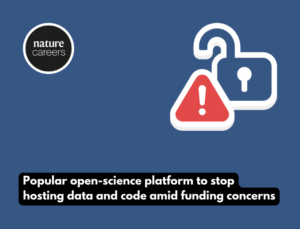 The co-founder of a prominent open-science platform has announced that funding uncertainties have forced the site to make changes to some of its most popular features.
In a statement released on 11 August, Brian Nosek, executive director of the Center for Open Science (COS) in Charlottesville, Virginia, which runs the Open Science Framework (OSF), announced that the platform will no longer allow researchers to post their code and data after 16 November. Any documents that are already publicly available on the site will remain online. But users will no longer be able to upload new materials in private mode.
The OSF’s preregistration workflow — which allows scientists to post research designs and articles that describe their planned methods and analyses for upcoming experiments — will continue to operate as normal, as will the 14 preprint servers run on the OSF platform.
Launched in 2012, the OSF allows researchers to publish their code, data, supplementary materials and manuscripts online indefinitely and to share them publicly. Users can also choose to keep uploaded materials private or share them with only collaborators. With more than one million users, the platform has served as a one-stop shop for researchers looking to manage entire projects in a single space — all at no cost to the researchers themselves.
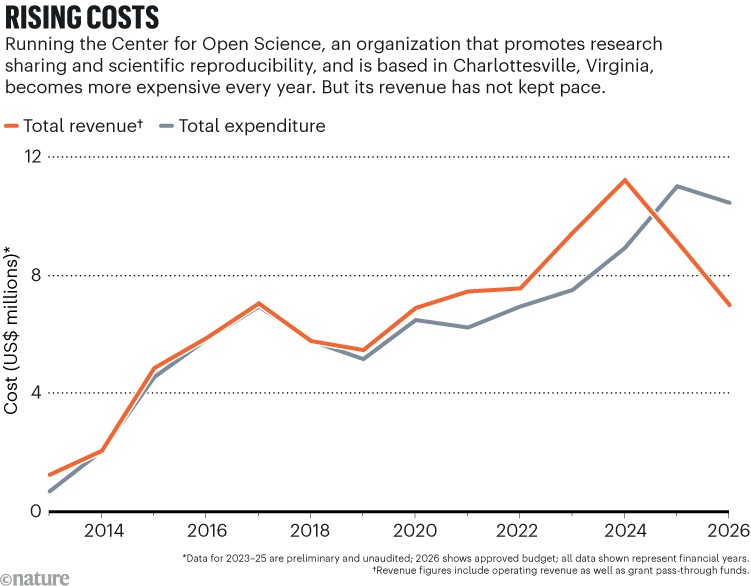
But that doesn’t mean that the tools OSF provides are free. Nosek says the policy change was “necessitated because of financial realities”, noting that it costs between US$4 million and $5 million annually to manage the OSF (see ‘Rising costs’). He adds that, over the past few years, the COS has relied on financial backing from federal agencies and private foundations, but not all of this funding has been renewed.
Phasing out data and code storage and not allowing researchers to host documents privately will reduce the OSF’s operating costs by more than half, Nosek estimates. Although he recognizes that these features are popular and widely used, he notes that many users were using the OSF’s private mode as a free storage platform, often hosting content not relevant to science. About one-fifth of the platform’s users keep all of their materials private, Nosek says, which runs counter to the COS’s open-science ethos.
“We’re not raising philanthropic dollars to provide a free, private data-storage solution,” he explains. Those factors, collectively, create a “meaningful burden that these changes will reduce”. Nosek encourages researchers to post their data, code and supplementary materials on repositories such as Zenodo, Dryad, Dataverse and Figshare instead.
Erin Wamsley, a cognitive neuroscientist at Furman University in Greenville, South Carolina, who has been using the OSF since its earliest days, is disappointed by the policy change. Her laboratory has dozens of projects hosted on the platform, she says.
Usually, Wamsley starts projects on the OSF and makes studies and materials public once they are complete, but she also has continuing projects on the platform that she will now need to store elsewhere. “I would really like to have everything in one place,” Wamsley says.
Katie Corker, executive director of ASAPbio, a non-profit organization based in San Francisco, California, that advocates for innovation and transparency in the life sciences, is surprised that the COS is closing down the OSF’s most popular functionalities.
“I think they’re making that choice out of principle because they think that’s what’s going to be best for the open-science ecosystem,” says Corker, who has worked closely with the COS. “But it’s still a surprising business choice.”
Other ‘free’ projects have also felt the pinch as federal agencies cut budgets. Last year, for instance, FlyBase — a database of model-organism information that has served the fruit-fly research community for decades — was forced to scramble after the administration of US President Donald Trump cut the project’s funding during a disagreement with Harvard University in Cambridge, Massachusetts. Although the project grant was eventually restored, a subaward to collaborators at the University of Cambridge, UK, was terminated. The site “now requests annual contributions from fly labs to support curation of new data into FlyBase” and says that, without these funds, the resource “will become frozen in its current state and become progressively less useful”.
The rapid surge in ‘AI slop’ — fake or subpar content produced by AI tools — has exacerbated the COS’s problems. Last year, the organization closed its OSF Preprints platform after being inundated with low-quality submissions.
The COS has registered as a non-profit entity in the European Union to make the organization less reliant on US funding. Although the details are still being worked out, the idea, says Nosek, is “to strengthen our partnerships” in Europe and to “broaden our base”.
Shared from Nature Careers find the original and more great content at doi: https://doi.org/10.1038/d41586-026-02598-y

 Nature Careers Blog

 Dementia Researcher