
 Print This Post
I was running low on things to discuss when I got sucked into an accidental science chat via email with some colleagues. I genuinely can’t remember how it started but it concluded with the fact that we have to have a journal club where we do a he said/she said argument about whether or not brain glymphatics actually exist, how we define them and what they do. Controversial start, right? So today we’re going to talk about how the brain rids itself of fluid via the so-called glymphatic system, and the arguments that currently exist on both sides of the fence.
How the lymphatic system works
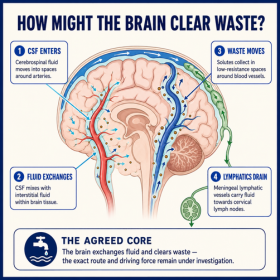
A simplified overview of how cerebrospinal fluid, interstitial fluid and meningeal lymphatics may work together to clear waste from the brain.
Let’s start back at the beginning with the lymphatic system and what it does in the body. In the old days, and probably still in the brains of some people who don’t think about physiology sensibly, the circulatory system looked like those pictures in anatomy books for children; the red blood has the oxygen and all those pipes go to the tissue, the oxygen comes out and then the blood that has no oxygen is blue and goes back to the heart and lungs to get made red again. Broadly, this can be considered the case but actually what happens is that there’s an intermediate step that helps out; the lymphatics.
Blood leaves the heart and tootles around the body collecting hormones and oxygen and other things that need to be delivered to various tissues. When it gets to said tissues, all these vital components are hanging out in the plasma and they can diffuse out of the capillaries. Tissue capillares, the smallest of your blood vessels, are fairly leaky and so things can come and go across them fairly easily. At this point the majority of your blood is being returned to your heart and lungs for reoxygenation but some of that fluid that came out remains in your tissues.
BUT….the issue we have is that your vascular system is under pressure. Think of it like a hosepipe with a sprinkler at the end. You can get the water to come out when you turn the sprinkler on, but you’re not getting water to go back up the sprinkler. And if you just keep dumping fluid into your tissues and not returning it somehow your tissues are going to get bigger and bigger. And this is where your lymphatics come in.
Lymphatic vessels act to remove fluid from tissues, taking up damaged cells, proteins, bacteria, excess plasma, and returning it (eventually) to the circulatory system. They do this because of the special arrangement of their endothelial cells. Basically their endothelial cells are arranged in such a way as to respond to external pressure. When fluid builds up in the tissue it increases pressure around the endothelial cell junctions and causes a whole bunch of molecular biology to happen which opens small pores in the lymphatics, the interstitial fluid rushes down the pressure gradient into the lymphatics, pressure is increased on the inside and the pores close. The system then requires external forces, like muscle contraction, to move it back to the veinous system via the lymph nodes. All in all this is why they recommend you get up and walk about on long flights, your leg muscles are basically squeezing your lymphatic vessels to get them to return the fluid to where it belongs, i.e. not in your ankles.
So why is this relevant in the brain?
Most tissues in the body can be thought of kind of like the city of London. Stuff goes in, stuff gets produced, stuff comes out. The brain is a little bit more like the old city of Dubrovnik, all walled in and with only a couple of gates. Brain capillaries are not like tissue capillaries, the blood brain barrier is much more restrictive so that ‘leakage’ that happens in peripheral tissue simply happens less in the brain. But the brain is still a tissue, there is still production of stuff inside that needs to get out. If anything there is more need for stuff to get out.
If your ankles swell up then maybe you can’t put on your favourite strappy sandals. If your brain swells up, you die.
Now, the less informed amongst you (myself included until a couple of years ago) will be thinking ‘but the brain is surrounded by CSF (cerebrospinal fluid), surely stuff just gets out and goes into that?’ and yes, it sort of does. Some fluid exchange between the brain and the CSF happens but if you think about where the CSF is, in the ventricles, around the edges, it doesn’t really explain how stuff from deep within the brain is cleared. If we stick with the city/waste analogy, CSF as the sole means of clearance would be like having your bin men only empty the bins on the big A-roads around towns. Pretty soon the middle is going to get a bit grotty.
Around the early to mid-2000s this is where we were at with the brain. Experiments from the 90s showed us that if you inject Indian ink into the brain, that it accumulates in spaces around blood vessels. This is important because if you inject anything into the brain the assumption was, if you know nothing about how the fluid clearance is going to work, that your injection will just sort of diffuse according to the space around it and just gradually become a fuzzy cloud around wherever you originally put it. This does not happen, what happens is that it preferentially ends up in these perivascular spaces. Diffusion in the brain is slow, it’s packed with cells and dendrites and axons and stuff that gets in the way of large molecules just ‘moving around’ so when they bump into a low-resistance space, like that around the vasculature, they’re likely to accumulate there just because of physics.
Now…this is where it gets fun and controversial.
We start with the famous 2012 Nedergaard paper. Basically, Nedergaard’s group were trying to establish whether CSF gets into the brain. Not anything more fancy at that stage, just does CSF enter the parenchyma or does it remain in its own space. They injected tracer into the cisterna magna and found it accumulated in periarterial spaces. So now what we have is the earlier experiments by people like Weller and Carare, who said ‘stuff in the brain goes out via perivascular spaces’ and Nedergaard now showing that ‘stuff going into the brain gets there via periarterial spaces’. The important thing about this 2012 paper is that Nedergaard’s group linked these two concepts. They said that bulk fluid movement, via periarterial and perivascular spaces was a way of clearing the brain.
The controversy really begins when you think about how the vasculature looks in the brain. I work a lot in a field where people are really interested in capillaries, and the model there looks like a tube of endothelial cells then smack bang on top of them are pericytes (occasionally, they’re there own controversy we absolutely do not have time for) and directly contacting them, astrocyte end feet. There is not really a great deal of ‘perivascular space’. This space, often referred to as the Virchow-Robin space, only really exists around large vessels. But if the proposal is that this space forms part of the brains clearance system, then how are things being cleared from deep within the brain, from neurons that are distant from large penetrating vessels and arteries that do not have a Virchow-Robin space?
Nobody is arguing, at this point, that fluid does not leave the brain via perivascular spaces. The question is how.
Proponents of the glymphatic hypothesis suggest that fluid moves by bulk flow. Those against this hypothesis think that it’s largely diffusion. You can think of this as like dropping a bucket of golf balls into a lake. The lake has small drainage ditches. If you just drop the balls in, they’ll initially sort of just float around but because there’s a little more flow around the ditches, eventually they’re like to accumulate there. This is diffusion into perivascular spaces. If there is natural flow between the drainage ditches and you drop the balls in, they’re much more likely to end up there because there is a current within the water. This is the glymphatic model as of 2012-ish.
The meningeal lymphatics discovery
Now the glymphatic system is really all about flow, not so much about vessels. You’ll remember in the rest of the body we have lymphatic vessels but the main lymphatic marker, LYVE-1, was never really found in the brain. Which is what led people to believe the brain had no lymphatic system. This changed in 2015 with a couple of papers, from Louveau et al. and Aspelund et al., that found LYVE-1 staining in the meninges. These protective membranes are often lost when you take a brain out of the skull and so naturally, up until that point, nobody had found anything in the brain. These papers were specifically interested in what was going on within the dural space, so they looked at isolated meninges and found lymphatic vessels.
This means we now have an explanation (sort of) about how things get from the brain to the cervical lymph nodes. If they manage to get into the meningeal space, this is essentially a tissue like any other in the body and the lymphatic vessels there act in the same way as they do elsewhere. Pressure builds up, lymphatic endothelial cells open pores to allow fluid to flow down pressure gradients, pressure equalises, pores close, fluid drains. Great. The issue we have now, is how does stuff get from within the brain to the meninges? If you remember, we’ve ended up with a whole bunch of stuff draining into perivascular spaces which, hopefully you’ve noticed, are PERI vascular. These are not active vessels pumping stuff, this is just space around vessels passively collecting things.
In the rest of the body we have valves in our lymphatics, our body’s muscles do a lot of the heavy lifting by squeezing the lymphatic vessels during movement, we have none of this in the brain so how are we getting it up to the meninges? This is where we get back to our ‘glymphatics’ controversy. The glymphatic theory basically tells us that the interstitial fluid within the brain is part of the whole system, and beyond that, that arterial contractions within the brain create ‘waves’ within that fluid which is what generates the bulk flow. And this is where a lot of people struggle with this theory. Nobody seems to be disputing the fact that arteries pulsate, and indeed there is a very neat study by the Nedergaard crew showing that changing arterial pulsation affects tracer movement out of the brain. What people are disputing currently is whether arterial pulsation is sufficient to generate the kind of movement that is required to bulk shift solutes over a whole brain.
I am acutely aware, because I type all these blogs using the same word doc template, that we are just about to go over my normal length of blog. I’ve tripped into the three-page territory here and for that, I apologise but I hope you’re staying with me and finding this as interesting as I am. If not, feel free to step away now.
Let’s go back to our golf balls in the lake analogy. The glymphatic fans would have us believe that the arteries are producing enough pulsatile force to generate that subtle current between the drains that we discussed. The diffusion fans, who do a lot of mathematical modelling, suggest that all we’re doing is stirring up the water around the drains which just means maybe the balls get there faster but ultimately, it’s not because of bulk flow.
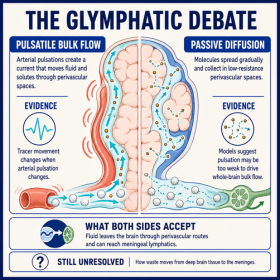
The glymphatic controversy centres on whether brain waste clearance is driven mainly by arterial pulsations and bulk flow or by passive diffusion.
Where the field stands today
And this is where we get to the state of play today. Basically, the early 2010s had us believe that there was a degree of directionality about fluid clearance from the brain. Papers proved that CSF tracers accumulated around arteries, suggesting CSF to brain exchange, and papers proved that parenchymal tracers accumulated around veins, suggesting brain to vein drainage. The Nedergaard papers linked those two and introduced pulsatility as a way of generating the bulk flow needed to move fluid around and between all these compartments.
Between then and now the field has changed. The first thing critics brought up which contravened directionality was CAA, or cerebral amyloid angiopathy. The pathology of this disease shows that amyloid accumulates around the periarterial space. If there is directionality of fluid flow, as the old-school glymphatics hypothesis suggests, then this would seem counterintuitive. If fluid is just diffusing passively then this makes more sense. The second thing the critics introduced was the modelling, showing that pulsatility may not generate enough movement to create bulk flow. And finally the meningeal lymphatics were discovered, showing an actual direct route for solutes out of the brain.
These days, over a decade on from the original discoveries, we have a different definition of ‘glymphatic function’ which tries to encompass more of the physical controversies whilst still maintaining that there is absolutely a fluid clearance system in the brain. Basically, glymphatic function can be considered to be efficient CSF–interstitial fluid exchange and clearance to meningeal lymphatics. Exactly how the fluid is cleared from the deeper parts of the brain and via what routes, is what remains largely elusive and the focus of a lot of ongoing research.
I’m sure I’ve missed out a ton in this field. There’s the contribution of sleep, where extracellular space might be larger and so diffusion might be improved. There’s the role and contribution of AQP4, which moves water around the brain. There’s all the hard-core modelling which I absolutely do not understand. But hopefully what I’ve done is walked you through where the glymphatic system idea started, why it’s important, and where it’s going.
Quick answers
What is the glymphatic system?
A proposed system for clearing fluid and waste from the brain, using the fluid filled spaces around blood vessels rather than a dedicated network of vessels like the lymphatics found elsewhere in the body.
Is the glymphatic system real?
Nobody disputes that fluid leaves the brain via the spaces around blood vessels. What’s still contested is how, specifically whether it moves by bulk flow driven by arterial pulsation, or largely by diffusion.
Does the glymphatic system clear waste during sleep?
Sleep is thought to help, since the extracellular space between brain cells may open up during sleep, but exactly how much this contributes to fluid clearance is still being researched.

Dr Yvonne Couch
Author
Dr Yvonne Couch is an Associate Professor of Neuroimmunology at the University of Oxford. Yvonne studies the role of extracellular vesicles and their role in changing the function of the vasculature after stroke, aiming to discover why the prevalence of dementia after stroke is three times higher than the average. It is her passion for problem solving and love of science that drives her, in advancing our knowledge of disease. Yvonne shares her opinions, talks about science and explores different careers topics in her monthly blogs – she does a great job of narrating too.


 Dementia Researcher

 Beccy Owen
 Bernie McInally
 Dr Chloe Fawns-Ritchie

 Dr Clíona Farrell
 Dr Becky Carlyle


 Rahul Sidhu
 Dr Emma Law