 Print This Post
For most of my career so far, I have spoken about dementia through the lens of research. I have discussed experiments, scientific discoveries, research papers and spend much of my time thinking about dementia as a scientific challenge. However, before I became a researcher and studied neuroscience, dementia was something I experienced every day at home with my late Grandad.
As I have progressed in dementia research, I have realised how important lived experiences are, as they shape the questions we ask, the passion we bring to our work, and our understanding of the people behind the disease. Therefore, I have decided to use this platform to share my family’s experience of dementia, for three main reasons. I want to remind researchers why this work matters and that behind every experiment, every paper and every research project are real people and families whose lives have been changed by dementia forever. I want to raise awareness of the realities of dementia and the stigma that still exists in many communities, including South Asian communities like my own. I want to honour my grandfather and ensure that his legacy is remembered for far more than the dementia he developed later in life. I hope that sharing my family’s experience will encourage other families to seek support sooner, while reminding and inspiring fellow researchers of the purpose behind the years we dedicate in the lab
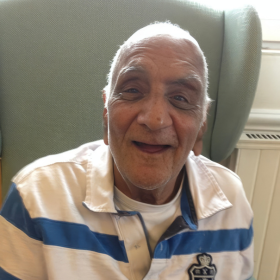
Rahul’s grandad in his later years.
My grandad was one of the most influential people in my life, and he lived with vascular dementia during my formative years. I was a teenager when his symptoms became more severe, until he passed away in 2019.
Watching somebody you love slowly change because of dementia, knowing there is no cure, is like a continuous slow drip of sadness and an experience that stays with you.
I can now see that my experiences with my grandad have shaped almost every aspect of my journey into dementia research, even if I did not fully realise it at the time. Before I tell the story of his dementia, I want to tell the story of my grandad before he got dementia, as although dementia became a big part of his life, it wasn’t everything.
My Grandad Before Dementia
When I think about my grandfather, dementia is not the first thing that comes to mind. I think about a man who was resilient, intellectual, respected and fiercely independent, who endured challenges that most of us could never imagine in our generation. He lived through the Partition of India in 1947, which was one of the most turbulent and troubling periods in modern history. He was forced to leave his home and travel over 300 miles to create a whole new life from scratch, navigating unbelievable uncertainty and loss. It was an experience that required extraordinary determination. Despite this, he went on to train as a highly successful doctor in India before immigrating to England in search of better opportunities for our family. In the UK, he built a successful career and established a life that created opportunities for future generations.
I am struck by the scale of everything he overcame, as he rebuilt his life more than once, adapting to entirely new circumstances. He still always remained dedicated to helping others, guided by his Sikh values, he believed strongly in kindness, humility and selfless service. The opportunities that I have today, including the privilege of pursuing a career in dementia research, are only possible because of the sacrifices of people like my grandad. That is why it is so important to me that when I tell his story, dementia is only one chapter.
Watching His Dementia Progress
I lived with my grandad my entire life, which meant I witnessed the progression of his dementia first-hand and at first, the changes were subtle. Every morning, he would make the most tasteful masala chai. It was part of his daily routine for decades, but gradually he began to become confused about the order of making it and tasks that were once automatic in his brain, became more difficult. When making breakfast, he would sometimes pour oil onto his cereal instead of milk, and when getting dressed, he would put his clothes on incorrectly. As a young teenager, I didn’t entirely understand what was happening and what caused this confusion shift.
Over time, this confusion became much more noticeable. His sense of time was disrupted, and he would regularly wake us up during the middle of the night believing it was morning time. This heightened confusion led to much more dangerous incidences. When my brother and I were at school, and my parents were at work, he would sometimes leave the house alone, vulnerable and disoriented. Thankfully, our neighbours knew him and would help bring him home safely.
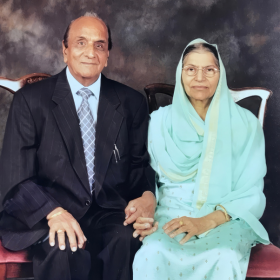
Rahul’s grandad and grandmother.
Eventually, we accepted that what we were seeing was more than normal ageing and sought medical help. My grandad was diagnosed with vascular dementia and although the diagnosis provided answers, it also raised difficult questions about how we would navigate the future as a family.
As the disease progressed, the changes became increasingly difficult to watch. The most upsetting changes were not the memory problems, but the changes to his behaviour and personality. My grandad was always kind, fair and patient, yet dementia made him increasingly anxious, agitated and prone to sudden, extreme mood swings. Small frustrations would trigger anger and agitation in ways that were completely out of character before he developed dementia.
He then lost the fluent English he had spoken his entire life and reverted to his mother tongue of Punjabi. Eventually, even his Punjabi disappeared, and he could only say a few words at most. Language is not simply a means of communication; it is a person’s identity and culture. As the disease progressed further, he lost his mobility and could no longer walk, causing him to be bound to his bed or wheelchair. However, for me, the hardest stage of his dementia was when he stopped recognising us. Watching somebody lose their memories is difficult but watching them lose their connection to the people they love is heartbreaking.
Breaking the Stigma
One of the reasons I wanted to write this blog is that I believe there is still far too little awareness of dementia in many communities, including South Asian communities. Our family’s experience highlighted this very clearly. Even though we had healthcare professionals within our wider family, we knew remarkably little about dementia ourselves before and during Papaji’s diagnosis. In many South Asian families, dementia is still not openly discussed or well understood.
Symptoms are often dismissed as a normal part of ageing, and families frequently try to manage by themselves for as long as possible.
As my grandad’s condition progressed, it became even more challenging for us as a family unit to care for his increasingly demanding needs. We made the incredibly difficult decision to move him into a nursing home, and it remains one of the hardest decisions we have ever made. We did not make that decision because we loved him less but made it because we loved him enough to recognise that he needed specialist care that we could no longer provide safely at home. The nursing home offered round-the-clock support from professionals with expertise in dementia care and could provide a quality of care that we could not provide ourselves.
Many family members struggled to understand our decision, and judged us for it, believing that we should continue caring for him at home. Like many others, they did not fully appreciate the reality of living with someone who had advanced dementia every day. They did not see the emotional exhaustion, the sleepless nights, or the constant concern for his safety and well-being. They did not fully understand that dementia affects an entire family, not just the individual living with the disease. I do not blame them for this lack of understanding, as I believe it came from a lack of awareness rather than a lack of compassion. Therefore, raising awareness is important because until you experience dementia yourself, it can be difficult to appreciate its impact.
Reducing its stigma starts with conversations and starts with families feeling able to discuss dementia openly and seek support without fear of judgement. Communities need to be more understanding that dementia is not a normal part of ageing, and it is not something that families should be expected to face alone. This is why it is really important for dementia scientists to openly discuss the disease and organise more public-facing events. The more we engage with the public, the greater the awareness and understanding of dementia will become.
Representation in Research Matters
My family’s experience also taught me something about representation. Dementia does not discriminate and affects people from every background, culture and community, yet not all communities are equally represented in research or public awareness. South Asian communities are one example where, too often, dementia remains misunderstood, hidden or associated with stigma. Families may delay seeking support, and symptoms may go unrecognised, meaning important conversations may never happen.
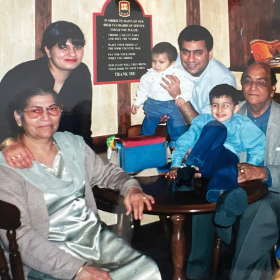
Rahul’s grandad (right) with the wider family.
We need more culturally sensitive approaches to dementia awareness, more engagement with underrepresented communities, more opportunities for people from underrepresented backgrounds to contribute to research, and more researchers and clinicians who understand how culture can shape people’s experiences with dementia. Most importantly, we need more lived stories like mine. These stories help people recognise themselves in experiences that might otherwise feel invisible and they create a personal understanding in ways that statistics never can.
Remembering Why We Research
Seven years after losing my grandad, I now find myself in the most privileged position, working in a field that seeks to understand and ultimately defeat the disease of dementia that changed his life. Research is built on experiments, data and scientific discovery, but it is easy to become consumed by statistics and results and lose sight of the people we are ultimately trying to help.
When that happens, I remind myself why this work matters. I think about my grandad, the man who survived the largest global partition ever, the doctor who cared for patients, the man who built a new life in a new country and the man who sacrificed so much to help the future generations succeed.
I think about how dementia slowly stripped away the abilities he had spent a lifetime building. So, I remember that every sample, every dataset and every experiment represent real people and real families. These are people like my grandfather, who were pillars of their communities and spent their lives helping others.
This is my own personal evidence that dementia can affect the sharpest of minds. For those of us working in dementia research, that reality should never feel distant. On the days when experiments fail, when funding applications are rejected, when progress feels unbearably slow, when you’re running experiments until late at night… just remember why you started.
Behind every research question is a person, and for me, that person will always be my Papaji. His dementia shaped my journey into research, but his life shaped something more important; it taught me why the work I do every single day, and many others, to abolish dementia is worth doing.

Rahul Sidhu
Author
Rahul Sidhu is a PhD student at The University of Sheffield, focusing on the effects of heart disease on dementia in preclinical models of Alzheimer’s disease. His research aims to uncover how cardiovascular health influences neurodegenerative conditions, potentially leading to novel therapeutic strategies.
Follow @rahulsidhu_
Find Rahul on LinkedIn

 Beccy Owen
 Bernie McInally
 Dementia Researcher
 Dr Chloe Fawns-Ritchie
 Dr Yvonne Couch
 Dr Clíona Farrell
 Dr Emma Law
 Dr Ajantha Abey