Welcome to my blog. I’m Louise—pleased to meet you all. I’m an Emerita professor (yes, the “a” is correct), and I guess I’m at the other end of the career spectrum than many of you. I’ve been working on Alzheimer’s disease since 1992. Seriously, it’s hard to believe. I still feel a little like that painfully shy PhD student shaking visibly at my first laboratory talk in the Laboratory of Molecular Biophysics at Oxford. I now shake less when I give talks, but I occasionally forget to breathe.
As a Biochemistry undergrad at Nottingham, I realized that brain diseases were where my passion lay. I was intrigued by them—schizophrenia, prion diseases. I applied to Oxford and was utterly shocked to be offered a place in the LMB, a building renowned for structural biology, mainly X-ray crystallography.
I found myself completely out of my depth, learning a subject I knew next to nothing about. But then, I found my area: protein misfolding, amyloid fibril structure. It was different, it was difficult, it was interesting!
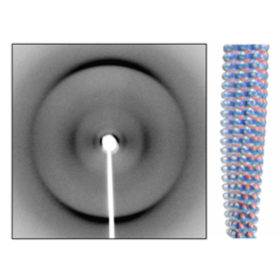
The X-ray fibre diffraction pattern (right) obtained from a cross-beta amyloid fibril (molecular model shown right).
The Beauty of X-Ray Diffraction
On a little lab bench within the office (health and safety!!) we aligned samples of amyloid fibrils made from different proteins. We popped them into the X-ray beam and—low and behold—a diffraction pattern. Not a spotty one like those produced by the crystallographers, but a beautiful set of arcs, like a rainbow!
I’d first been inspired to do biochemistry by the work of Rosalind Franklin, and I was delighted to follow in her footsteps and use X-ray fibre diffraction to gain an understanding of these tricky fibrous proteins. Amyloid fibrils are long, heterogeneous, and therefore their structure can’t be investigated easily with the traditional approaches of X-ray crystallography or NMR.
The diffraction pattern you gain is cylindrically averaged, so the diffraction is different, tricky, and fascinating. The pattern is produced by repeating units, like a spiral staircase or, of course, the bases of DNA. Amyloid is highly organized, and it gives a cross-beta pattern telling us that the structures formed by multiple proteins are the same—the cross-beta structure for amyloid.
A Journey Across Continents
Enough. Back to life.
After my PhD, I moved to Toronto—an exciting extreme of extraordinarily cold and very hot. Work was fun, people were lovely. I stayed, played football followed by beer and wings, followed by flaming Sambucas.
After 18 months, I found myself back in Cambridge (my home town) working at another LMB, this time the Laboratory of Molecular Biology. Working now alone in my lab, tinkering with X-ray patterns, electron microscopy, and cryo-electron microscopy, I benefitted enormously from surrounding experts—from Max Perutz to Nigel Unwin and Richard Henderson. Working closely with Jude Short, an amazing computer scientist, we showed the first picture of cross-beta fibre for a fibre made from a fragment of Amyloid-beta.
Building Independence and Finding My Leadership Style
Time came for me to find more independence, and I managed to win a Wellcome grant (my first and last!) and was able to recruit students and a postdoc. This was new territory—being a boss. That shy person was still there, reluctant to tell anyone what to do. And thus developed my collaborative supervision style, one that I believe is based on equity, the realization that students become the expert on their work and quickly surpass me.

Kittens…
A family-driven move to the University of Sussex in Brighton led to another long story of searching for that elusive permanent job (a story for another day).
What I’ve Learned
Over the past 34 years, I have learned a lot. Mostly, I have learned how much I don’t know and what remains to learn. It’s been a rollercoaster—a journey of highs and lows, a succession of failed grant applications, of a happy handful of successful grants, a wonderful 26 years of connection with aspiring and growing scientists.
I watch them gain expertise, experience, and confidence, going on to run their own labs, win fellowships, and take on new challenges in technical service management, hedge funds, scientific writing, and as directors of cryoEM.
What’s Coming Next
And hence begins my blog series. I hope to write about:
- How we should define success
- What is amyloid anyway?
- What is next for Alzheimer’s?
- Why is tau important?
- Work out what seizes you!
If there is a topic you’d like to know more about, please let me know.
Until then, “Please – now, more than ever, “be excellent to each other.” (Quote from Bill and Teds excellent adventure and full quote from Films to be buried with podcast by Brett Goldstein).
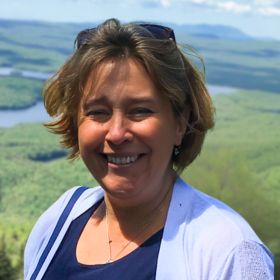
Professor Louise Serpell
Author
Professor Louise Serpell is an Emerita Professor of Biochemistry at the University of Sussex. Her research focuses on how proteins misfold and form amyloid structures linked to Alzheimer’s disease and other neurodegenerative conditions, using approaches from structural biology and molecular biophysics. Louise completed her DPhil at the University of Oxford and later established her own research group in the UK. Alongside her research career, she has been active in mentoring, public engagement, and supporting early career researchers.

 LSE Impact Blog
 Dementia Researcher
 Nature Careers Blog