 Print This Post

Neuroimaging Dementia Biomarkers - AAIC Neuroscience Next

Neuroimaging Dementia Biomarkers - AAIC Neuroscience Next
Physiological and Behavioural Biomarkers - AAIC Neuroscience Next Manchester
Dementia Technology Biomarkers - AAIC Neuroscience Next Manchester
Cognitive Assessments - AAIC Neuroscience Next Manchester
New Hope in Early Alzheimer's Detection Research - AAIC Neuroscience Next
The Road to AAIC Neuroscience Next 2026
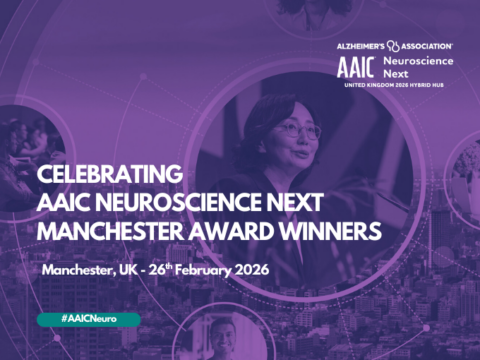
On 26 February 2026, we welcomed researchers to Manchester for AAIC Neuroscience Next Manchester, part of the global AAIC Neuroscience Next programme. The focus of the day was biomarkers across dementia research, spanning cognition, behaviour, imaging and technology.
If you were not able to join us in person, you can now watch the session recordings via our curated playlist.
Cognitive Assessments
Chaired by Dr Rhian Convery from University College London and Viktorija Smith from the University of Cambridge, this session placed cognition firmly at the centre of biomarker research.
Professor Masud Husain explored scalable digital cognitive testing and the potential for high frequency measurement in both trials and clinical care. Dr Chloe Fawns Ritchie examined how device type influences remote cognitive data in UK Biobank. Lightning talks from Dr Laura Stankeviciute, Toya Pauwels Romero, Dr Kirsty Lu and Dr Alexander Kaula connected digital cognition with plasma biomarkers, gene specific FTD composites, birth cohort findings and reaction time based measures.
Together, the session reinforced that biomarkers only matter if we understand what they mean for thinking, memory and everyday function.
Physiological and Behavioural Biomarkers
Chaired by Kalliopi Mavromati from the University of Glasgow and Rebecca Egerton from Queen’s University Belfast, this session focused on capturing change beyond the clinic.
Dr Francesca Cormack highlighted digital tools that reflect real world function, while Dr Thomas Wilcockson presented work on eye movement tasks in preclinical stages. Lightning talks from Christine Weaver, Dr Matt Bancroft, Dr Kiran K G Ravindran and Dr George Devitt explored speech, gait, sleep and optical approaches as scalable early markers.
The theme was clear: behaviour and physiology offer powerful insight when measured carefully and at scale.
Neuroimaging
Chaired by Dr Michael Stringer from The University of Edinburgh and Dr Darragh Patrick O’Brien from the University of Oxford, this session examined advances in PET and MRI.
Professor David Cash discussed amyloid and tau trajectories, disease staging and improving imaging access. Dr Andreia Rocha compared tau PET tracers and highlighted implications for harmonisation. Lightning talks from Harry Crook, Lorenzo Barcellos, Grace Gillis and Dr Fatemeh Tabassi Mofrad addressed neuroinflammation imaging, MRI based staging and subcortical volumetric biomarkers.
Imaging continues to refine biological staging, while working towards greater accessibility.
Technology Biomarkers
Chaired by Dr Ria Kodosaki from University College London and Dr Mosi Li from The University of Edinburgh, this session explored emerging digital tools.
Dr Cynthia Sandor examined technology driven measurement approaches, and Dr Lukas Hughes Noehrer discussed translating innovation into practice. Lightning talks from Dr Zeke Steer, Labhpreet Kaur, Luna Nordenström and Dr Ahmet Begde covered wearable monitoring, large language model analysis and the integration of digital cognition with plasma biomarkers.
These talks demonstrated how technology is shifting from concept to implementation.
All Biomarkers Panel Discussion
Chaired by Professor Selina Wray from University College London, the panel brought together Professor Masud Husain, Dr Francesca Cormack, Professor David Cash, Dr Marc Suárez Calvet and Dr Cynthia Sandor.
The discussion addressed integration across modalities, disclosure of biomarker results, equity and representation, and the practical challenges of translation into routine care. A consistent message emerged: no single biomarker is enough. The future lies in thoughtful integration.
Fluid Biomarkers
The fluid biomarkers session (Manchester) is not included in this playlist. It remains available for 28 days on the AAIC Neuroscience Next platform. This includes talks from Dr Marc Suarez Calvet, Exploring the latest in fluid biomarkers, to diagnose dementias and Lightning talks from Ellie Crispin, Measuring Nptx1 in extracellular vesicles from genetic frontotemporal dementia mutation carriers. Dr Sonia Wagner Reguero, Linking seeding to pathology: insights from α synuclein RT QuIC in postmortem CSF. Hanjun Zhao, Plasma proteomic signatures of Alzheimer’s neuropathology: insights from Bio Hermes study & Dr Sujin Kang, Organ specific proteomic aging and cognitive performance.
Global AAIC Neuroscience Next On Demand
AAIC Neuroscience Next 2026 was a global, no-cost hybrid conference taking place 23–26 February 2026. It connected researchers and clinicians from hubs in Sydney, Montevideo, San Jose, Nnewi, Prishtina and Manchester, alongside a virtual core scientific programme.
If you pre-registered for the event, the global programme is available to watch on demand for the next 28 days via the AAIC Neuroscience Next platform.
The international plenary sessions brought together global leaders to share perspectives on dementia research, each reflecting key regional and thematic priorities:
- Rachel Buckley (Harvard University) – Global Perspectives: Advancing Dementia Research through an Inclusive Lens (Sydney)
- Lucía Crivelli (FLENI) – Global Perspectives: Integrative Dementia Care and Lifestyle-Based Approaches (Montevideo)
- Jinkook Lee (University of Southern California) – Understanding Lifecourse Exposures and Brain Health (San Jose)
- Chiadi U. Onyike (Johns Hopkins Medicine) – Advancing Dementia Diagnosis, Treatment and Care Across the African Diaspora (Nnewi)
- Jonathan Rosand (Harvard Medical School) – Modernising Approaches to Dementia Risk, Resilience and Brain Health (Prishtina)
- Marc Suárez-Calvet (BarcelonaBeta Brain Research Centre) – Biomarker Advancements in Dementia Diagnosis (Manchester)
These plenaries complement the Manchester hub recordings by placing local discussions on cognition, imaging, behaviour and technology into a broader global context.
If you’re already registered, log in to the AAIC Neuroscience Next platform to explore the full set of global sessions, including plenaries, hub highlights and expert discussions from around the world.