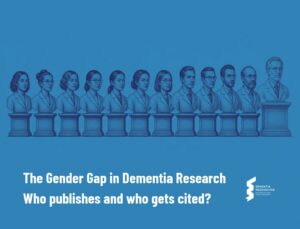
 Women now make up a large share of the dementia research workforce, but a study of more than 400,000 papers shows that men still publish more, are cited more and hold most of the senior author slots. Women who answered the accompanying survey reported using the same strategies as men to get their work seen, but said they faced more barriers along the way.
The paper, Authorship and citation trends in dementia research: A path to equitable career development for scientists, is published open access in Alzheimer’s & Dementia. It comes from a working group set up through two ISTAART Professional Interest Areas, the Alliance for Women Alzheimer’s Researchers (AWARE) and Diversity and Disparities, and was led by Dr Jayalakshmi Viswanathan (Indiana University School of Medicine). The 19-strong international author team includes Dr Diana Karamacoska (Western Sydney University), Dr Beth Shaaban (University of Pittsburgh), Anika Wuestefeld (Lund University), Dr Audrey Low (Mayo Clinic), Dr Claudia Suemoto (University of São Paulo) and Dr Shana Stites (University of Pennsylvania). Karamacoska and Shaaban were also co-authors on our 2025 study of sexism in dementia research careers.
In brief
Across 20 years of dementia research, papers led by men were published in greater numbers and cited more often, and the gap was widest among senior authors. Women are close to parity as first authors in lab, biomarker and translational research, but far fewer make it to the last author position. The authors argue that the evidence base is being shaped mostly by men, and they set out changes for funders, institutions and journals.
How the study worked
The team pulled 400,482 original research articles published between 2003 and 2022 from Web of Science. They sorted them into the five broad research areas of the Common Alzheimer’s and Related Dementias Research Ontology (CADRO): molecular pathogenesis and physiology, diagnosis and disease monitoring, translational research and clinical interventions, population studies, and dementia care and the impact of disease.
The gender of each paper’s first and last author was inferred from their first name using an AI tool called Gender API. Publication counts, citation counts and the relative citation ratio (RCR) were then pulled from the NIH’s iCite tool. The RCR measures how often a paper is cited compared with others in its field and year. The team also used an unsupervised machine learning method to look for clusters of high- and low-performing authors.
To understand what lay behind the numbers, the group held two open sessions at the Alzheimer’s Association International Conference (AAIC) in 2023 and 2024, each attended by around 30 researchers. They followed these up with an anonymous survey of the field, which ran from February to May 2025.
What they found
Men published more and were cited more. Author gender predicted every measure the team looked at. Male authors published significantly more papers than female authors in every research area, and their work received roughly twice as many citations. The gap held after adjusting for field and year: men’s papers had a mean RCR of 2.04, compared with 1.79 for women.
The gap is widest at the top. Male last authors, usually the senior or supervising author, published the most, and female last authors the least. In lab-based, biomarker and translational research, women were close to parity as first authors but remained well behind as last authors. That matches the familiar pattern of plenty of women at junior level and a sharp drop in senior roles. The authors describe it as a bottleneck at exactly the point where influence, resources and recognition come together.
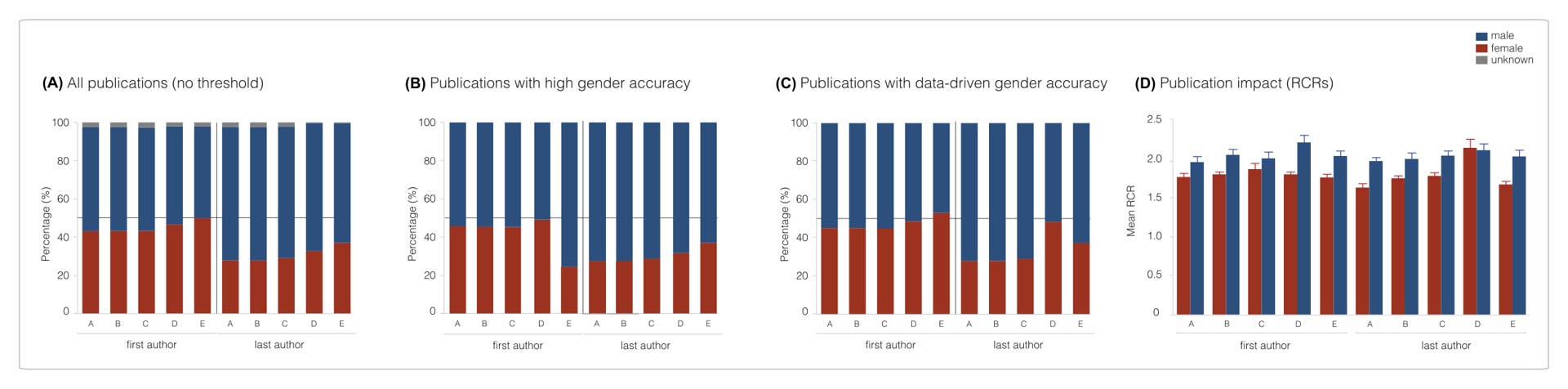
Share of papers by male (blue) and female (red) first and last authors across the five research areas, A to E, and their mean relative citation ratio (D). Fig. 3 from Viswanathan et al., Alzheimer’s & Dementia (2026), reproduced under a CC BY-NC-ND licence.
Care research is less cited, and so is the work women lead. The gender gap in senior authorship was smaller in population studies and in dementia care. These were also the least published and least cited areas in the whole dataset. The authors say this means both care and equity research and the women leading it are undervalued by current academic reward systems. As a result, the evidence that shapes guidelines and policy is drawn mostly from fields where fewer women reach senior positions.
The best-performing groups of men pulled far ahead. The machine learning analysis found that the lowest-performing clusters of male and female authors looked much the same, with median citations of 10 and 9. At the top end, the highest-performing male cluster had a median of 7,541 citations, against 2,022 for the highest-performing female cluster.
Same strategies, more barriers
Of the 163 people who completed the survey, 135 identified as women, 25 as men and three as gender diverse. Women most often said their productivity was held back by administrative work, mentoring and service commitments. Their most common barriers to publishing were lack of time, limited research resources and rejection by journal editors.
Men reported broadly similar pressures, but women reported more barriers overall. The median number of barriers was one for women and zero for men. When it came to getting their work seen, both groups relied on the same things: presenting at conferences, networking and promoting their work on social media. Around a quarter of both men and women said they did nothing to promote their publications.
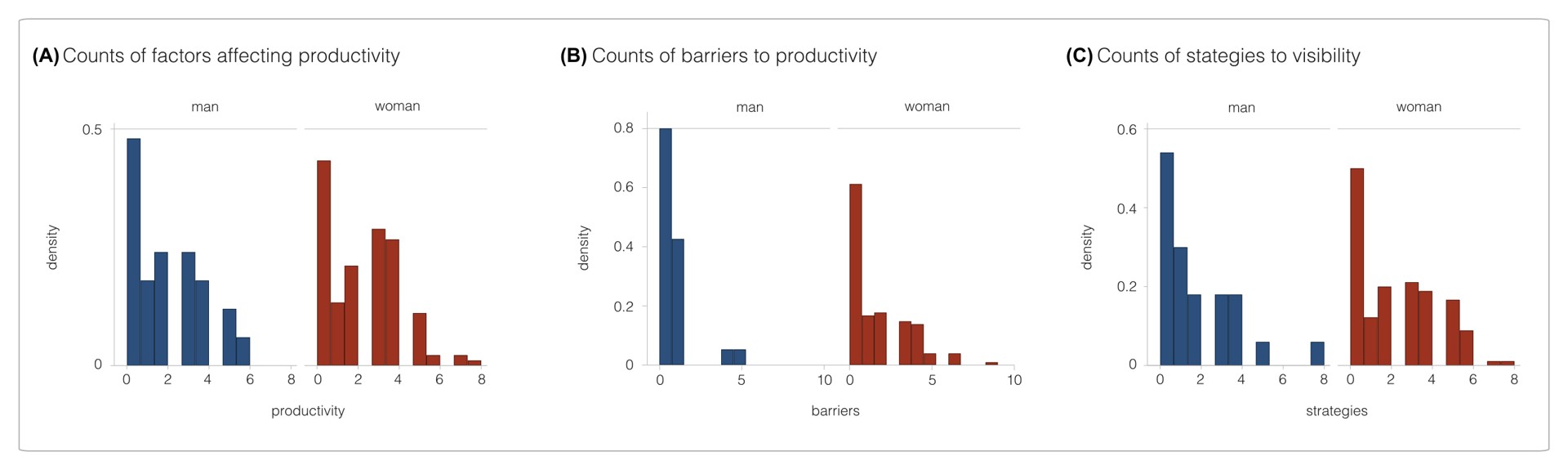
How many factors affecting productivity (A), barriers to publishing (B) and strategies for visibility (C) men and women reported in the survey. Fig. 5 from Viswanathan et al., Alzheimer’s & Dementia (2026), reproduced under a CC BY-NC-ND licence.
In other words, the difference was not in effort or approach. The authors put it down to structural factors, and they point to other research showing that women are more likely to leave academia because of unsupportive workplaces, caring responsibilities, and fewer opportunities for mentoring and promotion. Our own global survey of sexism in dementia research careers, which this paper cites, found much the same.
What the working group recommends
For funders and institutions, the group recommends:
- reforming the criteria for peer review and promotion
- offering mentoring, professional development and cross-network collaboration to all early career researchers
- tracking funding success rates and running bias-awareness initiatives
- providing resources to help researchers overcome barriers and build networks
- correcting the imbalance in funding towards patient-centred care research
For journals and editorial boards, it recommends:
- adopting double-blind peer review
- diversifying editorial boards and reviewer pools
- giving diverse authors routes into high-impact journals
- promoting strong research in ways that don’t depend on who wrote it
- asking authors for citation diversity statements
Some of this is already supported by evidence. The paper cites studies showing that double-blind review increases the number of papers by women that get accepted. It also cites research showing that who the author is shapes how reviewers respond, and that papers by women spend 7–15% longer in review.
Why it matters
Citation counts and senior authorship feed into hiring, promotion and grant decisions, so a gap in these metrics compounds over a career. For early career researchers, the study is a reminder that the numbers used to judge them are not neutral. For anyone who supervises, sits on a panel or reviews for a journal, it is a prompt to look at who gets the last author slot, whose work gets cited, and who ends up doing the committee work.
The authors also make a scientific case. Dementia affects more women than men, and they argue that a field with fewer women in senior roles is more likely to overlook sex- and gender-specific questions that matter for treatment and care.
Limitations
Gender was inferred from first names, which only gives a binary male or female category and doesn’t reflect how people identify. The tool is also less confident with names it hasn’t seen often, so authors with non-Anglo names were more likely to be left out of the analysis. Papers where only an initial was given were excluded. The team chose an accuracy threshold of 74 to keep more of these names in, at the cost of some misclassification.
Raw citation counts favour older papers, and RCR figures only covered papers up to 2021. Most survey respondents were women, which limited comparisons by gender and career stage, and the survey was only available in English. The study shows where the gaps are, not what causes them.
The work was supported by ISTAART and the Alzheimer’s Association, which funded access to Gender API. Several authors hold or have held roles in ISTAART Professional Interest Areas.
Viswanathan J, Karamacoska D, Thakur LS, et al. Authorship and citation trends in dementia research: A path to equitable career development for scientists. Alzheimer’s & Dementia. 2026;22:e71597. https://doi.org/10.1002/alz.71597 (open access).

 Nature Careers Blog

 Dr Becky Carlyle

 Dr Yvonne Couch
 LSE Impact Blog