Your contract has an end date. Your grant has an end date. And at some point, usually later than it should be, someone in HR will send you a letter about it. For most researchers in the UK, that’s normal. About two in three research-only staff are on fixed-term contracts. Yet very few of us are ever told what our fixed-term contract rights are when the money runs out.
This guide sets that out. It covers your fixed-term contract rights in law, what your university should do but doesn’t have to, the money you’re owed, and the traps that catch people out. It’s written for anyone employed on a fixed-term or grant-funded contract at a UK university, with a section for researchers employed by the NHS, a note for PhD students, and notes for dementia researchers along the way. It’s up to date with the Employment Rights Act 2025, including the big change that arrives on 1 January 2027.
In brief
This guide explains what UK researchers on fixed-term contracts can expect. It starts with how common these contracts are and how to work out which kind you’re on. It then covers your core fixed-term contract rights: equal treatment, the four-year rule, what happens when a contract ends, and redundancy pay. A section on the Employment Rights Act 2025 explains what’s already changed and what changes in 2027. Next come the things the law doesn’t cover but your university and funder do, such as redeployment, bridging funding and parental leave, followed by how the rules differ if you work for the NHS. The guide ends with the traps to avoid, a 12-month countdown, questions to ask, a leaving checklist, notes on Scotland and Northern Ireland, and answers to common questions.
Not legal advice. This guide explains the general position in the UK as of October 2026. Your contract, your university’s policies and any local agreements also matter. If you think your employer has treated you unfairly, talk to your union, HR or an employment adviser before deadlines pass.
Two in three researchers work to an end date
If you’re on a fixed-term contract, you’re in the majority. In the latest national figures, about 64% of research-only staff at UK universities were on fixed-term contracts, according to HESA data reported by Times Higher Education. Vitae’s CEDARS 2025 survey found the same 64%, plus another 13% on “funding-limited” contracts. Nearly two-thirds of research-only staff said they didn’t feel their future was secure.
That share has barely moved in more than a decade. It was 76% in 2007/08 and has hovered in the mid-60s ever since, according to UCU’s analysis. And it doesn’t fall evenly. Black and Asian academics, and disabled staff, are more likely to be on fixed-term contracts than their colleagues.
Contracts are often short, too. A quarter of researchers on time-limited contracts in the CEDARS survey had contracts of 12 months or less.
In dementia research
When Dementia Researcher and ISTAART surveyed early career dementia researchers around the world, over 85% agreed that short-term contracts and funding hold back dementia research. Around half were thinking about leaving the field, or might.
Our follow-up analysis found about 90% of respondents were on fixed-term contracts. Interestingly, how long their contract had left made no significant difference to their mental health. Money worries did, with roughly three times the odds of a mental health condition. That’s one reason this guide spends a lot of time on money. Read more about mental health challenges in dementia researchers.
If you’d like support with the emotional side of an ending contract, our guide to career uncertainty in academia is a good place to start. This guide sticks to the practical side: what you’re owed, and how to make sure you get it.
First, check which contract you’re actually on
Before anything else, dig out your contract and find out which of these you have. It changes what applies to you.
- Fixed-term contract. It has an end date, or ends when a specific task or project finishes. Most research contracts are this kind.
- Open-ended contract with a funding end date. Some universities, including UCL, Glasgow, Edinburgh and Cambridge, now employ researchers on contracts that are permanent on paper but tied to a funding end date or “review date”. Birmingham calls these PFED, “Permanent with a Fixed-End date”. You get permanent-staff terms, but when the money runs out your university can still make you redundant.
- Cover contract. You’re covering someone’s maternity, adoption or shared parental leave, and your employer told you so in writing when it took you on. Different rules apply when the person comes back, and you usually won’t get redundancy pay.
Your contract should also say what the end date is, why it’s fixed-term, and how much notice you’ll get. If it doesn’t, ask HR. If you’ve had several contracts in a row, write down the start and end dates of each. You’ll need them later.
If you’re a PhD student
Most funded PhD students in the UK are students, not employees. Your stipend is a tax-free grant rather than a salary, so most of the employment rights in this guide, such as redundancy pay, the four-year rule, notice and unfair dismissal, don’t apply to your studentship. When your funding ends, it isn’t a redundancy. Your rights come from your funder’s terms and your university’s regulations instead.
Funders do give some protection. UKRI-funded students, for example, usually get up to 13 weeks’ paid sick leave in a 12-month period, and up to 52 weeks’ maternity or adoption leave, with 26 weeks on full stipend and 13 weeks at a lower rate (Bristol’s summary sets this out). Other funders and university scholarships have their own rules, so check with your doctoral college.
It’s different if you’re employed. If you’re doing your PhD while on a salary, as some clinical research fellows and NHS staff are, or you’re paid separately for teaching, demonstrating or research assistant work, you have employment rights for that job. Our guide to the stages of a PhD covers the rest of PhD life.

Start with the basics: your contract type, end date and continuous service date shape what happens next.
Your fixed-term contract rights in law
These fixed-term contract rights apply in England, Wales and Scotland. You can enforce them at an employment tribunal. They apply to employees, which covers nearly all university research staff. Northern Ireland has its own version, covered later in this guide.
The right to equal treatment
The Fixed-term Employees Regulations 2002 say your employer can’t treat you less favourably than a comparable permanent colleague just because you’re fixed-term. That covers pay, pension, training and the chance to apply for permanent jobs. The comparison is with a permanent employee at the same workplace doing the same or broadly similar work.
Your employer must also tell you about permanent vacancies. If you think you’ve lost out, you can ask in writing for the reasons, and they must reply within 21 days.
There are two catches. Your employer can compare the whole package, so something better elsewhere can make up for something missing. And they can treat you differently if they can “objectively justify” it, a term the law doesn’t define.
In practice, most universities give fixed-term staff the same pay scale, increments, holiday and pension as everyone else. Where people lose out is subtler. You might hear about internal-only jobs late, or find yourself back on probation with every new contract.
The four-year rule
If you’ve worked for the same employer for four years or more on back-to-back fixed-term contracts, you automatically become permanent when your contract is next renewed. The only exception is if your employer can objectively justify keeping you fixed-term.
- It only kicks in on a renewal. A single four-year contract doesn’t trigger it.
- You can ask in writing for confirmation that you’re now permanent. Your employer must reply within 21 days.
- If they say no, you can ask a tribunal to decide, but only while you’re still employed.
- UCU has template letters for making the request and following it up.
Short-term grant funding on its own isn’t necessarily a good enough reason to keep you fixed-term. In 2008, a tribunal declared a University of Aberdeen research fellow permanent after three grant-funded contracts over about nine years, for exactly that reason.
Two things to know before you get your hopes up:
- Your university may have a local agreement that changes the limit. Universities and unions can agree a different limit. York’s, for example, lets research staff stay fixed-term for “up to three contracts or six years, whichever is longer”. Ask HR or your union whether one applies to you.
- Permanent doesn’t mean safe. Becoming permanent removes the end date, but your employer can still make you redundant when the grant runs out. What you gain is a proper redundancy and redeployment process, rather than your contract simply lapsing.
When your contract ends, it’s a dismissal
This surprises a lot of people. When a fixed-term contract ends without a renewal, the law treats it as a dismissal, whatever your university calls it. When the reason is that the project or funding has ended, that’s usually a redundancy.
That matters, because a dismissal has to be fair. The contract simply running out isn’t automatically a fair reason. A fair process normally includes:
- a meeting with you before the end date
- the chance to respond and suggest alternatives
- a genuine look at other jobs you could do
- written confirmation of the decision
- a right of appeal
Right now, you can only bring an unfair dismissal claim once you have two years’ service. From 1 January 2027 that drops to six months. More on that below.
You can also ask for written reasons for your dismissal. At the moment you need two years’ service for that, unless you’re pregnant or on maternity or adoption leave, when there’s no service requirement. From 1 January 2027 it drops to six months.
The exception: cover contracts
If your employer told you in writing when it took you on that you’re covering someone’s maternity, adoption or shared parental leave, the rules are different. When they come back, the law treats ending your contract as “some other substantial reason”, not redundancy. Your employer still has to handle it reasonably, but universities usually won’t pay redundancy pay.
Redundancy pay: the minimum you should expect
This section covers statutory redundancy pay, the minimum the law says you must get. Many universities have their own redundancy policy, and some pay more than this, so treat these figures as the floor, not the ceiling. Always check your own university’s policy. If you’re employed by the NHS on Agenda for Change terms, your redundancy pay works differently and is usually much higher, as the NHS section explains.
If you have two years’ continuous service when your contract ends, you’re entitled to statutory redundancy pay. It’s worked out from your age, your years of service and your weekly pay:
| For each full year you worked when you were… | You get |
|---|---|
| Under 22 | Half a week’s pay |
| 22 to 40 | One week’s pay |
| 41 or over | One and a half weeks’ pay |
There are limits on the statutory amount. Only your last 20 years count, and there’s a cap on a week’s pay of £751 (from 6 April 2026). So the most the law guarantees is £22,530. The first £30,000 of redundancy pay is tax-free. gov.uk has a calculator that will do the sums for you.
A worked example
Sam is 30 and earns £39,000 a year, which is about £750 a week. They’ve worked for the university for three full years on back-to-back contracts. Their statutory redundancy pay is 3 × £750 = £2,250. Because of the cap, the calculation treats anyone earning more than about £39,000 as if they earned £751 a week. So a postdoc on £45,000 with three years’ service would get £2,253, not £2,596. These are statutory figures. If Sam’s university has an enhanced redundancy scheme, Sam could get more.
That’s not a lot of money. Some universities have their own redundancy schemes that pay more than the statutory minimum, but many don’t. When UCU asked universities in 2023, only a handful, including Leeds, Queen’s University Belfast and Ulster, said they paid significantly more. Check your university’s redundancy policy to see where it stands.
A few other points worth knowing:
- You can’t sign away redundancy pay. A clause saying you give it up is void if you agreed, renewed or extended your contract on or after 1 October 2002.
- Turning down a suitable alternative job can cost you it. If your university offers you a suitable job and you unreasonably refuse, you can lose your redundancy pay.
- You can take paid time off to look for work. With two years’ service, you’re entitled to reasonable time off during your notice period to look for a job or arrange training. Your employer only has to pay up to 40% of a week’s pay for this time.
What the Employment Rights Act 2025 changes
The Employment Rights Act 2025 became law in December 2025, and its changes are arriving in stages. Nothing in it targets fixed-term researchers specifically, but several changes affect you.
| When | What changes |
|---|---|
| 6 April 2026 (in force) | Paternity leave and unpaid parental leave from your first day. Statutory sick pay from your first day of sickness, whatever you earn. |
| 1 October 2026 (in force) | You have six months, not three, to bring most tribunal claims. |
| 1 January 2027 | Unfair dismissal protection after six months’ service instead of two years. The cap on compensation goes, and you can ask for written reasons after six months. |
| March 2027 | Limits on “fire and rehire”, where employers dismiss staff and offer them their job back on worse terms. |
| October 2027 | Stronger protection from dismissal for pregnant women and new parents, from day one. |
Why 1 January 2027 matters
At the moment, if your contract ends before you’ve done two years, you generally can’t claim unfair dismissal. For researchers on one- or two-year contracts, that’s left the end-of-contract process with very little teeth.
From 1 January 2027, anyone with six months’ service can challenge an unfair process. What counts is the date your contract ends. A contract ending on 31 December 2026 falls under the old rules. One ending on 1 January 2027 or later falls under the new ones.
It’s important to be clear about what this doesn’t do:
- It doesn’t give you a right to have your contract renewed. It means your university has to follow a fair process before letting you go.
- Redundancy pay still needs two years’ service. That hasn’t changed.
A lot of older advice online, including some union guidance, still says you need two years for unfair dismissal and have three months to claim. Check the date on anything you read. Acas keeps its guide to the Employment Rights Act up to date.
What your university should do
Most of what shapes your final months isn’t in the law at all. It’s in your university’s policies. That includes when consultation starts, whether you get priority for other jobs, and whether there’s bridging money. These vary a lot, and they only bind your university if they’re in your contract or a collective agreement. But knowing them gives you something to point to.
The sector’s own guidance, agreed between employers and unions in 2002, says permanent contracts should be the norm. It also says universities should consider redeployment before a contract ends. The Researcher Development Concordat, which most universities have signed, commits them to improving job security through better redeployment and more open-ended contracts. You can’t enforce either, but both are worth quoting.
The usual timeline
Every university does it differently, but the pattern usually looks something like this:
- A letter inviting you to a consultation meeting, four to six months before your end date.
- A consultation meeting, usually no later than three months before. You can bring a union rep or a colleague.
- Written confirmation of the outcome, and your notice.
- A right of appeal, usually within five to ten working days.
Some universities start much earlier. Glasgow begins planning ten months out. Others leave it later than they should. If you’re within six months of your end date and haven’t heard anything, ask.
Redeployment
Most universities have a redeployment scheme that gives staff at risk of redundancy priority for other jobs. In UCU’s 2023 survey, 90% of universities offered some form of redeployment. But 30% couldn’t say whether they had actually redeployed any research staff. The scheme on paper and the scheme in practice can be very different things.
Three things to check in your university’s policy:
- When you qualify. At UCL, fixed-term staff get priority after six months’ service. At Cambridge it’s two years.
- Whether it covers research jobs. Some schemes exclude research roles, or let departments skip priority candidates for research posts. In practice, redeployment often leads to professional services jobs rather than another postdoc.
- How trial periods work. You’ll usually get a trial period in a new role, often four to eight weeks. If it doesn’t work out, check whether you keep your redundancy rights.
Bridging funding
Bridging funding covers your salary for a short gap between grants. In UCU’s survey, 59% of universities offered some kind of bridging, but most of it was ad hoc and depended on a next grant being likely.
Formal schemes are short, and usually your PI has to apply. UCL’s scheme, for example, offers up to six months where the next award is already secured, and up to three months otherwise. It expects the PI to raise it at least six months, and ideally 9 to 12 months, before funding ends. Aston offers up to 12 weeks, and Lancaster up to three months for career development.
The lesson is simple: talk to your PI about bridging early. By the time you’re three months from the end, it’s often too late.
Parental leave, sickness and funder rules
Maternity and parental leave
Going on maternity leave doesn’t extend a fixed-term contract. But some of your entitlements carry on after it ends:
- Statutory Maternity Pay carries on for the full 39 weeks if you qualified for it before your contract ended. To qualify, you need 26 weeks’ service by the 15th week before your baby is due, and to earn at least £129 a week on average.
- Enhanced maternity pay from your university usually stops when your contract ends.
- Not renewing your contract because you’re pregnant is automatically unfair, and it’s pregnancy and maternity discrimination.
- You may get priority for redeployment. Since April 2024, people who are pregnant, on maternity, adoption or shared parental leave, or recently back, get priority for any suitable vacancy in a redundancy. For pregnancy and maternity, it lasts until 18 months after the birth. Acas has a clear guide. Check with HR how your university applies it when a fixed-term contract simply ends.
What your funder will and won’t pay for
If you take parental or long-term sick leave, your funder decides whether to extend your grant. And here’s the catch: a grant extension doesn’t automatically extend your employment contract. Your university has to agree to that separately.
- Alzheimer’s Society can pause a grant and offers a no-cost extension appropriate to the period of leave. It decides on cover case by case. Requests for no-cost extensions are due at least six months before the grant ends (details).
- Alzheimer’s Research UK expects the university to meet the cost of long-term leave. It can suspend the grant, and the usual 12-month limit on no-cost extensions doesn’t apply. Requests are due at least three months before the end date (details).
- NIHR expects the university to cover maternity, paternity and sick leave from the funding it already pays. You can ask for an extension through the Programme Manager (details).
- Wellcome pays salary during the grantholder’s parental or sick leave and extends their end date to match. Other staff on the grant need to ask (details).
- UKRI can extend grants to cover parental or sick leave, and pays the extra costs.
Where a funder pays nothing extra, it comes down to your university. Some cover the gap centrally. Oxford’s Mathematical, Physical and Life Sciences division, for example, extends fixed-term researchers’ contracts for parental leave whatever the funder. Ask your research office before your leave starts.
Moving universities: what carries over and what doesn’t
Your continuous service carries across back-to-back contracts with the same employer, including moves between departments. Even a short gap between contracts can sometimes still count, though that’s decided case by case.
Moving to another university usually resets the clock. That means a new two-year wait for redundancy pay, a new unfair dismissal clock and a new four-year clock.
There’s one exception, and it only applies to redundancy pay. A legal order lets service carry over between certain public bodies, including most post-1992 universities (the former polytechnics), FE colleges and councils. It doesn’t cover the older universities. So a postdoc moving between two Russell Group universities starts again from zero. Even between post-1992 universities, there are conditions, so check with HR before you move.
If you’re moving with a grant, our guide on how to transfer a research grant covers the funding side. NHS staff have different rules on service, as the NHS section explains.
Fixed-term contract rights in the NHS
Plenty of dementia researchers work for the NHS rather than a university: research nurses, clinical research practitioners, trial coordinators and NHS-employed research fellows among them. The law in this guide still applies to you. That covers equal treatment, the four-year rule, a contract ending counting as a dismissal, and the Employment Rights Act changes. But if you’re on Agenda for Change terms, the NHS Terms and Conditions of Service Handbook changes some important details, often in your favour.
NHS redundancy pay is more generous
If you have two years’ continuous NHS service, Agenda for Change redundancy pay is one month’s pay for each complete year of service, counting up to 24 years. There are no age bands. In England, the calculation uses a salary of at least £23,000 and no more than £80,000 a year, and no payment can be more than £160,000. NHS Employers says staff on fixed-term contracts that end through redundancy, with two years’ service, should get the same treatment as permanent staff.
To compare with the worked example above: three years’ service on £39,000 would mean about three months’ pay, roughly £9,750, against £2,250 under the statutory scheme.
Your NHS service can follow you
Unlike moving between universities, service with one NHS employer can count at another. To qualify for redundancy pay, you need two years’ continuous NHS service, and a break of a week or more between NHS jobs breaks that. Once you qualify, earlier NHS service counts towards how much you get, as long as the gaps were no longer than 12 months. Previous NHS service also counts towards sick pay and annual leave. Time spent working for a university doesn’t normally count.
There’s a catch that mirrors the university rules. You won’t get NHS redundancy pay if you start a suitable NHS job within four weeks of your contract ending, or if you unreasonably turn one down. You also need to claim within six months.
NHS maternity pay
To get NHS occupational maternity pay, you need 12 months’ NHS service by the 11th week before your baby is due. Normally you agree to return to NHS work for at least three months afterwards, or pay some of it back. The handbook has specific rules for fixed-term staff. If you qualify and your contract is due to end after the 11th week before your baby is due, your employer extends it so you can take your full 52 weeks’ leave. And if your contract would have ended anyway, you don’t have to repay. Ask HR exactly how these apply to you before you go on leave.
Scotland, Wales and Northern Ireland
The core NHS redundancy rules are the same across the UK, but the £23,000 floor and £80,000 cap only apply in England. NHS Scotland has a national fixed-term contract policy that names research posts as a valid reason for a fixed-term contract, aims for nobody to stay temporary for more than two years, and offers up to three months’ redeployment. Wales has an All Wales Redundancy Policy, and Northern Ireland’s health and social care bodies use the same UK handbook.
Doctors and clinical academics
Doctors aren’t on Agenda for Change. Resident doctors and consultants have their own contracts. The BMA can tell you what applies to yours.
Clinical academics employed by a university with an honorary NHS contract are on the university’s terms, not the NHS’s. The honorary contract normally ends when the university contract does. If you’re the other way round, employed by the NHS with an honorary university contract, NHS terms apply. Check who your actual employer is on your contract and payslip.
Your NHS pension
If you’ve been in the NHS Pension Scheme for two years or more, you can leave your pension in the scheme until you retire. With less than two years, you can usually get a refund of your contributions, unless you rejoin within 12 months. The NHS Business Services Authority has the details.
If you’re on a visa
If your employer sponsors your job under the Skilled Worker route, your contract ending affects your right to stay. Your university must tell the Home Office within 10 working days that your sponsored job has ended. The Home Office then usually cuts your permission to stay to 60 days, unless it was due to end sooner anyway. To stay longer, you’ll need a new sponsored job.
Be careful about travelling. If you’re abroad when the Home Office issues its notice, your permission can end on the date of the notice. If you leave the UK after it, it ends the day you leave. Even travelling after your employer has reported your job ending is risky, because Border Force can cancel your permission when you come back. Law firm Lewis Silkin has a useful explainer. The Home Office has also been acting faster than it used to, so get advice early from your university’s immigration team.
Ten traps nobody tells you about
Most researchers know roughly what their fixed-term contract rights are. Where people get caught out is in the gaps between the law, university policy and funder rules.
- Taking a cover contract can cost you your redundancy rights. At some universities, if your funded contract ends and you move straight onto a cover contract, you lose your redeployment and redundancy pay rights. Bath’s guidance spells this out. Ask before you accept.
- Moving to an older university resets your service. Two years at one Russell Group university doesn’t count towards redundancy pay at the next.
- Accepting a redeployment can also end your redundancy pay. If you take a suitable new job at the same university, you won’t usually get redundancy pay, because you haven’t lost your job.
- Turning down a suitable job can too. Unreasonably refusing a suitable alternative can cost you your redundancy pay.
- Becoming permanent after four years doesn’t stop redundancy. And you have to ask a tribunal to confirm it while you’re still employed.
- Your university may have stretched the four-year limit. Check for a local agreement.
- Working past your end date changes it. If you carry on working without new paperwork, the law treats your end date as changed, and your university then has to give you proper notice. Get any extension in writing.
- Redeployment priority may not cover you. Some schemes need up to two years’ service, and some exclude research jobs.
- A grant extension isn’t a contract extension. Your funder agreeing to more time doesn’t mean your university has agreed to employ you for it.
- Enhanced maternity pay stops with your contract. Statutory pay carries on, but only if you qualified for it in time.
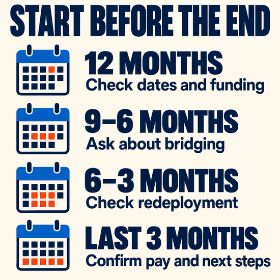
Start early to give yourself more time to explore funding, redeployment and your next move.
The 12-month countdown
The earlier you start, the more options you have. Here’s what to do and when.
12 months out
- Confirm your end date in writing, and check your contract type.
- Work out your continuous service. Note whether you’ll pass two years (redundancy pay) or four years (the four-year rule) before the end.
- Ask your PI what the funding plan is, and whether any applications are in that could keep you on.
- Find your university’s policies on ending fixed-term contracts, redeployment and bridging funding.
- Join a union if you haven’t already.
9 to 6 months out
- Ask your PI to talk to the Head of Department about bridging funding or a no-cost extension.
- If you’re planning leave, check your funder’s rules and talk to your research office.
- Start looking at jobs, inside and outside your university. Our dementia research jobs board is a good place to start.
- Think about what papers and data you need to finish, and agree authorship.
6 to 3 months out
- You should receive a letter about your contract ending and an invitation to a consultation meeting. If you haven’t by four months out, ask HR.
- Find out when you go on the redeployment register, and sign up.
- Ask HR to consider you under redeployment for any vacancies you’re interested in.
The last three months
- Go to your consultation meeting, ideally with a union rep or colleague, and take notes.
- Note the deadline for any appeal.
- Plan your remaining holiday. Take it, or check your final pay will include it.
- Use your right to paid time off to look for work, if you have two years’ service.
- Work through the leaving checklist below.
After you leave
- If you think the process was unfair, you normally have six months to start a claim. You have to contact Acas for early conciliation first.
- Ask about honorary or visiting status if you need to finish papers.

Your PI and HR hold different parts of the picture. Speak to both before your contract ends.
Questions to ask your PI and HR
These conversations can feel awkward. Having the questions written down helps.
Ask your PI
- What’s the funding position for my post after the current end date?
- Are there any applications in, or planned, that could fund my post?
- Would you be willing to apply for bridging funding or a no-cost extension? When would you need to start?
- Which papers can I realistically finish before I go, and what’s the plan for authorship on the rest?
- Will you be a referee for me?
Ask HR
- What’s my continuous service date?
- Is there a local agreement on the four-year rule?
- When will the consultation process start, and when do I go on the redeployment register?
- Am I entitled to redundancy pay, and is it statutory or enhanced?
- How much holiday will I have left, and will you pay me for any I don’t take?
- If I take another contract here, such as a cover post, what happens to my redundancy rights?
- Can I have honorary or visiting status after I leave?
Your leaving checklist
None of the university guidance we looked at brought all of this together, so here it is.
- Holiday. Take what’s left, or check your final salary will include it.
- Redundancy pay. Check the amount and when you’ll get it.
- Pension. Find out what happens to your pension when you leave. With USS, the NHS Pension Scheme and most other workplace schemes, you can usually leave your savings in the scheme or move them. Check with the scheme before deciding.
- Email and data. Find out when your university account will close. Save anything you need, forward important contacts, and check what data you’re allowed to take with you under your data-sharing and ethics agreements.
- Honorary or visiting status. Many universities offer this so you can keep library access and an affiliation while you finish papers. Liverpool’s researcher development team has written about honorary contracts as a bridge.
- References. Agree who’ll write them before you go, especially if your PI might move on.
- Your P45 and tax. You’ll get a P45 when you leave. If you don’t start another job straight away, you may be able to claim back tax you’ve overpaid.
- Benefits. If there’s a gap before your next job, check whether you can claim New Style Jobseeker’s Allowance, which depends on your National Insurance record, or Universal Credit, which depends on your income and savings. Redundancy pay may count as savings.
- Visa. If you’re sponsored, know your dates and get advice before you travel.
- Your profiles. Update your ORCID, LinkedIn and any researcher profiles with an email address you’ll keep.

Before your last day, confirm the practical details that will matter after you leave.
Scotland and Northern Ireland
Scotland follows the same employment law as England and Wales. The rules in this guide apply. Scottish universities set their own policies, so the timelines may differ.
Northern Ireland has its own version of the fixed-term regulations, with the same four-year rule. But there are differences:
- Unfair dismissal protection starts after one year’s service.
- The cap on a week’s pay for redundancy is higher, at £783.
- Fixed-term contracts of more than three months count towards collective consultation.
- Most of the Employment Rights Act 2025 doesn’t apply.
nibusinessinfo.co.uk has a summary of fixed-term contract rights in Northern Ireland.
Who to talk to
- Your PI, about funding, bridging and your next steps.
- HR, about your dates, your rights and the process.
- Your research office, about grant extensions and funder rules.
- Your union. UCU branches deal with ending contracts all the time and can come to meetings with you. Join early, as unions don’t always take on problems that started before you joined.
- Your research staff association, if your university has one.
- If you work for the NHS, your union is more likely to be the RCN, UNISON or the BMA, and your trust’s HR team will have its own redeployment policy.
- Acas, for free, confidential advice on employment and fixed-term contract rights. Call 0300 123 1100.
- Your university’s careers service, which is usually open to research staff as well as students.
Further reading
- gov.uk, Fixed-term employment contracts. The official basics.
- Acas, Employment Rights Act 2025. What’s changing and when.
- UCU, Requesting confirmation of permanence. Template letters for the four-year rule.
- Vitae, CEDARS 2025 policy briefing. The latest survey of research staff.
- Dementia Researcher, Career uncertainty in academia. Coping with the uncertainty and planning what’s next.
- Dementia Researcher, Facing redundancy in academia. A researcher’s own experience.
Check your own fixed-term contract rights
Use these tools to see which rights apply to you, estimate your redundancy pay, keep track of the 12-month countdown and test what you’ve learned. They’re a guide, not legal advice, and nothing you enter leaves your browser.
Which rights apply to you?
Answer four questions to see what you're entitled to.
Fill in your situation and the list updates. It starts with an example: a university postdoc with two and a half years' service. Nothing you enter leaves your browser.
Estimate your redundancy pay
See the statutory minimum and the NHS figure side by side.
Statutory pay is the legal minimum. Your university's own policy may pay more. NHS Agenda for Change staff use a different, usually higher, scheme.
Statutory figures use the cap of £751 a week from 6 April 2026, count up to 20 years, and give half a week's pay for each year under 22, one week for each year aged 22 to 40, and one and a half weeks for each year aged 41 or over. The NHS figure uses the England rules in Section 16 of the Agenda for Change handbook: one month's pay per complete year, up to 24 years, with pay treated as at least £23,000 and no more than £80,000. Both need two years' continuous service. These are estimates, not advice. Use the gov.uk calculator or ask HR for your exact figure.
Your 12-month countdown checklist
What to do, and when, as your end date gets closer.
Tick things off as you go. Your ticks are saved in this browser only.
Test what you know
Seven quick questions, one at a time.
Common questions about fixed-term contract rights
Click a question to see the answer.
Your fixed-term contract rights
What rights do I have as a researcher on a fixed-term contract?
Your employer must treat you no less favourably than comparable permanent staff, including on pay, pension and training, and must tell you about permanent vacancies. After four years on back-to-back fixed-term contracts, you usually become permanent automatically. When your contract ends, that counts as a dismissal, so your employer has to handle it fairly. With two years’ service, you’re entitled to statutory redundancy pay.
I’m a PhD student. Does this apply to me?
Mostly not. Most funded PhD students in the UK are students rather than employees, and your stipend is a tax-free grant, not a salary. So redundancy pay, the four-year rule, notice and unfair dismissal don’t apply to your studentship, and the end of your funding isn’t a redundancy. Your rights come from your funder’s terms and your university’s regulations, which usually include some paid sick leave and maternity leave. If you’re employed on a salary while doing your PhD, or paid for teaching or research assistant work, you do have employment rights for that job.
Pay, leave and pension
Am I entitled to the same pay and benefits as colleagues on permanent contracts?
Yes, as a rule. The Fixed-term Employees Regulations say your employer can’t treat you less favourably than a comparable permanent colleague on pay, pension, holiday, training or other benefits, unless your employer can objectively justify it. Your employer can look at your package as a whole, so something better elsewhere can make up for one thing missing. Most universities put fixed-term staff on the same pay scale, with the same increments, leave and pension. If you think you’re losing out, you can ask in writing for the reasons, and your employer must reply within 21 days.
Your contract and its terms
Does my employer have to explain why my contract is fixed-term?
Your written statement of terms must say when your fixed-term contract ends, or how long your employer expects a temporary job to last. The law doesn’t require your employer to give the reason. But sector guidance agreed by universities and unions says universities should only use fixed-term contracts where there’s a genuine, objective reason, and many university policies say the reason, such as the end of a grant, should be in your contract. If you’ve been on back-to-back contracts for four years or more, you can ask your employer to confirm in writing that you’re now permanent, or to explain why not. They must reply within 21 days.
Am I entitled to sick pay, annual leave and pension contributions?
Yes, on the same basis as permanent colleagues. Statutory sick pay is now paid from your first day of sickness, and university sick pay schemes, which often depend on length of service, should apply to you in the same way. You’re entitled to at least 5.6 weeks’ paid holiday a year, though universities usually give more. You should be auto-enrolled into a workplace pension if you’re eligible, and you can join the same scheme as permanent colleagues, such as USS, with the same employer contributions. NHS staff are usually in the NHS Pension Scheme.
When your contract ends
What happens when my contract reaches its end date?
If your employer doesn’t renew or extend it, your employment ends on that date. In law that’s a dismissal, and if the funding or project has ended, it’s usually a redundancy. Your university should start a process well before then, usually with a letter and a consultation meeting, a look at other jobs, written confirmation and a right of appeal. You’re owed your pay up to the end, payment for untaken holiday and, if you have two years’ service, redundancy pay. If you carry on working past the end date without new paperwork, the law treats your contract as continuing, and your employer then has to give you proper notice.
Does the end of a fixed-term contract count as a dismissal?
Yes. When a fixed-term contract ends without a renewal, the law treats it as a dismissal, whatever your university calls it. That means your employer needs a fair reason, usually redundancy, and a fair process. You can currently challenge an unfair dismissal if you have two years’ service. For contracts ending on or after 1 January 2027, that drops to six months. Some reasons, such as pregnancy, are automatically unfair from your first day.
Notice, early endings and holiday
How much notice should I get if my contract will not be renewed?
Legally, a fixed-term contract that ends on its agreed date doesn’t need notice, because you already know when it ends. In practice, most universities give notice anyway, often around three months, and their policies set out when the process should start. Sector guidance says universities should consider options up to four months before the end and consult up to three months before. Check your contract and your university’s policy. If your employer ends your contract early, you’re entitled to at least the statutory minimum notice: one week after a month’s service, then a week for each complete year, up to 12 weeks, or your contractual notice if that’s longer.
Can my employer end my contract before the agreed finish date?
Only if your contract allows it, usually through a notice clause, and then they must give you the notice it sets out. If there’s no notice clause, ending your contract early is likely to be a breach of contract, and you may be able to claim the pay you would have received. Either way, it’s still a dismissal, so your employer needs a fair reason and a fair process. If your employer ends 20 or more contracts early at the same site, collective consultation rules apply too. Talk to your union straight away.
Holiday when you leave
What happens to my unused annual leave when my contract ends?
Your employer must pay you for any statutory holiday you’ve built up but not taken. What happens to the extra holiday most universities give depends on your contract and your university’s policy. Many universities would rather you took your remaining leave before you go, and some can ask you to take it during your notice period. If you’ve taken more leave than you’ve built up, your contract may allow your employer to deduct it from your final pay. Plan your remaining leave with your PI early.
Redundancy pay and time off
Am I entitled to redundancy pay when my research funding runs out?
Yes, if you have two years’ continuous service when your contract ends. You won’t usually get it if your job was to cover someone’s leave, if you accept another suitable job at the same university, or if you unreasonably turn one down. Statutory redundancy pay depends on your age, years of service and weekly pay, with a cap of £751 on a week’s pay, so the most the law guarantees is £22,530. That’s the legal minimum. Your university’s own redundancy policy may pay more, so check it. NHS staff on Agenda for Change terms get one month’s pay for each complete year of service.
Can I take paid time off to attend interviews or look for another job?
If you’ll have two years’ continuous service by the end of your notice period, you have a legal right to reasonable paid time off during your notice to look for work or arrange training. Your employer only has to pay up to 40% of a week’s pay for this time. Many universities are more generous, especially for interviews for jobs within the university. Ask your manager and HR what your university allows.
Staying on or moving on
What should my employer do to help me find another role within the university?
A fair dismissal process includes genuinely looking at other jobs you could do. Beyond that, it depends on your university’s redeployment policy. Most have one, and it usually means going on a redeployment register, getting first consideration for suitable vacancies, and a trial period in a new role, often four to eight weeks. When you qualify varies, from six months’ service at some universities to two years at others, and some schemes don’t cover research roles. If you’re pregnant or on family leave, you have a legal right to priority for suitable vacancies. Ask HR when you go on the register and what it covers.
Do I have to apply and interview for a job I am already doing?
Not always. If the same role continues on new funding, many universities can simply extend or renew your contract without advertising it. Some university policies or funder rules do require universities to advertise a post. If that happens, ask whether you’ll count as a priority candidate under redeployment. If the work you’re doing carries on and your university appoints someone else to do it, the end of your contract may not be a genuine redundancy, so talk to your union or HR.
The four-year rule and continuous service
After four years on fixed-term contracts, am I entitled to a permanent contract?
Usually, yes. If you’ve had four or more years’ continuous service on back-to-back fixed-term contracts with the same employer, you become permanent when your contract is next renewed, unless your employer can objectively justify keeping you fixed-term. A local agreement can change the limit, so check with HR or your union. You can ask in writing for confirmation, and your employer must reply within 21 days. Becoming permanent removes the end date, but it doesn’t stop your employer making you redundant if the funding ends.
Can my university keep extending my fixed-term contract because my role depends on grant funding?
It can renew your contract for up to four years in total. After that, a further renewal makes you permanent, unless the university can objectively justify keeping you fixed-term. Grant funding on its own isn’t necessarily enough. In 2008, a tribunal declared a University of Aberdeen research fellow permanent after about nine years on grant-funded contracts. Some universities have local agreements that change the limit, and many now use open-ended contracts with a funding end date instead.
Gaps between contracts
Do gaps between contracts affect my length of service and employment rights?
They can. As a general rule, if there’s a full week (Sunday to Saturday) when you have no contract, your continuous service breaks and the clock restarts. That affects redundancy pay, unfair dismissal and the four-year rule. Some gaps don’t break continuity, such as a temporary break in the work, but that’s decided case by case. Moving to a different university normally restarts your service anyway. In the NHS, earlier NHS service can still count towards redundancy pay if the gaps were no longer than 12 months. Wherever you can, get any extension agreed before your current contract ends.
Different employers and contracts
I work for the NHS. Do the same rules apply?
The employment law does, including the four-year rule and the rules on fair dismissal. But if you’re on Agenda for Change terms, NHS redundancy pay is more generous: one month’s pay for each complete year of service, once you have two years’ continuous NHS service. Service with other NHS employers can also count, which isn’t the case when you move between universities. Doctors have their own contracts, and clinical academics employed by a university are on university terms.
My contract says permanent but has a funding end date. Am I fixed-term?
Not technically. You’re on an open-ended contract, so you get permanent-staff terms and the four-year rule doesn’t apply. But when the funding ends, your university can still make you redundant, and it should follow its redundancy and redeployment process. Check your university’s policy on these contracts.
Family leave and visas
What happens if my funding ends while I am pregnant or on maternity, adoption or shared parental leave?
Your employer can’t end your contract because you’re pregnant or on leave. That’s automatically unfair and is discrimination. But leave doesn’t extend a fixed-term contract, so it can still end if the funding runs out. If you qualified for Statutory Maternity Pay before your contract ended, it carries on for the full 39 weeks, while enhanced university pay usually stops. Other statutory pay for adoption and shared parental leave has its own rules, so check with HR. If the end of your contract is a redundancy, you have priority for any suitable vacancy, during pregnancy and for up to 18 months after the birth or adoption. Funders’ rules on extending grants for leave vary, so talk to your research office before your leave starts. NHS staff on Agenda for Change may have their contract extended to cover their full maternity leave.
How could the end of my contract affect my visa and right to stay in the UK?
If you’re on a Skilled Worker visa, your university must tell the Home Office within 10 working days that your job has ended. The Home Office then usually cuts your permission to stay to 60 days, unless it was due to end sooner anyway. To stay longer, you’ll need a new sponsored job, or to switch to another visa route. Be careful about travelling abroad around this time, as your permission can end while you’re away, or Border Force can cancel it when you come back. The Home Office has been acting faster than it used to, so get advice from your university’s immigration team early.
Planning ahead and getting help
When should I start planning for the end of my contract?
About 12 months before your end date. That gives your PI time to look for bridging funding, which they often need to raise six to twelve months ahead, and gives you time to apply for jobs. Your university’s formal process usually starts four to six months before the end.
What is changing for fixed-term staff in January 2027?
From 1 January 2027, the law protects you against unfair dismissal after six months’ service instead of two years, and the cap on compensation goes. That applies to contracts ending on or after that date. It doesn’t give you a right to renewal, and redundancy pay still needs two years’ service.
What can I do if I think my contract has not been renewed unfairly?
Start by asking for the reasons in writing. You have a legal right to written reasons after two years’ service, or six months for contracts ending from 1 January 2027, and straight away if you’re pregnant or on maternity or adoption leave. Use your university’s appeal process, and talk to your union as early as you can. If that doesn’t resolve it, you must contact Acas for early conciliation before you can make a tribunal claim. For dismissals on or after 1 October 2026, you generally have six months to claim. An unfair dismissal claim currently needs two years’ service, or six months from January 2027, but a discrimination claim needs no minimum service.


 Nature Careers Blog
 LSE Impact Blog


 Dr Becky Carlyle

 Dr Yvonne Couch