Research News

Dementia Researcher X ISTAART Relay 2026: Complete Series

Reading Time: 3 minutes
Dementia Researcher X ISTAART Relay 2026: Complete Series

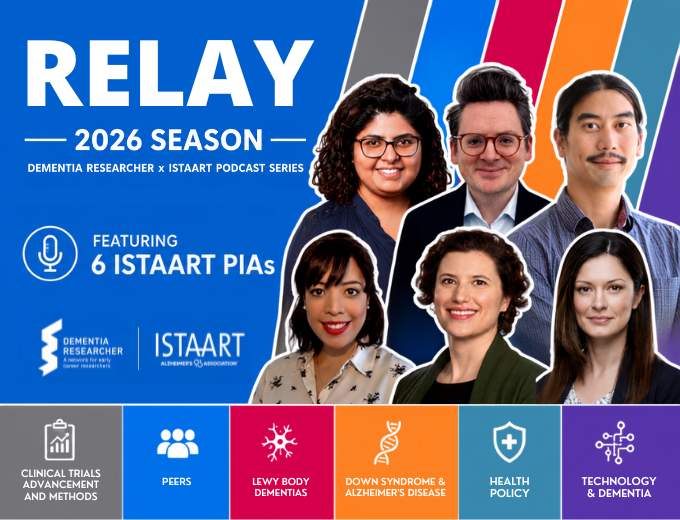
The Dementia Researcher ISTAART Relay returns for 2026 with six podcast episodes and two special Relay Live sessions, bringing together researchers from across the Alzheimer’s Association International Society to Advance Alzheimer’s Research and Treatment, better known as ISTAART.

Across the series, members of ISTAART’s Professional Interest Areas interview one another about their research, the communities they represent, the topics shaping their fields, and what their PIAs have planned around the Alzheimer’s Association International Conference in London and online.

The format is simple: each guest becomes the next host, passing the conversation from one researcher to the next. The result is a connected series that moves across technology, policy, imaging, biomarkers, clinical trials, early career support, sensory health, sex and gender differences, frontotemporal dementia, Lewy body dementia, and Down syndrome-associated Alzheimer’s disease.

The 2026 Relay series features conversations with Vanessa Young, Lillian Morgado, Patrick Lao, Joe Kane, Sindhuja Tirumalai Govindarajan, Carla Abdelnour, Michael Belloy, Carmela Tartaglia, Sam Lockhart and Ingrid Ekström.

Together, the episodes offer a snapshot of where dementia research is moving now: towards better use of biomarkers, more inclusive research design, earlier detection, clearer trial methods, stronger global networks, and more opportunities for researchers at every career stage to get involved.

Whether you are attending AAIC, joining virtually, new to ISTAART, or simply curious about the work of the PIAs, this collection is a great way to meet the people behind these international research communities.

Watch the full playlist, listen to each episode, and follow the links below to learn more about each guest and how to get involved in ISTAART.

Title Description
Technology and Dementia PIA: Sleep, Wearables and Digital Equity Carla Abdelnour speaks with Vanessa Young about sleep, the ageing brain, digital measures, wearables, nearables, AI and making technology-based dementia research more accessible.
Health Policy PIA: AI, Biomarkers and the Human Side of Policy Vanessa Young speaks with Lillian Morgado about qualitative research, legal epidemiology, caregivers, the justice system, AI, blood-based biomarkers and why policy conversations matter.
Down Syndrome and Alzheimer’s Disease PIA: Imaging, Timelines and Trial Readiness Lillian Morgado speaks with Patrick Lao about multimodal biomarkers, Down syndrome-associated Alzheimer’s disease, disease timelines, risk and resilience, clinical trials and return of results.
Lewy Body Dementias PIA: Diagnosis, Biomarkers and Better Trials Patrick Lao speaks with Joe Kane about Lewy body dementia diagnosis, MIPG and DAT scans, alpha-synuclein biomarkers, skin biopsy, outcome measures and trial design.
PEERs PIA: Building Careers, Confidence and Community Joe Kane speaks with Sindhuja T Govindarajan about neuroimaging, machine learning, large datasets, research careers, AAIC skills sessions and supporting early career researchers.
Clinical Trials Advancement and Methods PIA: Mixed Pathologies and Trial Design Sindhuja T Govindarajan speaks with Carla Abdelnour about Lewy body disease, Alzheimer’s co-pathology, fluid biomarkers, alpha-synuclein, stratification and clinical trial methods.
Relay Live: Sex, Gender and FTD in Focus Adam Smith hosts Michael Belloy and Carmela Tartaglia for a live discussion on sex differences, X chromosome research, frontotemporal dementia, heterogeneity, diversity, biomarkers and AAIC.
Relay Live: Neuroimaging and Sensory Health in Focus Adam Smith hosts Sam Lockhart and Ingrid Ekström for a live discussion on imaging biomarkers, AI, sensory decline, smell testing, dementia risk, translation and AAIC activities.

Welcome to the seventh season of the Dementia Researcher X ISTAART PIA Relay Podcast. Across six episodes, leading early career and senior researchers hand the mic from one ISTAART PIA to the next, giving you an honest, peer-to-peer tour of where dementia research is actually heading, from wearables and biomarkers to policy and trial design, in the run-up to AAIC.

Series closer, and the relay comes full circle: Dr Carla Abdelnour, who hosted episode one, returns as the guest. Carla is a clinician scientist in Barcelona and incoming Chair of the ISTAART Clinical Trials Advancement and Methods PIA, working on mixed neurodegenerative disease, particularly Lewy body and Alzheimer's pathology together. With host Dr Sindhuja Tirumalai Govindarajan she explains why co-pathology is so common and what it means for treatment: does someone with both alpha-synuclein and Alzheimer's pathology respond to an anti-amyloid drug the same way as someone without? They discuss why she leans on fluid biomarkers, the wish for a synuclein PET tracer, and how trials might stratify or include people by co-pathology. Carla makes a useful point for anyone designing research, that clinical trial methods translate straight to observational studies, and previews the CTAM PIA's AAIC programme, including a panel and featured session on global representation in trials.

Takeaways

• Mixed pathology is common, and co-occurring alpha-synuclein and Alzheimer's pathology may change how people respond to treatment.
• Trials could stratify or include people by co-pathology, but alpha-synuclein is currently detectable only in CSF, which limits that.
• Fluid biomarkers offer the specificity to track different proteinopathies and, potentially, response to treatment.
• Clinical trial design transfers straight to observational research: the same inclusion criteria, outcomes and sample-size thinking.
• Global representation in trials is a live priority, with a CTAM panel launching at AAIC.
--

The Alzheimer’s Association International Society to Advance Alzheimer’s Research and Treatment (ISTAART) convenes the global Alzheimer’s and dementia science community. Members share knowledge, fuel collaboration and advance research to find more effective ways to detect, treat and prevent Alzheimer’s and other dementias. Professional Interest Areas (PIA) are an assembly of ISTAART members with common subspecialties or interests.
There are currently 30 PIAs covering a wide range of interests and fields, from Neuroimaging to Diversity and Disparities and everything in between. 

Find out more at https://istaart.alz.org/
--

A transcript of this show, links and show notes and profiles on all our guests are available on our website at https://www.dementiaresearcher.nihr.ac.uk.

Leave us a tip:
https://dementia-researcher.captivate.fm/support

Follow us on social media:
https://www.instagram.com/dementia_researcher/ 
https://www.facebook.com/Dementia.Researcher/
https://www.twitter.com/demrescommunity
https://www.linkedin.com/company/dementia-researcher 
https://bsky.app/profile/dementiaresearcher.bsky.social

Download and Register with our Community App:
https://www.onelink.to/dementiaresearcher

We gratefully acknowledge the support of our funders: Alzheimer’s Association, Race Against Dementia, Alzheimer’s Research UK, Alzheimer’s Society, and the National Institute for Health and Care Research.

The views and opinions expressed by guests in this podcast are their own and do not necessarily reflect those of the producers, funders, or sponsors.

Chapters

00:00 Introduction to the series
01:14 Dr Carla Abdelnour’s research background
03:54 Mixed pathology in dementia
07:18 Biomarkers and imaging methods
10:08 Bringing biomarkers into trials
13:40 Inside the CTAM PIA
20:47 AAIC sessions and member involvement
24:59 Clinical trials vs. research studies
28:04 Promising trials in Lewy body disease
29:10 Advice for new members
31:26 Final thoughts on collaboration

Welcome to the seventh season of the Dementia Researcher X ISTAART PIA Relay Podcast. Across six episodes, leading early career and senior researchers hand the mic from one ISTAART PIA to the next, giving you an honest, peer-to-peer tour of where dementia research is actually heading, from wearables and biomarkers to policy and trial design, in the run-up to AAIC.

Series closer, and the relay comes full circle: Dr Carla Abdelnour, who hosted episode one, returns as the guest. Carla is a clinician scientist in Barcelona and incoming Chair of the ISTAART Clinical Trials Advancement and Methods PIA, working on mixed neurodegenerative disease, particularly Lewy body and Alzheimer's pathology together. With host Dr Sindhuja Tirumalai Govindarajan she explains why co-pathology is so common and what it means for treatment: does someone with both alpha-synuclein and Alzheimer's pathology respond to an anti-amyloid drug the same way as someone without? They discuss why she leans on fluid biomarkers, the wish for a synuclein PET tracer, and how trials might stratify or include people by co-pathology. Carla makes a useful point for anyone designing research, that clinical trial methods translate straight to observational studies, and previews the CTAM PIA's AAIC programme, including a panel and featured session on global representation in trials.

Takeaways

• Mixed pathology is common, and co-occurring alpha-synuclein and Alzheimer's pathology may change how people respond to treatment.
• Trials could stratify or include people by co-pathology, but alpha-synuclein is currently detectable only in CSF, which limits that.
• Fluid biomarkers offer the specificity to track different proteinopathies and, potentially, response to treatment.
• Clinical trial design transfers straight to observational research: the same inclusion criteria, outcomes and sample-size thinking.
• Global representation in trials is a live priority, with a CTAM panel launching at AAIC.
--

The Alzheimer’s Association International Society to Advance Alzheimer’s Research and Treatment (ISTAART) convenes the global Alzheimer’s and dementia science community. Members share knowledge, fuel collaboration and advance research to find more effective ways to detect, treat and prevent Alzheimer’s and other dementias. Professional Interest Areas (PIA) are an assembly of ISTAART members with common subspecialties or interests.
There are currently 30 PIAs covering a wide range of interests and fields, from Neuroimaging to Diversity and Disparities and everything in between.

Find out more at https://istaart.alz.org/
--

A transcript of this show, links and show notes and profiles on all our guests are available on our website at https://www.dementiaresearcher.nihr.ac.uk.

Leave us a tip:
https://dementia-researcher.captivate.fm/support

Follow us on social media:
https://www.instagram.com/dementia_researcher/
https://www.facebook.com/Dementia.Researcher/
https://www.twitter.com/demrescommunity
https://www.linkedin.com/company/dementia-researcher
https://bsky.app/profile/dementiaresearcher.bsky.social

Download and Register with our Community App:
https://www.onelink.to/dementiaresearcher

We gratefully acknowledge the support of our funders: Alzheimer’s Association, Race Against Dementia, Alzheimer’s Research UK, Alzheimer’s Society, and the National Institute for Health and Care Research.

The views and opinions expressed by guests in this podcast are their own and do not necessarily reflect those of the producers, funders, or sponsors.

Chapters

00:00 Introduction to the series
01:14 Dr Carla Abdelnour’s research background
03:54 Mixed pathology in dementia
07:18 Biomarkers and imaging methods
10:08 Bringing biomarkers into trials
13:40 Inside the CTAM PIA
20:47 AAIC sessions and member involvement
24:59 Clinical trials vs. research studies
28:04 Promising trials in Lewy body disease
29:10 Advice for new members
31:26 Final thoughts on collaboration

1 0

YouTube Video UExDRDBSckVMTk9Yay41NkI0NEY2RDEwNTU3Q0M2

ISTAART Relay Podcast - Clinical Trials Advancement and Methods PIA 2026

Welcome to the seventh season of the Dementia Researcher X ISTAART PIA Relay Podcast. Across six episodes, leading early career and senior researchers hand the mic from one ISTAART PIA to the next, giving you an honest, peer-to-peer tour of where dementia research is actually heading, from wearables and biomarkers to policy and trial design, in the run-up to AAIC.

Most people with hypertension after 50 never develop dementia, so what separates those who do? That is the question driving Sindhuja Tirumalai Govindarajan, a neuroimaging researcher and outgoing Chair of the ISTAART PEERs PIA, recorded as she moves from a postdoc at the University of Pennsylvania to an assistant professorship at the Karolinska Institute. With host Joe Kane she explains how machine learning on tens of thousands of MRI scans can pick up subtle brain changes years before symptoms, and why scans from different scanners have to be harmonised first. The conversation then turns to PEERs itself, a PIA built not around one research area but around early career researchers everywhere, and the work of levelling opportunity across borders through local routes like Neuroscience Next, WYLD and INTERDEM Academy. Sindhuja runs through the PIA's AAIC workshops, from narrative CVs to social bingo for ECRs, and closes with practical advice on getting people involved: make the ask specific.

Takeaways

• Machine learning on large MRI datasets can detect brain changes years before any cognitive symptoms show.
• Scans from different scanners must be harmonised first, stripping out machine noise so only the biology remains.
• PEERs exists to level opportunity for early career researchers wherever they are, across every research area.
• Local routes such as Neuroscience Next, WYLD and INTERDEM Academy widen access for those who cannot get to the big conference.
• Interest among ECRs is common but clarity often is not, so make the ask specific and people will step up.
--

The Alzheimer’s Association International Society to Advance Alzheimer’s Research and Treatment (ISTAART) convenes the global Alzheimer’s and dementia science community. Members share knowledge, fuel collaboration and advance research to find more effective ways to detect, treat and prevent Alzheimer’s and other dementias. Professional Interest Areas (PIA) are an assembly of ISTAART members with common subspecialties or interests.
There are currently 30 PIAs covering a wide range of interests and fields, from Neuroimaging to Diversity and Disparities and everything in between. 

Find out more at https://istaart.alz.org/
--

A transcript of this show, links and show notes and profiles on all our guests are available on our website at https://www.dementiaresearcher.nihr.ac.uk.

Leave us a tip:
https://dementia-researcher.captivate.fm/support

Follow us on social media:
https://www.instagram.com/dementia_researcher/ 
https://www.facebook.com/Dementia.Researcher/
https://www.twitter.com/demrescommunity
https://www.linkedin.com/company/dementia-researcher 
https://bsky.app/profile/dementiaresearcher.bsky.social

Download and Register with our Community App:
https://www.onelink.to/dementiaresearcher

We gratefully acknowledge the support of our funders: Alzheimer’s Association, Race Against Dementia, Alzheimer’s Research UK, Alzheimer’s Society, and the National Institute for Health and Care Research.

The views and opinions expressed by guests in this podcast are their own and do not necessarily reflect those of the producers, funders, or sponsors.

Chapters

00:00 Introduction to the Podcast and Guests
01:58 Sindhuja's Research Journey and Neuroimaging in Dementia
07:31 Exciting Developments in Dementia Research
11:03 Challenges and Opportunities for Early Career Researchers
15:39 The Role of PIA in Supporting Researchers
20:41 Sindhuja's Personal Journey in the PIA
25:10 Engagement Strategies for Early Career Researchers
29:05 Conclusion and Future Directions

Welcome to the seventh season of the Dementia Researcher X ISTAART PIA Relay Podcast. Across six episodes, leading early career and senior researchers hand the mic from one ISTAART PIA to the next, giving you an honest, peer-to-peer tour of where dementia research is actually heading, from wearables and biomarkers to policy and trial design, in the run-up to AAIC.

Most people with hypertension after 50 never develop dementia, so what separates those who do? That is the question driving Sindhuja Tirumalai Govindarajan, a neuroimaging researcher and outgoing Chair of the ISTAART PEERs PIA, recorded as she moves from a postdoc at the University of Pennsylvania to an assistant professorship at the Karolinska Institute. With host Joe Kane she explains how machine learning on tens of thousands of MRI scans can pick up subtle brain changes years before symptoms, and why scans from different scanners have to be harmonised first. The conversation then turns to PEERs itself, a PIA built not around one research area but around early career researchers everywhere, and the work of levelling opportunity across borders through local routes like Neuroscience Next, WYLD and INTERDEM Academy. Sindhuja runs through the PIA's AAIC workshops, from narrative CVs to social bingo for ECRs, and closes with practical advice on getting people involved: make the ask specific.

Takeaways

• Machine learning on large MRI datasets can detect brain changes years before any cognitive symptoms show.
• Scans from different scanners must be harmonised first, stripping out machine noise so only the biology remains.
• PEERs exists to level opportunity for early career researchers wherever they are, across every research area.
• Local routes such as Neuroscience Next, WYLD and INTERDEM Academy widen access for those who cannot get to the big conference.
• Interest among ECRs is common but clarity often is not, so make the ask specific and people will step up.
--

The Alzheimer’s Association International Society to Advance Alzheimer’s Research and Treatment (ISTAART) convenes the global Alzheimer’s and dementia science community. Members share knowledge, fuel collaboration and advance research to find more effective ways to detect, treat and prevent Alzheimer’s and other dementias. Professional Interest Areas (PIA) are an assembly of ISTAART members with common subspecialties or interests.
There are currently 30 PIAs covering a wide range of interests and fields, from Neuroimaging to Diversity and Disparities and everything in between.

Find out more at https://istaart.alz.org/
--

A transcript of this show, links and show notes and profiles on all our guests are available on our website at https://www.dementiaresearcher.nihr.ac.uk.

Leave us a tip:
https://dementia-researcher.captivate.fm/support

Follow us on social media:
https://www.instagram.com/dementia_researcher/
https://www.facebook.com/Dementia.Researcher/
https://www.twitter.com/demrescommunity
https://www.linkedin.com/company/dementia-researcher
https://bsky.app/profile/dementiaresearcher.bsky.social

Download and Register with our Community App:
https://www.onelink.to/dementiaresearcher

We gratefully acknowledge the support of our funders: Alzheimer’s Association, Race Against Dementia, Alzheimer’s Research UK, Alzheimer’s Society, and the National Institute for Health and Care Research.

The views and opinions expressed by guests in this podcast are their own and do not necessarily reflect those of the producers, funders, or sponsors.

Chapters

00:00 Introduction to the Podcast and Guests
01:58 Sindhuja's Research Journey and Neuroimaging in Dementia
07:31 Exciting Developments in Dementia Research
11:03 Challenges and Opportunities for Early Career Researchers
15:39 The Role of PIA in Supporting Researchers
20:41 Sindhuja's Personal Journey in the PIA
25:10 Engagement Strategies for Early Career Researchers
29:05 Conclusion and Future Directions

0 0

YouTube Video UExDRDBSckVMTk9Yay4wMTcyMDhGQUE4NTIzM0Y5

ISTAART Relay Podcast - PIA for Early Career Researchers (PEERS) 2026

Join Dementia Researcher for the second of two special ISTAART Relay LIVE livestreams, hosted alongside this year’s six episode Relay podcast series.

In this session, Adam Smith will be joined by Samuel N. Lockhart from the Neuroimaging PIA and Ingrid Ekström from the Sensory Health and Cognition PIA. The conversation will explore their research, current hot topics in neuroimaging, sensory health, and cognition, and how their PIAs are bringing researchers together around shared scientific and career interests.

We will also talk about AAIC, including what Samuel and Ingrid are planning, what their PIAs will be focusing on, and which sessions, themes, and conversations they think researchers should be watching for.

Find the podcast in your podcast app https://podfollow.com/dementia-researcher
--

The Alzheimer’s Association International Society to Advance Alzheimer’s Research and Treatment (ISTAART) convenes the global Alzheimer’s and dementia science community. Members share knowledge, fuel collaboration and advance research to find more effective ways to detect, treat and prevent Alzheimer’s and other dementias. Professional Interest Areas (PIA) are an assembly of ISTAART members with common subspecialties or interests.
There are currently 30 PIAs covering a wide range of interests and fields, from Neuroimaging to Diversity and Disparities and everything in between. 

Find out more at https://istaart.alz.org/
--

A transcript of this show, links and show notes and profiles on all our guests are available on our website at https://www.dementiaresearcher.nihr.ac.uk.

Leave us a tip:
https://dementia-researcher.captivate.fm/support

Follow us on social media:
https://www.instagram.com/dementia_researcher/ 
https://www.facebook.com/Dementia.Researcher/
https://www.twitter.com/demrescommunity
https://www.linkedin.com/company/dementia-researcher 
https://bsky.app/profile/dementiaresearcher.bsky.social

Download and Register with our Community App:
https://www.onelink.to/dementiaresearcher

We gratefully acknowledge the support of our funders: Alzheimer’s Association, Race Against Dementia, Alzheimer’s Research UK, Alzheimer’s Society, and the National Institute for Health and Care Research.

The views and opinions expressed by guests in this podcast are their own and do not necessarily reflect those of the producers, funders, or sponsors.

Chapters

00:00 Introduction to the series and guest experts
01:55 Dr. Sam Lockhart's background and role in neuroimaging
03:44 The impact of AI and machine learning in neuroimaging
05:46 Upcoming activities and educational programs in neuroimaging
07:17 Dr. Ingrid Ekstrom's research on sensory decline and dementia
09:14 Olfactory testing as a predictor for dementia
13:00 Sensory impairments and their impact on quality of life
19:23 Current research on brain imaging biomarkers
22:28 Operational challenges in clinical trials and imaging infrastructure
25:18 The role of technology in democratizing neuroimaging
28:12 Future directions and innovations in neuroimaging and sensory health
48:41 Join the iSTART community and upcoming conference highlights

Join Dementia Researcher for the second of two special ISTAART Relay LIVE livestreams, hosted alongside this year’s six episode Relay podcast series.

In this session, Adam Smith will be joined by Samuel N. Lockhart from the Neuroimaging PIA and Ingrid Ekström from the Sensory Health and Cognition PIA. The conversation will explore their research, current hot topics in neuroimaging, sensory health, and cognition, and how their PIAs are bringing researchers together around shared scientific and career interests.

We will also talk about AAIC, including what Samuel and Ingrid are planning, what their PIAs will be focusing on, and which sessions, themes, and conversations they think researchers should be watching for.

Find the podcast in your podcast app https://podfollow.com/dementia-researcher
--

The Alzheimer’s Association International Society to Advance Alzheimer’s Research and Treatment (ISTAART) convenes the global Alzheimer’s and dementia science community. Members share knowledge, fuel collaboration and advance research to find more effective ways to detect, treat and prevent Alzheimer’s and other dementias. Professional Interest Areas (PIA) are an assembly of ISTAART members with common subspecialties or interests.
There are currently 30 PIAs covering a wide range of interests and fields, from Neuroimaging to Diversity and Disparities and everything in between.

Find out more at https://istaart.alz.org/
--

A transcript of this show, links and show notes and profiles on all our guests are available on our website at https://www.dementiaresearcher.nihr.ac.uk.

Leave us a tip:
https://dementia-researcher.captivate.fm/support

Follow us on social media:
https://www.instagram.com/dementia_researcher/
https://www.facebook.com/Dementia.Researcher/
https://www.twitter.com/demrescommunity
https://www.linkedin.com/company/dementia-researcher
https://bsky.app/profile/dementiaresearcher.bsky.social

Download and Register with our Community App:
https://www.onelink.to/dementiaresearcher

We gratefully acknowledge the support of our funders: Alzheimer’s Association, Race Against Dementia, Alzheimer’s Research UK, Alzheimer’s Society, and the National Institute for Health and Care Research.

The views and opinions expressed by guests in this podcast are their own and do not necessarily reflect those of the producers, funders, or sponsors.

Chapters

00:00 Introduction to the series and guest experts
01:55 Dr. Sam Lockhart's background and role in neuroimaging
03:44 The impact of AI and machine learning in neuroimaging
05:46 Upcoming activities and educational programs in neuroimaging
07:17 Dr. Ingrid Ekstrom's research on sensory decline and dementia
09:14 Olfactory testing as a predictor for dementia
13:00 Sensory impairments and their impact on quality of life
19:23 Current research on brain imaging biomarkers
22:28 Operational challenges in clinical trials and imaging infrastructure
25:18 The role of technology in democratizing neuroimaging
28:12 Future directions and innovations in neuroimaging and sensory health
48:41 Join the iSTART community and upcoming conference highlights

3 0

YouTube Video UExDRDBSckVMTk9Yay5DQUNERDQ2NkIzRUQxNTY1

Relay LIVE: Neuroimaging and Sensory Health in Focus

Welcome to the seventh season of the Dementia Researcher X ISTAART PIA Relay Podcast. Across six episodes, leading early career and senior researchers hand the mic from one ISTAART PIA to the next, giving you an honest, peer-to-peer tour of where dementia research is actually heading, from wearables and biomarkers to policy and trial design, in the run-up to AAIC.

Lewy body pathology shows up in roughly 30% of the brains of people who had dementia, yet it gets diagnosed in only about 5% of cases. Closing that gap has shaped much of Dr Joe Kane's career. Joe is a geriatric psychiatrist at Queen's University Belfast and outgoing Chair of the ISTAART Lewy Body Dementias PIA, and with host Dr Patrick Lao he traces his work from the Diamond Lewy programme to consensus diagnostic guidelines built by Delphi process. They discuss the symptoms clinicians often miss because they don't think to ask, from constipation to loss of smell, the cardiac scans and seed amplification assays now detecting pathology in CSF and even skin, and the TOP HAT trial repurposing an anti-sickness drug for hallucinations. Joe makes the case for a Lewy body specific rating scale, explains why the prodrome may be psychiatric or delirium rather than cognitive, and runs through the PIA's biggest AAIC programme in years, including a PIA Day panel on seed amplification assays.

Takeaways

• Lewy body dementia is heavily underdiagnosed: pathology appears in about 30% of brains but is diagnosed in around 5%.
• Much of the disease shows outside the brain, in constipation, blood pressure and smell, so it gets missed if nobody asks.
• Seed amplification assays, now usable on CSF and even a small skin biopsy, are changing how the pathology is detected.
• Trials can fail on the wrong yardstick, which is why the PIA is building a Lewy body specific rating scale.
• The prodrome is not only cognitive; the first sign can be depression, psychosis or delirium, and those gaps need data.
--

The Alzheimer’s Association International Society to Advance Alzheimer’s Research and Treatment (ISTAART) convenes the global Alzheimer’s and dementia science community. Members share knowledge, fuel collaboration and advance research to find more effective ways to detect, treat and prevent Alzheimer’s and other dementias. Professional Interest Areas (PIA) are an assembly of ISTAART members with common subspecialties or interests.
There are currently 30 PIAs covering a wide range of interests and fields, from Neuroimaging to Diversity and Disparities and everything in between. 

Find out more at https://istaart.alz.org/
--

A transcript of this show, links and show notes and profiles on all our guests are available on our website at https://www.dementiaresearcher.nihr.ac.uk.

Leave us a tip:
https://dementia-researcher.captivate.fm/support

Follow us on social media:
https://www.instagram.com/dementia_researcher/ 
https://www.facebook.com/Dementia.Researcher/
https://www.twitter.com/demrescommunity
https://www.linkedin.com/company/dementia-researcher 
https://bsky.app/profile/dementiaresearcher.bsky.social

Download and Register with our Community App:
https://www.onelink.to/dementiaresearcher

We gratefully acknowledge the support of our funders: Alzheimer’s Association, Race Against Dementia, Alzheimer’s Research UK, Alzheimer’s Society, and the National Institute for Health and Care Research.

The views and opinions expressed by guests in this podcast are their own and do not necessarily reflect those of the producers, funders, or sponsors.

Chapters

00:00 Introduction to the Podcast and Guests
01:03 Exploring Lewy Body Dementia Research
04:36 Clinical Guidelines and Diagnosis Challenges
08:25 Biomarkers in Lewy Body Dementia
12:09 Emerging Biomarkers and Clinical Trials
15:35 The Role of the PIA in Research
18:17 Engagement and Collaboration in the PIA
20:58 Understanding the Prodromal Stage of Lewy Body Dementia
24:43 Advice for New Researchers in the Field

Welcome to the seventh season of the Dementia Researcher X ISTAART PIA Relay Podcast. Across six episodes, leading early career and senior researchers hand the mic from one ISTAART PIA to the next, giving you an honest, peer-to-peer tour of where dementia research is actually heading, from wearables and biomarkers to policy and trial design, in the run-up to AAIC.

Lewy body pathology shows up in roughly 30% of the brains of people who had dementia, yet it gets diagnosed in only about 5% of cases. Closing that gap has shaped much of Dr Joe Kane's career. Joe is a geriatric psychiatrist at Queen's University Belfast and outgoing Chair of the ISTAART Lewy Body Dementias PIA, and with host Dr Patrick Lao he traces his work from the Diamond Lewy programme to consensus diagnostic guidelines built by Delphi process. They discuss the symptoms clinicians often miss because they don't think to ask, from constipation to loss of smell, the cardiac scans and seed amplification assays now detecting pathology in CSF and even skin, and the TOP HAT trial repurposing an anti-sickness drug for hallucinations. Joe makes the case for a Lewy body specific rating scale, explains why the prodrome may be psychiatric or delirium rather than cognitive, and runs through the PIA's biggest AAIC programme in years, including a PIA Day panel on seed amplification assays.

Takeaways

• Lewy body dementia is heavily underdiagnosed: pathology appears in about 30% of brains but is diagnosed in around 5%.
• Much of the disease shows outside the brain, in constipation, blood pressure and smell, so it gets missed if nobody asks.
• Seed amplification assays, now usable on CSF and even a small skin biopsy, are changing how the pathology is detected.
• Trials can fail on the wrong yardstick, which is why the PIA is building a Lewy body specific rating scale.
• The prodrome is not only cognitive; the first sign can be depression, psychosis or delirium, and those gaps need data.
--

The Alzheimer’s Association International Society to Advance Alzheimer’s Research and Treatment (ISTAART) convenes the global Alzheimer’s and dementia science community. Members share knowledge, fuel collaboration and advance research to find more effective ways to detect, treat and prevent Alzheimer’s and other dementias. Professional Interest Areas (PIA) are an assembly of ISTAART members with common subspecialties or interests.
There are currently 30 PIAs covering a wide range of interests and fields, from Neuroimaging to Diversity and Disparities and everything in between.

Find out more at https://istaart.alz.org/
--

A transcript of this show, links and show notes and profiles on all our guests are available on our website at https://www.dementiaresearcher.nihr.ac.uk.

Leave us a tip:
https://dementia-researcher.captivate.fm/support

Follow us on social media:
https://www.instagram.com/dementia_researcher/
https://www.facebook.com/Dementia.Researcher/
https://www.twitter.com/demrescommunity
https://www.linkedin.com/company/dementia-researcher
https://bsky.app/profile/dementiaresearcher.bsky.social

Download and Register with our Community App:
https://www.onelink.to/dementiaresearcher

We gratefully acknowledge the support of our funders: Alzheimer’s Association, Race Against Dementia, Alzheimer’s Research UK, Alzheimer’s Society, and the National Institute for Health and Care Research.

The views and opinions expressed by guests in this podcast are their own and do not necessarily reflect those of the producers, funders, or sponsors.

Chapters

00:00 Introduction to the Podcast and Guests
01:03 Exploring Lewy Body Dementia Research
04:36 Clinical Guidelines and Diagnosis Challenges
08:25 Biomarkers in Lewy Body Dementia
12:09 Emerging Biomarkers and Clinical Trials
15:35 The Role of the PIA in Research
18:17 Engagement and Collaboration in the PIA
20:58 Understanding the Prodromal Stage of Lewy Body Dementia
24:43 Advice for New Researchers in the Field

0 0

YouTube Video UExDRDBSckVMTk9Yay41MjE1MkI0OTQ2QzJGNzNG

ISTAART Relay Podcast - Lewy Body Dementias PIA

Join Dementia Researcher for the first of two special ISTAART Relay LIVE livestreams, taking place alongside this year’s six episode Relay podcast series.

In this session, Adam Smith will be joined by Michael Belloy from the Sex and Gender Differences PIA and Carmela Tartaglia from the Frontotemporal Dementia PIA. Together, they will discuss their research, the latest hot topics in their fields, and the work of their PIAs in supporting collaboration, knowledge sharing, and career development across the dementia research community.

We will also look ahead to AAIC, exploring what Michael and Carmela are most looking forward to, what their PIAs have planned, and where they see important conversations happening this year.

Join us live to hear from our guests, learn more about their research areas, and get a closer look at the people and PIAs helping to shape the Relay podcast series.

Find the podcast in your favourite podcast app - https://podfollow.com/dementia-researcher
--

The Alzheimer’s Association International Society to Advance Alzheimer’s Research and Treatment (ISTAART) convenes the global Alzheimer’s and dementia science community. Members share knowledge, fuel collaboration and advance research to find more effective ways to detect, treat and prevent Alzheimer’s and other dementias. Professional Interest Areas (PIA) are an assembly of ISTAART members with common subspecialties or interests.
There are currently 30 PIAs covering a wide range of interests and fields, from Neuroimaging to Diversity and Disparities and everything in between. 

Find out more at https://istaart.alz.org/
--

A transcript of this show, links and show notes and profiles on all our guests are available on our website at https://www.dementiaresearcher.nihr.ac.uk.

Leave us a tip:
https://dementia-researcher.captivate.fm/support

Follow us on social media:
https://www.instagram.com/dementia_researcher/ 
https://www.facebook.com/Dementia.Researcher/
https://www.twitter.com/demrescommunity
https://www.linkedin.com/company/dementia-researcher 
https://bsky.app/profile/dementiaresearcher.bsky.social

Download and Register with our Community App:
https://www.onelink.to/dementiaresearcher

We gratefully acknowledge the support of our funders: Alzheimer’s Association, Race Against Dementia, Alzheimer’s Research UK, Alzheimer’s Society, and the National Institute for Health and Care Research.

The views and opinions expressed by guests in this podcast are their own and do not necessarily reflect those of the producers, funders, or sponsors.

Chapters

00:00 Introduction to the series and guests
01:08 Research focus of Dr. Michael Beloy in neurogenomics
03:35 History and structure of the iStart PIA groups
10:12 Current research on sex differences in dementia
13:41 Sex and gender differences in frontotemporal dementia
18:44 Research on neuroinflammation and biomarkers in FTD
23:58 Dr. Beloy's motivation for studying sex differences
27:47 Research interests of Dr. Carmela Tataglia in FTD
32:10 Biggest challenges and opportunities in FTD research
35:47 Therapeutic developments and clinical trials in FTD
41:07 Who should join the iStart PIA groups
50:26 Upcoming AAIC conference and iStart activities
58:05 Conference tips and final thoughts

Join Dementia Researcher for the first of two special ISTAART Relay LIVE livestreams, taking place alongside this year’s six episode Relay podcast series.

In this session, Adam Smith will be joined by Michael Belloy from the Sex and Gender Differences PIA and Carmela Tartaglia from the Frontotemporal Dementia PIA. Together, they will discuss their research, the latest hot topics in their fields, and the work of their PIAs in supporting collaboration, knowledge sharing, and career development across the dementia research community.

We will also look ahead to AAIC, exploring what Michael and Carmela are most looking forward to, what their PIAs have planned, and where they see important conversations happening this year.

Join us live to hear from our guests, learn more about their research areas, and get a closer look at the people and PIAs helping to shape the Relay podcast series.

Find the podcast in your favourite podcast app - https://podfollow.com/dementia-researcher
--

The Alzheimer’s Association International Society to Advance Alzheimer’s Research and Treatment (ISTAART) convenes the global Alzheimer’s and dementia science community. Members share knowledge, fuel collaboration and advance research to find more effective ways to detect, treat and prevent Alzheimer’s and other dementias. Professional Interest Areas (PIA) are an assembly of ISTAART members with common subspecialties or interests.
There are currently 30 PIAs covering a wide range of interests and fields, from Neuroimaging to Diversity and Disparities and everything in between.

Find out more at https://istaart.alz.org/
--

A transcript of this show, links and show notes and profiles on all our guests are available on our website at https://www.dementiaresearcher.nihr.ac.uk.

Leave us a tip:
https://dementia-researcher.captivate.fm/support

Follow us on social media:
https://www.instagram.com/dementia_researcher/
https://www.facebook.com/Dementia.Researcher/
https://www.twitter.com/demrescommunity
https://www.linkedin.com/company/dementia-researcher
https://bsky.app/profile/dementiaresearcher.bsky.social

Download and Register with our Community App:
https://www.onelink.to/dementiaresearcher

We gratefully acknowledge the support of our funders: Alzheimer’s Association, Race Against Dementia, Alzheimer’s Research UK, Alzheimer’s Society, and the National Institute for Health and Care Research.

The views and opinions expressed by guests in this podcast are their own and do not necessarily reflect those of the producers, funders, or sponsors.

Chapters

00:00 Introduction to the series and guests
01:08 Research focus of Dr. Michael Beloy in neurogenomics
03:35 History and structure of the iStart PIA groups
10:12 Current research on sex differences in dementia
13:41 Sex and gender differences in frontotemporal dementia
18:44 Research on neuroinflammation and biomarkers in FTD
23:58 Dr. Beloy's motivation for studying sex differences
27:47 Research interests of Dr. Carmela Tataglia in FTD
32:10 Biggest challenges and opportunities in FTD research
35:47 Therapeutic developments and clinical trials in FTD
41:07 Who should join the iStart PIA groups
50:26 Upcoming AAIC conference and iStart activities
58:05 Conference tips and final thoughts

1 0

YouTube Video UExDRDBSckVMTk9Yay41MzJCQjBCNDIyRkJDN0VD

Relay LIVE: Sex, Gender and FTD in Focus

Welcome to the seventh season of the Dementia Researcher X ISTAART PIA Relay Podcast. Across six episodes, leading early career and senior researchers hand the mic from one ISTAART PIA to the next, giving you an honest, peer-to-peer tour of where dementia research is actually heading, from wearables and biomarkers to policy and trial design, in the run-up to AAIC.

Almost everyone born with Down syndrome overproduces the amyloid precursor protein from birth, which makes it one of the clearest natural windows we have into how Alzheimer's begins. Dr Patrick Lao, Assistant Professor at Columbia and Programmes Chair of the ISTAART Down Syndrome and Alzheimer's Disease PIA, comes from a medical physics background and uses multimodal neuroimaging to map the disease across its genetic and sporadic forms. With host Lillian Morgado, he explains amyloid and tau PET, Thal phases and Braak staging, and how chronological age can stand in for disease stage in this population, with a typical symptom onset around 54. They talk about why people with Down syndrome were long left out of anti-amyloid trials and how that is now changing, and the risk and resilience research asking why some people fall off the expected timeline. Patrick also previews the PIA's AAIC PIA Day session on returning results, plus the separate DSAD/ADAD conference coming to London next year.

Takeaways

• Genetic forms of Alzheimer's, including Down syndrome, let researchers study the earliest disease pathways before symptoms appear.
• In Down syndrome, chronological age can approximate disease stage, with symptoms typically expected around age 54.
• Imaging shows where amyloid and tau sit in the brain, the spatial detail a blood test cannot give.
• People with Down syndrome were historically excluded from anti-amyloid trials; that is shifting, with a lecanemab safety extension now underway.
• Not everyone follows the population timeline, and risk and resilience work asks what pushes onset earlier or later.
--

The Alzheimer’s Association International Society to Advance Alzheimer’s Research and Treatment (ISTAART) convenes the global Alzheimer’s and dementia science community. Members share knowledge, fuel collaboration and advance research to find more effective ways to detect, treat and prevent Alzheimer’s and other dementias. Professional Interest Areas (PIA) are an assembly of ISTAART members with common subspecialties or interests.
There are currently 30 PIAs covering a wide range of interests and fields, from Neuroimaging to Diversity and Disparities and everything in between. 

Find out more at https://istaart.alz.org/
--

A transcript of this show, links and show notes and profiles on all our guests are available on our website at https://www.dementiaresearcher.nihr.ac.uk.

Leave us a tip:
https://dementia-researcher.captivate.fm/support

Follow us on social media:
https://www.instagram.com/dementia_researcher/ 
https://www.facebook.com/Dementia.Researcher/
https://www.twitter.com/demrescommunity
https://www.linkedin.com/company/dementia-researcher 
https://bsky.app/profile/dementiaresearcher.bsky.social

Download and Register with our Community App:
https://www.onelink.to/dementiaresearcher

We gratefully acknowledge the support of our funders: Alzheimer’s Association, Race Against Dementia, Alzheimer’s Research UK, Alzheimer’s Society, and the National Institute for Health and Care Research.

The views and opinions expressed by guests in this podcast are their own and do not necessarily reflect those of the producers, funders, or sponsors.

Chapters

00:00 Introduction to the Podcast and Guests
01:06 Research Background and Focus Areas
03:32 Neuroimaging Techniques and Their Importance
08:20 Understanding Alzheimer's Disease in Down Syndrome
10:51 Life Expectancy and Alzheimer's Disease Concerns
12:56 Resilience and Variability in Disease Progression
13:38 Clinical Trials and Inclusion of Down Syndrome
16:33 Advancements in Alzheimer's Disease Research
17:27 Role of Professional Interest Areas (PIAs)
22:37 Future Plans and Conferences

Welcome to the seventh season of the Dementia Researcher X ISTAART PIA Relay Podcast. Across six episodes, leading early career and senior researchers hand the mic from one ISTAART PIA to the next, giving you an honest, peer-to-peer tour of where dementia research is actually heading, from wearables and biomarkers to policy and trial design, in the run-up to AAIC.

Almost everyone born with Down syndrome overproduces the amyloid precursor protein from birth, which makes it one of the clearest natural windows we have into how Alzheimer's begins. Dr Patrick Lao, Assistant Professor at Columbia and Programmes Chair of the ISTAART Down Syndrome and Alzheimer's Disease PIA, comes from a medical physics background and uses multimodal neuroimaging to map the disease across its genetic and sporadic forms. With host Lillian Morgado, he explains amyloid and tau PET, Thal phases and Braak staging, and how chronological age can stand in for disease stage in this population, with a typical symptom onset around 54. They talk about why people with Down syndrome were long left out of anti-amyloid trials and how that is now changing, and the risk and resilience research asking why some people fall off the expected timeline. Patrick also previews the PIA's AAIC PIA Day session on returning results, plus the separate DSAD/ADAD conference coming to London next year.

Takeaways

• Genetic forms of Alzheimer's, including Down syndrome, let researchers study the earliest disease pathways before symptoms appear.
• In Down syndrome, chronological age can approximate disease stage, with symptoms typically expected around age 54.
• Imaging shows where amyloid and tau sit in the brain, the spatial detail a blood test cannot give.
• People with Down syndrome were historically excluded from anti-amyloid trials; that is shifting, with a lecanemab safety extension now underway.
• Not everyone follows the population timeline, and risk and resilience work asks what pushes onset earlier or later.
--

The Alzheimer’s Association International Society to Advance Alzheimer’s Research and Treatment (ISTAART) convenes the global Alzheimer’s and dementia science community. Members share knowledge, fuel collaboration and advance research to find more effective ways to detect, treat and prevent Alzheimer’s and other dementias. Professional Interest Areas (PIA) are an assembly of ISTAART members with common subspecialties or interests.
There are currently 30 PIAs covering a wide range of interests and fields, from Neuroimaging to Diversity and Disparities and everything in between.

Find out more at https://istaart.alz.org/
--

A transcript of this show, links and show notes and profiles on all our guests are available on our website at https://www.dementiaresearcher.nihr.ac.uk.

Leave us a tip:
https://dementia-researcher.captivate.fm/support

Follow us on social media:
https://www.instagram.com/dementia_researcher/
https://www.facebook.com/Dementia.Researcher/
https://www.twitter.com/demrescommunity
https://www.linkedin.com/company/dementia-researcher
https://bsky.app/profile/dementiaresearcher.bsky.social

Download and Register with our Community App:
https://www.onelink.to/dementiaresearcher

We gratefully acknowledge the support of our funders: Alzheimer’s Association, Race Against Dementia, Alzheimer’s Research UK, Alzheimer’s Society, and the National Institute for Health and Care Research.

The views and opinions expressed by guests in this podcast are their own and do not necessarily reflect those of the producers, funders, or sponsors.

Chapters

00:00 Introduction to the Podcast and Guests
01:06 Research Background and Focus Areas
03:32 Neuroimaging Techniques and Their Importance
08:20 Understanding Alzheimer's Disease in Down Syndrome
10:51 Life Expectancy and Alzheimer's Disease Concerns
12:56 Resilience and Variability in Disease Progression
13:38 Clinical Trials and Inclusion of Down Syndrome
16:33 Advancements in Alzheimer's Disease Research
17:27 Role of Professional Interest Areas (PIAs)
22:37 Future Plans and Conferences

0 0

YouTube Video UExDRDBSckVMTk9Yay4yODlGNEE0NkRGMEEzMEQy

ISTAART Relay Podcast - Down Syndrome and Alzheimer's Disease PIA

Welcome to the seventh season of the Dementia Researcher X ISTAART PIA Relay Podcast. Across six episodes, leading early career and senior researchers hand the mic from one ISTAART PIA to the next, giving you an honest, peer-to-peer tour of where dementia research is actually heading, from wearables and biomarkers to policy and trial design, in the run-up to AAIC.

If we cured Alzheimer's tomorrow but did no work on cost, distribution or access, we would have cured it only for the richest people in the world. That line from Lillian Morgado sits at the centre of this episode. Lillian is a research coordinator at Georgia State University and Communications Chair of the ISTAART Health Policy PIA, working mainly in qualitative research and legal epidemiology. With host Dr Vanessa Young, she talks through what qualitative work actually involves, her research on caregivers and people with dementia in the justice system, and the question that opened up next: what happens to someone with no caregiver to advocate for them. They get into why AI and blood-based biomarkers are as much policy problems as scientific ones, how regulation differs across borders, and why policy is the bridge that decides whether science reaches the people it was meant for. Lillian also runs through the Health Policy PIA's busy week at AAIC, from PIA Day to a featured research session on dementia care across countries.

Takeaways

• Policy is the bridge from the lab to the patient; without it, a breakthrough only reaches the few who can already afford care.
• Qualitative interviews and coding surface the right questions before the big quantitative money goes in.
• Caregivers matter enormously when someone with dementia meets the justice system, which raises the question of those who have none.
• AI and blood-based biomarkers carry legal and access questions, and the rules differ between, say, the US and Europe under GDPR.
• You do not join a PIA because you already belong; you belong because you get involved, and you need not be an expert to contribute.
--

The Alzheimer’s Association International Society to Advance Alzheimer’s Research and Treatment (ISTAART) convenes the global Alzheimer’s and dementia science community. Members share knowledge, fuel collaboration and advance research to find more effective ways to detect, treat and prevent Alzheimer’s and other dementias. Professional Interest Areas (PIA) are an assembly of ISTAART members with common subspecialties or interests.
There are currently 30 PIAs covering a wide range of interests and fields, from Neuroimaging to Diversity and Disparities and everything in between. 

Find out more at https://istaart.alz.org/
--

A transcript of this show, links and show notes and profiles on all our guests are available on our website at https://www.dementiaresearcher.nihr.ac.uk. 

Leave us a tip:
https://dementia-researcher.captivate.fm/support

Follow us on social media:
https://www.instagram.com/dementia_researcher/ 
https://www.facebook.com/Dementia.Researcher/
https://www.twitter.com/demrescommunity
https://www.linkedin.com/company/dementia-researcher 
https://bsky.app/profile/dementiaresearcher.bsky.social

Download and Register with our Community App:
https://www.onelink.to/dementiaresearcher

We gratefully acknowledge the support of our funders: Alzheimer’s Association, Race Against Dementia, Alzheimer’s Research UK, Alzheimer’s Society, and the National Institute for Health and Care Research.

The views and opinions expressed by guests in this podcast are their own and do not necessarily reflect those of the producers, funders, or sponsors.

Chapters

00:00 Introduction to the episode and guest
01:09 Guest introduction: Lilian Morgalo and her role
01:51 Research focus: Qualitative methods in dementia
04:26 Themes from qualitative interviews with caregivers
07:07 Hot topics: AI and blood-based biomarkers
08:38 Communicating health policy and legal considerations
10:48 International policy landscape and differences
12:47 Benefits of international collaboration and PIA involvement
14:27 Joining and contributing to PIA
16:30 Community engagement and collaboration opportunities
17:53 Upcoming events at the Alzheimer's Association Conference
20:13 How the European dementia community engages
21:18 Ways to get involved in the PIA
22:17 Advice for early career researchers
24:02 Skills gained from policy involvement
25:36 Closing remarks and resources

Welcome to the seventh season of the Dementia Researcher X ISTAART PIA Relay Podcast. Across six episodes, leading early career and senior researchers hand the mic from one ISTAART PIA to the next, giving you an honest, peer-to-peer tour of where dementia research is actually heading, from wearables and biomarkers to policy and trial design, in the run-up to AAIC.

If we cured Alzheimer's tomorrow but did no work on cost, distribution or access, we would have cured it only for the richest people in the world. That line from Lillian Morgado sits at the centre of this episode. Lillian is a research coordinator at Georgia State University and Communications Chair of the ISTAART Health Policy PIA, working mainly in qualitative research and legal epidemiology. With host Dr Vanessa Young, she talks through what qualitative work actually involves, her research on caregivers and people with dementia in the justice system, and the question that opened up next: what happens to someone with no caregiver to advocate for them. They get into why AI and blood-based biomarkers are as much policy problems as scientific ones, how regulation differs across borders, and why policy is the bridge that decides whether science reaches the people it was meant for. Lillian also runs through the Health Policy PIA's busy week at AAIC, from PIA Day to a featured research session on dementia care across countries.

Takeaways

• Policy is the bridge from the lab to the patient; without it, a breakthrough only reaches the few who can already afford care.
• Qualitative interviews and coding surface the right questions before the big quantitative money goes in.
• Caregivers matter enormously when someone with dementia meets the justice system, which raises the question of those who have none.
• AI and blood-based biomarkers carry legal and access questions, and the rules differ between, say, the US and Europe under GDPR.
• You do not join a PIA because you already belong; you belong because you get involved, and you need not be an expert to contribute.
--

The Alzheimer’s Association International Society to Advance Alzheimer’s Research and Treatment (ISTAART) convenes the global Alzheimer’s and dementia science community. Members share knowledge, fuel collaboration and advance research to find more effective ways to detect, treat and prevent Alzheimer’s and other dementias. Professional Interest Areas (PIA) are an assembly of ISTAART members with common subspecialties or interests.
There are currently 30 PIAs covering a wide range of interests and fields, from Neuroimaging to Diversity and Disparities and everything in between.

Find out more at https://istaart.alz.org/
--

A transcript of this show, links and show notes and profiles on all our guests are available on our website at https://www.dementiaresearcher.nihr.ac.uk.

Leave us a tip:
https://dementia-researcher.captivate.fm/support

Follow us on social media:
https://www.instagram.com/dementia_researcher/
https://www.facebook.com/Dementia.Researcher/
https://www.twitter.com/demrescommunity
https://www.linkedin.com/company/dementia-researcher
https://bsky.app/profile/dementiaresearcher.bsky.social

Download and Register with our Community App:
https://www.onelink.to/dementiaresearcher

We gratefully acknowledge the support of our funders: Alzheimer’s Association, Race Against Dementia, Alzheimer’s Research UK, Alzheimer’s Society, and the National Institute for Health and Care Research.

The views and opinions expressed by guests in this podcast are their own and do not necessarily reflect those of the producers, funders, or sponsors.

Chapters

00:00 Introduction to the episode and guest
01:09 Guest introduction: Lilian Morgalo and her role
01:51 Research focus: Qualitative methods in dementia
04:26 Themes from qualitative interviews with caregivers
07:07 Hot topics: AI and blood-based biomarkers
08:38 Communicating health policy and legal considerations
10:48 International policy landscape and differences
12:47 Benefits of international collaboration and PIA involvement
14:27 Joining and contributing to PIA
16:30 Community engagement and collaboration opportunities
17:53 Upcoming events at the Alzheimer's Association Conference
20:13 How the European dementia community engages
21:18 Ways to get involved in the PIA
22:17 Advice for early career researchers
24:02 Skills gained from policy involvement
25:36 Closing remarks and resources

0 0

YouTube Video UExDRDBSckVMTk9Yay4xMkVGQjNCMUM1N0RFNEUx

ISTAART Relay Podcast - Health Policy PIA 2026

Welcome to the seventh season of the Dementia Researcher X ISTAART PIA Relay Podcast. Across six episodes, leading early career and senior researchers hand the mic from one ISTAART PIA to the next, giving you an honest, peer-to-peer tour of where dementia research is actually heading, from wearables and biomarkers to policy and trial design, in the run-up to AAIC.

Sleep might be one of the earliest windows we have into brain health, and Dr Vanessa Young thinks the way we measure it is about to change. Fresh from finishing her PhD in May, Vanessa is a postdoc at the Glenn Biggs Institute and Communications Chair of the Technology and Dementia PIA. She studies sleep and the ageing brain, where the relationship seems to run both ways: as dementia develops, sleep gets worse, and poor sleep may feed back into the disease. With host Dr Carla Abdelnour, she gets into digital biomarkers, why wearables let you capture sleep continuously at home rather than in a one-off sleep study, and the move from wearables to "nearables", bed sensors and room radar that ask nothing of the participant at all. They also cover the analysis headache that comes with years of continuous data, the equity problem when a study needs home Wi-Fi, and what the PIA has planned for its full-day AAIC preconference on AI.

Takeaways

• Sleep and dementia feed each other, so sleep is worth studying as somewhere we might • actually step in and help.
• Wearables capture sleep night after night at home, which reaches people who live nowhere near a big sleep centre.
• The field is shifting from wearables to "nearables", sensors in the mattress or radar in the room, to cut participant burden and bias.
• Years of continuous data brings its own problem: telling meaningful signal apart from background noise.
• If a study needs Wi-Fi to send its data, it quietly excludes people, so digital equity has to be designed in.
--

The Alzheimer’s Association International Society to Advance Alzheimer’s Research and Treatment (ISTAART) convenes the global Alzheimer’s and dementia science community. Members share knowledge, fuel collaboration and advance research to find more effective ways to detect, treat and prevent Alzheimer’s and other dementias. Professional Interest Areas (PIA) are an assembly of ISTAART members with common subspecialties or interests.
There are currently 30 PIAs covering a wide range of interests and fields, from Neuroimaging to Diversity and Disparities and everything in between. 

Find out more at https://istaart.alz.org/
--

A transcript of this show, links and show notes and profiles on all our guests are available on our website at https://www.dementiaresearcher.nihr.ac.uk.

Leave us a tip:
https://dementia-researcher.captivate.fm/support

Follow us on social media:

https://www.instagram.com/dementia_researcher/ 
https://www.facebook.com/Dementia.Researcher/
https://www.twitter.com/demrescommunity
https://www.linkedin.com/company/dementia-researcher 
https://bsky.app/profile/dementiaresearcher.bsky.social

Download and Register with our Community App:
https://www.onelink.to/dementiaresearcher

We gratefully acknowledge the support of our funders: Alzheimer’s Association, Race Against Dementia, Alzheimer’s Research UK, Alzheimer’s Society, and the National Institute for Health and Care Research.

The views and opinions expressed by guests in this podcast are their own and do not necessarily reflect those of the producers, funders, or sponsors.
--

Chapters

00:00 Introduction to the Podcast and Guests
01:52 Exploring Sleep and the Aging Brain
05:36 PhD Findings and Future Directions
09:14 Digital Biomarkers and Data Analysis
13:43 Hot Topics in Sleep Research
18:09 AI and Technology in Dementia Research
22:55 The Role of Professional Interest Areas (PIAs)
27:08 Upcoming Events and Opportunities at AAIC
30:42 Advice for New Researchers and Conclusion

Welcome to the seventh season of the Dementia Researcher X ISTAART PIA Relay Podcast. Across six episodes, leading early career and senior researchers hand the mic from one ISTAART PIA to the next, giving you an honest, peer-to-peer tour of where dementia research is actually heading, from wearables and biomarkers to policy and trial design, in the run-up to AAIC.

Sleep might be one of the earliest windows we have into brain health, and Dr Vanessa Young thinks the way we measure it is about to change. Fresh from finishing her PhD in May, Vanessa is a postdoc at the Glenn Biggs Institute and Communications Chair of the Technology and Dementia PIA. She studies sleep and the ageing brain, where the relationship seems to run both ways: as dementia develops, sleep gets worse, and poor sleep may feed back into the disease. With host Dr Carla Abdelnour, she gets into digital biomarkers, why wearables let you capture sleep continuously at home rather than in a one-off sleep study, and the move from wearables to "nearables", bed sensors and room radar that ask nothing of the participant at all. They also cover the analysis headache that comes with years of continuous data, the equity problem when a study needs home Wi-Fi, and what the PIA has planned for its full-day AAIC preconference on AI.

Takeaways

• Sleep and dementia feed each other, so sleep is worth studying as somewhere we might • actually step in and help.
• Wearables capture sleep night after night at home, which reaches people who live nowhere near a big sleep centre.
• The field is shifting from wearables to "nearables", sensors in the mattress or radar in the room, to cut participant burden and bias.
• Years of continuous data brings its own problem: telling meaningful signal apart from background noise.
• If a study needs Wi-Fi to send its data, it quietly excludes people, so digital equity has to be designed in.
--

The Alzheimer’s Association International Society to Advance Alzheimer’s Research and Treatment (ISTAART) convenes the global Alzheimer’s and dementia science community. Members share knowledge, fuel collaboration and advance research to find more effective ways to detect, treat and prevent Alzheimer’s and other dementias. Professional Interest Areas (PIA) are an assembly of ISTAART members with common subspecialties or interests.
There are currently 30 PIAs covering a wide range of interests and fields, from Neuroimaging to Diversity and Disparities and everything in between.

Find out more at https://istaart.alz.org/
--

A transcript of this show, links and show notes and profiles on all our guests are available on our website at https://www.dementiaresearcher.nihr.ac.uk.

Leave us a tip:
https://dementia-researcher.captivate.fm/support

Follow us on social media:

https://www.instagram.com/dementia_researcher/
https://www.facebook.com/Dementia.Researcher/
https://www.twitter.com/demrescommunity
https://www.linkedin.com/company/dementia-researcher
https://bsky.app/profile/dementiaresearcher.bsky.social

Download and Register with our Community App:
https://www.onelink.to/dementiaresearcher

We gratefully acknowledge the support of our funders: Alzheimer’s Association, Race Against Dementia, Alzheimer’s Research UK, Alzheimer’s Society, and the National Institute for Health and Care Research.

The views and opinions expressed by guests in this podcast are their own and do not necessarily reflect those of the producers, funders, or sponsors.
--

Chapters

00:00 Introduction to the Podcast and Guests
01:52 Exploring Sleep and the Aging Brain
05:36 PhD Findings and Future Directions
09:14 Digital Biomarkers and Data Analysis
13:43 Hot Topics in Sleep Research
18:09 AI and Technology in Dementia Research
22:55 The Role of Professional Interest Areas (PIAs)
27:08 Upcoming Events and Opportunities at AAIC
30:42 Advice for New Researchers and Conclusion

3 0

YouTube Video UExDRDBSckVMTk9Yay4wOTA3OTZBNzVEMTUzOTMy

ISTAART Relay Podcast - Technology & Dementia PIA 2026


Listen on Captivate, on Apple Podcasts, on Spotify 


Continue the Conversation with B-Sides

And because the Relay conversations did not stop when the main episodes ended, each of our guests stayed with us for a special B-Sides recording.

B-Sides is our bonus podcast series for Apple Podcasts and YouTube subscribers, where we step away from the main interview format and ask guests a few more off-piste questions about research, careers, conference life, lessons learned and the things that do not always fit into a standard episode.

Across these bonus conversations, the Relay guests share more about the people behind the research, the career moments that shaped them, the advice they would pass on, and the questions they are still thinking about.

So, after you have watched or listened to the full ISTAART Relay series, make sure you head over to B-Sides for the extra conversations with every guest from this year’s Relay.

Available to Dementia Researcher subscribers on Apple Podcasts and YouTube.
 

Leave a comment

Your email address will not be published. Required fields are marked *

Stay Connected

Get the latest dementia research news, jobs, funding opportunities, events, podcasts and career support delivered straight to your inbox.

No Thanks

Translate »