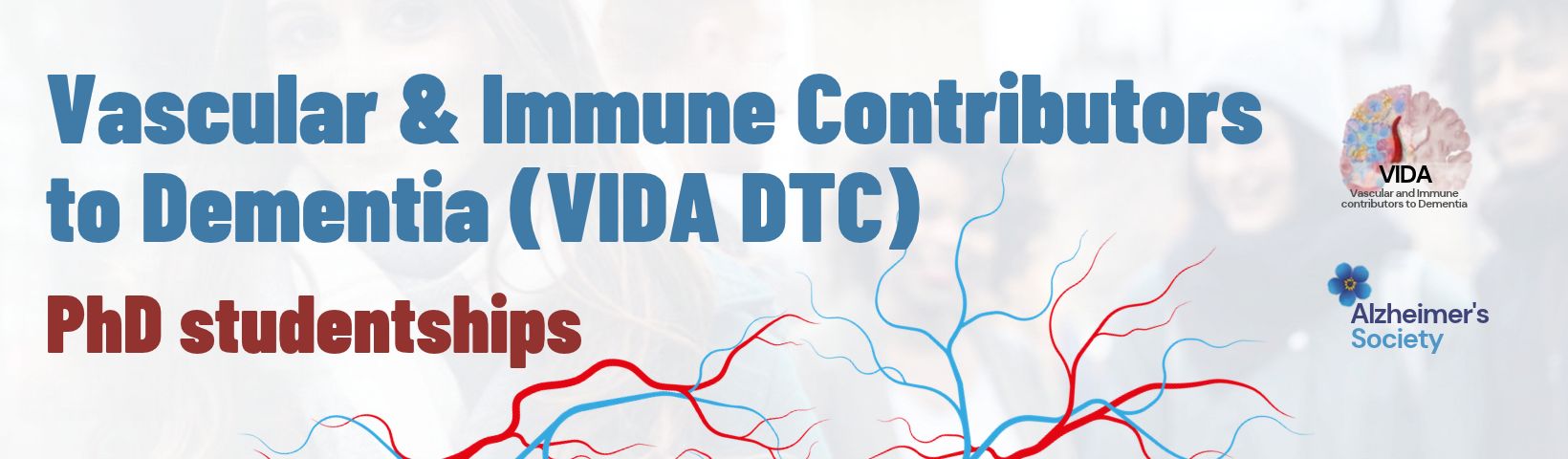
Funded by the Alzheimer’s Society, the Vascular and Immune contributors to dementia (VIDA DTC) brings together four leading institutions in the vascular and immune contributions to dementia field: The University of Manchester, The University of Edinburgh, Imperial College London and City St George’s, University of London.
Fourteen projects are open for 2027 entry – six at Edinburgh, five at Imperial and three at Manchester – and applications close on Monday 21 December 2026.
VIDA (Vascular and Immune contributors to DementiA) is a multi-institutional partnership between Alzheimer’s Society and four world-leading research sites. With projects focussing on the importance of vascular and immune mechanisms in dementia, VIDA PhD students will become the next generation of much-needed dementia researchers, contributing to breakthroughs in dementia diagnosis and treatment.
VIDA DTC focuses on how the body’s blood supply system (cardiovascular system), and the body’s immune system contribute to dementia. Researchers understand that changes to blood vessels and immune cells in the brain can have a major impact on dementia. It is estimated that at least 70% of people diagnosed with Alzheimer’s disease also have features of damage to the brain blood vessels and changes in the brain immune cells.
This Doctoral Training Centre will train 29 PhD students over 8 years. Throughout the 8 years, the researchers will focus on using cutting-edge science to understand the mechanisms behind how dementia develops, to find new treatments and new approaches that will ultimately improve the lives of those affected by dementia.
VIDA students will embark upon a 4-year fully-funded PhD project at one of the four institutions above, with access to the state-of-the-art research facilities and interdisciplinary training available at all sites. Students at each site will come together as a cohort at several points during the programme, including an induction week, annual conferences and residential workshop retreats which will link in with other Alzheimer’s Society Doctoral Training Centres across the UK. Students will also participate in engagement schemes with the Alzheimer’s Society and beyond, sharing the impact of their research in the community. The programme also benefits from built in opportunities for placements with leading industrial partners, and bespoke training plans including schemes to develop teaching, mentoring, and grant writing skills.
The opportunity
Fourteen projects are advertised for 2027 entry. The terms differ by host institution, so check the site you are applying to:
- University of Edinburgh – 6 projects. Open to students worldwide. A stipend of £21,805 rising by £1,000 each year, home fees covered, and international student fees covered by the University of Edinburgh for non-UK students if successful. Funding is also provided for research expenses, career development and student travel/conference attendance.
- Imperial College London – 5 projects. Home fee status only, starting October 2027. A tax-free stipend of £24,800 for 2027/28, reviewed annually, plus home-rate tuition fees and additional funding for research costs, professional development and conference travel. Students assessed at the overseas fee rate are responsible for the difference between Home and overseas tuition fees.
- The University of Manchester – 3 projects. Funded for UK students only, starting September 2027. Full funding for tuition fees and a stipend at the UKRI rate for four years, plus additional funding for research costs, professional development and conference travel.
Applications close on Monday 21 December 2026
Research Projects
There are fourteen research projects available across the three recruiting institutions. Each has a cross-University supervisory team.
Prior to applying, we recommend prospective applicants contact the lead for their first-choice project, who will be happy to discuss the opportunity and answer any questions.
University of Edinburgh
Astrocyte partial reprogramming to restore brain vascular health in ageing and dementia
Based at the University of Edinburgh
Supervisors: Dr Blanca Díaz Castro, Dr Alexi Nott, Dr Baptiste Brule
Contact: b.diaz-castro@ed.ac.uk
Abstract:
Ageing is the primary risk factor for neurodegenerative disorders leading to dementia, and vascular dysfunction is a major contributor to both brain ageing and dementia. Astrocytes closely interact with brain blood vessels, integrating signals from neurons and vascular cells to maintain brain homeostasis, and are altered with age and in neurodegenerative disease. Whether targeting astrocytes can prevent vascular dysfunction remains largely unexplored. This PhD project will test whether astrocyte partial reprogramming improves brain vascular health, profiling astrocyte and vascular cell epigenomes and integrating mouse data with human vascular cell-specific epigenomic and proteomic datasets from aged individuals and patients with dementia.
Probing the role of endothelial dysfunction in vascular dementia using advanced imaging
Based at the University of Edinburgh
Supervisors: Dr Tracy Farr, Prof Anna Williams, Dr Ben Dickie (Manchester), Dr Michael Stringer
Contact: Dr Tracy Farr via her Edinburgh profile, or anna.williams@ed.ac.uk
Abstract:
Cerebral small vessel disease (CSVD) is one of the leading causes of dementia, yet diagnosis occurs after significant and irreversible brain damage. A growing body of evidence suggests that dysfunction of endothelial cells is a critical early event, impairing cerebrovascular reactivity (CVR). This project will investigate the hypothesis that endothelial dysfunction produces early impairments in CVR and neurovascular coupling, and that these measurable biomarkers subsequently drive changes in brain network connectivity and structural injury, using two complementary animal models of CSVD available in Edinburgh and cutting-edge preclinical MRI.
Based at the University of Edinburgh
Supervisors: Dr Rikesh Rajani, Dr Tao Wang (Manchester), Prof Anna Williams
Contact: Dr Rikesh Rajani via his lab website, or anna.williams@ed.ac.uk
Abstract:
Cerebral small vessel disease is the leading cause of vascular dementia, characterised by white matter damage which correlates closely with cognitive impairment. The most common inherited form is CADASIL, caused by a mutation in the NOTCH3 gene. In this project the student will use human induced pluripotent stem cell (iPSC) derived cells to investigate interactions between vascular cells and oligodendrocytes, testing the hypothesis that vascular cells derived from CADASIL patient iPSCs secrete factors which alter oligodendrocyte behaviour and function – identifying possible therapeutic targets to prevent white matter damage.
Based at the University of Edinburgh
Supervisors: Prof Susanne van Veluw, Dr Hilde van den Brink, Dr Adam Greenstein (Manchester)
Contact: susanne.vanveluw@ed.ac.uk
Abstract:
Cerebral amyloid angiopathy (CAA) is a common cerebral small vessel disease and an important cause of intracerebral haemorrhage. Blood–brain barrier (BBB) dysfunction and inflammation have both been implicated in CAA pathophysiology, but their relationship remains unclear. This project combines spatial proteomics and spatial RNA analysis in post-mortem brain tissue with in vivo MRI data from patients, to investigate how BBB dysfunction relates to inflammation and to different manifestations of brain tissue injury in CAA.
Based at the University of Edinburgh
Supervisors: Dr Jill Fowler, Prof Karen Horsburgh, Dr Laura Parkes (Manchester)
Contact: Jill.Fowler@ed.ac.uk
Abstract:
Chronic cerebral hypoperfusion is a major contributor to white matter dysfunction, a key driver of vascular cognitive impairment and dementia. The purinergic receptor P2RY12 is emerging as an important regulator of microglial–vascular communication, but its role in chronic white matter damage remains unclear. Using an established model of chronic cerebral hypoperfusion, this project will investigate whether altered P2RY12-dependent communication between microglia and endothelial cells contributes to microvascular dysfunction, white matter damage and cognitive impairment, and whether targeting this pathway offers opportunities for therapeutic intervention.
Investigating brain-body immune influences on neural connectivity and cognition after stroke
Based at the University of Edinburgh
Supervisors: Dr Barry McColl, Dr Tracy Farr, Prof Stuart Allan (Manchester)
Contact: barry.mccoll@ukdri.ac.uk
Abstract:
Stroke is a leading cause of long-term cognitive impairment and dementia, but the mechanisms that link acute vascular injury to progressive brain-wide dysfunction remain unclear. This project will investigate how immune cells in the brain, particularly microglia, contribute to long-term brain connectivity and cognitive outcomes after stroke, building on findings that microglia become highly reactive not only around the injury site but also in remote brain areas connected through white matter pathways.
Imperial College London
Based at Imperial College London
Supervisor and lead contact: Prof Abbas Dehghan, a.dehghan@imperial.ac.uk
Abstract:
Could chronic inflammation increase the risk of vascular dementia? This PhD will investigate how immune-mediated disorders may influence vascular dementia through three complementary approaches: analysing large-scale UK electronic health records from the Clinical Practice Research Datalink, using Mendelian randomisation to test whether immune-mediated disorders and inflammatory pathways contribute to dementia risk, and integrating genome-wide genetic data with proteomic and metabolomic evidence. The project is computational and uses existing large-scale datasets; no laboratory experience is required.
Based at Imperial College London
Supervisor and lead contact: Prof Magdalena Sastre, m.sastre@imperial.ac.uk
Abstract:
Traumatic brain injury (TBI) is a major risk factor for the development of dementia, and there is evidence of blood brain barrier disruption in TBI brains. The aim of this proposal is to investigate the morphological and functional disturbances in the wall of the blood vessels after TBI and associate them with neuropathological events leading to synaptic loss and cognitive impairment, to determine whether there are sex differences, and to examine the therapeutic effect of ANXA1 treatment to reverse these effects.
B cells and sleep–wake disruption in Alzheimer’s disease
Based at Imperial College London, with research visits to the University of Manchester
Supervisor and lead contact: Dr Marco Brancaccio, m.brancaccio@imperial.ac.uk
Abstract:
Changes in the timing and regularity of sleep and activity can precede measurable memory impairment in Alzheimer’s disease. This project asks whether B-cell responses to amyloid-β help preserve circadian function or contribute to its disruption, and whether these responses influence pathology elsewhere in the brain. Using mouse models, the student will map the B-cell response to amyloid, test how B cells affect daily rhythms and memory, and determine whether the B-cell clock influences disease progression.
Based at Imperial College London
Supervisor and lead contact: Prof Julia Gorelik, j.gorelik@imperial.ac.uk
Abstract:
Recent work found that blocking phosphodiesterase 5 (PDE5) protected brain blood vessel cells grown from people with CADASIL. This PhD asks where that protection begins inside a cell and whether it can help preserve the blood-brain barrier, combining fluorescent biosensors (FRET) with scanning ion conductance microscopy (SICM) to study signalling nanodomains in stem cells from people with disease-causing variants in NOTCH3.
(Epi)genetic gene prioritisation for cerebral small vessel disease
Based at Imperial College London, with the UK Dementia Research Institute
Supervisor and lead contact: Dr Alexi Nott, a.nott@imperial.ac.uk
Abstract:
Cerebral small vessel disease is a major cause of stroke and vascular dementia, and a key contributor to Alzheimer’s disease. It is highly heritable, but most genetic risk variants lie in non-coding DNA and how they disrupt gene regulation is largely unknown. This computational project will build an integrative map of gene regulatory mechanisms in small vessel disease, analysing a deeply phenotyped cohort of 147 longitudinally followed patients from the Mild Stroke Study 2 — with genotyping, plasma proteomics, brain imaging and nine years of clinical follow-up — alongside matched controls, to find new blood biomarkers and genetically supported drug targets. No wet-lab experience is required.
The University of Manchester
Based at The University of Manchester
Supervisors: Dr Katie Murray, Prof Catherine Lawrence, Dr Kira Shaw
Abstract:
Microvascular dysfunction is increasingly recognised as an important contributor to dementia and Alzheimer’s disease. Our work has identified thromboangioplasticity (TAP), a novel vascular repair mechanism through which cerebral vessels actively remodel to remove obstructive clots and restore blood flow, which becomes markedly slower with normal ageing. This project will use longitudinal intravital two-photon microscopy to determine how vascular amyloid burden affects TAP in the intact living mouse brain.
Based at The University of Manchester
Supervisors: Dr Adrian Duszkiewicz, Dr Kira Shaw, Dr Axel Montagne
Abstract:
Neurovascular dysfunction is increasingly recognised as an early contributor to Alzheimer’s disease, but we still lack an understanding of how these changes disrupt neural circuit function to result in cognitive decline. Using mice carrying the human APOE4 gene variant, this project will characterise the functional relationship between local microvascular impairment and neural circuit function, and investigate the therapeutic potential of treatments that alleviate vascular dysfunction.
Thromboinflammation and infection in post-stroke neurodegeneration and cognitive decline
Based at The University of Manchester
Supervisors: Prof Craig Smith, Dr Fatemeh Geranmayeh, Prof Stuart Allan, Dr Matt Gittins
Abstract:
At least one third of stroke survivors develop dementia and there are currently no available treatments to prevent post-stroke dementia. This project aims to better understand how infections, thromboinflammation and measures of neurodegeneration and microstructural brain injury relate to cognitive outcomes after stroke, using clinical data, infection records, blood samples and MRI brain scans from the Stroke IMPaCT and IC3 studies.
Entry requirements
Applicants are expected to hold, or be about to obtain, a First or Upper Second-Class UK honours degree (or international equivalent) in a relevant discipline. Due to the competitive nature of the programme, many successful applicants may also have a master’s qualification, relevant research experience, or experience demonstrating suitability for doctoral research. Each institution sets its own English language requirements.
How to apply
- Edinburgh: contact the primary supervisor for your first-choice project first — email addresses are given with each project above — then send your application by email to the Postgraduate Admin team at IRRSchoolPGR@ed.ac.uk. You will need a CV and/or cover letter, university transcripts, degree certificates, a personal statement, two references, and English language certificates if you are an EU or international applicant. Queries about a project itself go to the named supervisors. Incomplete or late applications will not be considered.
- Imperial: apply separately for each project, by email to the supervisor named above, sending a CV, a cover letter and the contact details of two referees. The closing time is 5pm on Monday 21 December 2026, and shortlisted applicants will be interviewed in March 2027.
- Manchester: contact the primary supervisor before applying, then apply through the online application portal selecting VIDA DTC PhD Programme as the programme of study. You can apply for up to two projects, submitting a separate application and supporting statement for each.

 Rahul Sidhu




 Nature Careers Blog



 LSE Impact Blog