In this blog, I will discuss one of the most overlooked benefits of an academic career, how you can see the world through the eyes of science. Being a PhD student in neuroscience is incredibly demanding and research takes up a huge part of your life. We are either spending hours on end in the lab, analysing endless datasets, troubleshooting experiments, or trying to make sense of complicated scientific questions. Also, the financial side does not always make things easier, as UK PhD stipends rarely reflect the hours we put in or the amount of responsibility we carry in trying to improve lives. However, as dementia researchers, we are trying to understand one of the biggest challenges facing society, and that is the biggest motivator behind every scientist.
As well as this, another aspect which makes all this worth it and one of the best parts of academic life is the opportunity to see the world through international research travel. That is the dream, you are travelling to different parts of the world whilst discussing science and sharing your research with like-minded people. For me, this is combining my two greatest hobbies, science and travelling. This can be in the form of conferences, summer schools, research placements and collaborative visits.
Before starting my PhD, I never really imagined that I would be able to combine scientific research with international travel. Now that I am towards the end, I have been extremely fortunate to visit some amazing places which would have otherwise been out of reach, I have met researchers whose work I’ve admired for years, and I have developed skills that I wouldn’t have gained by staying in my own country. The best part about all of this is that all these international trips are fully funded, through my PhD programme and external awards, and I wish to share the importance of making the most of any opportunities you may get. I will describe each of my international trips, how I secured funding and what can be learnt from each trip.
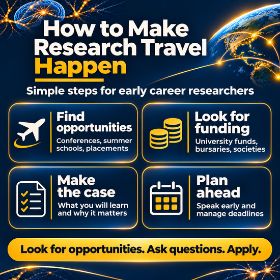
Practical steps to securing funding and making international research opportunities a reality.
International research travel during a PhD
Throughout my PhD, I’ve travelled to conferences and research events across the UK, including Edinburgh and Aberdeen in Scotland, as well as Newcastle, Leeds, Liverpool, Sheffield, York, Birmingham, Manchester and London. I’ve presented my research and networked with many incredible scientists, at all levels of their scientific journey.
I’ve also been fortunate enough to take part in five international opportunities, each offering different experiences.
Seoul: Brain & Brain PET
My first international conference was in Seoul, South Korea, where I attended the Brain & Brain PET conference, which is a conference that occurs every two years and involves experts in my field of neurovascular imaging. I used my PhD funding, which is the DiMeN PhD programme alongside a conference bursary to cover all costs. That was my first international experience, and it opened my eyes to the value of meeting researchers in person. I had spent a lot of time reading papers and referencing scientists whose work I respected, so attending this conference in person made the research community feel much more connected.
Toronto: Alzheimer’s Association International Conference
My next international conference was in Toronto, Canada, where I attended the Alzheimer’s Association International Conference (AAIC). I was presented with this opportunity by becoming an ambassador for the International Society to Advance Alzheimer’s Research and Treatment (ISTAART). Here, the Alzheimer’s Association covered all costs associated with this trip. This is the largest dementia conference in the world, meaning it gave me the opportunity to engage with the international dementia research community on a much larger scale. I’ll share more about that experience as an ambassador in a future blog.
Washington DC: Tau Global Conference
Linking to the Alzheimer’s Association, I have also travelled to Washington DC for the Tau Global Conference. I was flown out to this conference to help with the organisation, and I had the privilege of co-chairing a scientific session with the Association’s senior vice president. This was again funded by the Alzheimer’s Association, which I would encourage all early career scientists to get involved with as they offer many amazing opportunities all year round.
Boston: neurophotonics summer school
Following this, my next international travel opportunity came from being selected to attend an intensive neurophotonics summer school at Boston University, under the leadership of Professor Anna Devor. Scientists came from all around the world, bringing together different backgrounds and research interests, while sharing a common enthusiasm for neuroscience. We learnt new neuroimaging techniques, exchanged ideas and had the chance to learn from world leading neuroscientists. I also took the initiative while I was already in Boston to arrange a talk about my research with a senior scientist at Harvard Medical School and Massachusetts General Hospital. That experience reinforced something I’ve come to appreciate throughout my PhD, that you need to be proactive and realise that opportunities do not just stop at the event itself, as it is always important to look at the wider picture. This trip was fully funded through a highly competitive Medical Research Council award.
Opportunities do not just stop at the event itself.
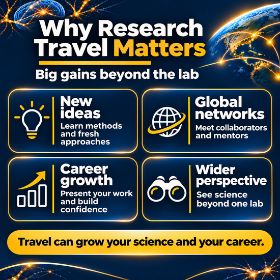
The benefits of research travel extend far beyond the laboratory, bringing new skills, connections and opportunities.
Tasmania: research placement
My final international opportunity was travelling to the University of Tasmania in Australia, on a research placement at a leading dementia lab, the Perivascular Research Group under the leadership of Associate Professor Brad Sutherland. I learnt new experimental techniques, gave a research talk to the university as a guest speaker, and worked alongside researchers whose expertise complemented my own. This trip was especially memorable as I made lifelong connections with brilliant scientists from Tasmania. The placement was fully funded by the International Society for Cerebral Blood Flow and Metabolism (ISCBFM).
Each of these international trips was different and all helped me grow as a scientist in various ways.
The benefits of international research travel
When it comes to conferences and events, it is interesting to listen to presentations and present your research, however, the most valuable experience happens outside the formal presentations and meetings. You get to know people more personally who are working on similar questions but approaching them from completely different angles. This is especially important as dementia is a complex challenge, and progress depends on researchers sharing knowledge across disciplines, institutions and countries. Building relationships with people working towards similar goals can open doors and helps you see your own work in a broader context.
Outside of science, there are personal benefits to international research travel. I personally found that travelling somewhere unfamiliar, navigating a different environment and spending time with people from different backgrounds is just as valuable as the science itself. Travelling for international events provides the opportunity to explore places you might otherwise never have visited. Experiencing Seoul, Toronto, Boston, Washington and Tasmania has been extremely special for me. I now have a massive scientific network from around the world and built lifelong friendships with fellow scientists which I would never have otherwise.
It is important to note that these trips aren’t holidays, and in fact they involve hard work, mentally and physically, through the jet lag, travel exhaustion, and constant fatigue from networking. However, they offer a chance to see the world while doing something you genuinely care about, and that is a rare privilege not many careers offer.
They offer a chance to see the world while doing something you genuinely care about.
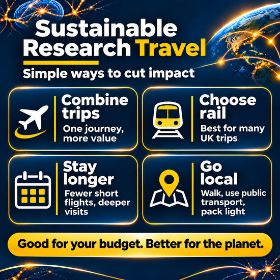
Explore the world through science while making more environmentally responsible travel choices.
How to make international research travel happen
If you are reading or listening to this as a PhD student or at the start of your research career, here is some advice about how to make these opportunities happen for you. My biggest piece of advice is to be proactive and do not assume that international research travel is only for established academics with large budgets. Look for opportunities where you’ll learn something new, meet people in your field or develop skills that will help your research. Start by looking at the funding available through your university, institute, lab or PhD programme and some conferences even offer bursary travel awards or reduced registration fees. Also, charities such as Alzheimer’s Research UK and nonprofit organisations like the Alzheimer’s Association advertise relevant travel funding opportunities aimed at early career researchers.
It’s worth setting aside some of your available research or training budget for a conference or placement, if your funding arrangements allow it. Even one international conference during your PhD is worthwhile. Keep a specific eye out for summer schools, early-career researcher programmes, ambassador schemes and lab exchanges. All these opportunities are highly competitive, therefore give yourself time to prepare a strong application explaining what you hope to learn and how the experience will benefit your research.
When planning an international trip, our experiments, deadlines and other commitments don’t disappear and prior planning is needed. Discuss potential trips with your supervisors early, work out how your research will be managed while you’re away, and make sure the opportunity is genuinely relevant to your development. I’ve been very fortunate to have supervisors who encouraged me to pursue these experiences, and their encouragement made a real difference.
Finally, a PhD can sometimes feel as though your world has reduced to your desk and your lab, but these international experiences reminded me that science is much bigger than any one project or institution. I’ve returned from these experiences with new skills, fresh ideas, and real connections with researchers from around the world. They have not only helped me grow professionally, but they’ve also given me memories and experiences that I’ll carry long after my PhD ends. If you’re a PhD student wondering whether these opportunities are worth pursuing, my advice is simple: look for them, ask questions and apply. You might be surprised by what’s possible. If you don’t ask and don’t apply, you won’t get these opportunities.
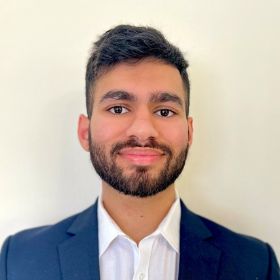
Rahul Sidhu
Author
Rahul Sidhu is a PhD student at The University of Sheffield, focusing on the effects of heart disease on dementia in preclinical models of Alzheimer’s disease. His research aims to uncover how cardiovascular health influences neurodegenerative conditions, potentially leading to novel therapeutic strategies.
Follow @rahulsidhu_
Find Rahul on LinkedIn

 Dementia Researcher

 Dr Sam Moxon