 Print This Post
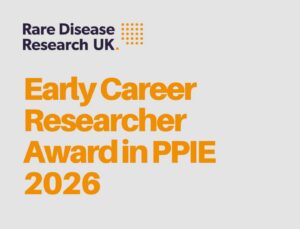 Rare Disease Research UK (RDR UK) is inviting early career researchers to apply for its Early Career Researcher Award in Patient and Public Involvement and Engagement (PPIE), and this year PhD students can enter for the first time. The twist is that you don’t apply on your own. You apply as a pair with a PPIE contributor you’ve worked with, and if you win, you both get funded to attend the RDR UK annual conference.
Now in its third year, the award recognises early career researchers who have done PPIE properly, working with people rather than doing things to them. It’s open to anyone working in rare disease in the UK, not only those connected to RDR UK, and it isn’t tied to any discipline. Basic science, therapeutic development, applied and translational work and psychosocial research are all in scope.
Is dementia research eligible?
It can be. RDR UK defines a rare disease as one affecting fewer than 1 in 2,000 people, so this isn’t one for common late-onset Alzheimer’s. But if you work on one of the rarer dementias or related neurodegenerative conditions, such as inherited forms of dementia, frontotemporal dementia, posterior cortical atrophy, primary progressive aphasia or prion disease, check your condition against that threshold. If you’re not sure where you stand, email the organisers before you put the work in. Our podcast on the Rare Dementia Support Impact study is a good reminder of how much involvement work is already going on in this space.
What the judges are looking for
They want PPIE that shows genuine partnership between researchers and contributors, going well beyond the old model of telling patients and support groups what you found once it’s all over. If you want a feel for what that looks like from both sides, have a read of our piece on ECR and PPI reflections on working together in co-production.
The work needs to have reached the point of having an impact, but it doesn’t need to be finished. If your project has already ended, it must have done so within the last two years. RDR UK has published blogs from previous winners and runners-up, which are the best guide to the standard.
Who can apply
- PhD students and postdoctoral researchers, including clinician scientists, who haven’t yet applied for grants or fellowships as an independent PI
- Researchers based in the UK and working on a rare disease, in any discipline
- Applying jointly with a key PPIE contributor they’ve worked with, as each of you contributes to the application
If you’re a lab scientist who has assumed PPIE isn’t really for you, basic science is explicitly welcome here, and our guide on how to implement PPI as a lab scientist is worth a look. So is this account of doing PPI on a PhD project.
What you win
The winning researcher and their PPIE contributor both receive funding to attend the RDR UK annual conference in April 2027 (location to be confirmed), where they’ll be celebrated at a prize-giving. The pair are also invited to co-write a blog for the RDR UK and Genetic Alliance UK websites.
How to apply
Applications go in through an online form that both of you need to contribute to. Download the application questions as a PDF and draft your answers together first. You’ll want time to agree how you tell the story of your partnership, and it’s much easier to do that on paper than halfway through an online form. When you’re setting out what involvement actually changed, the GRIPP2 reporting checklist gives you a useful structure. The questions are adapted from HDR UK’s own PPIE award scheme.
Questions go to Amy Hunter at Genetic Alliance UK: amy.hunter@geneticalliance.org.uk.
Who’s judging
The seven-strong panel mixes researchers, contributors and facilitators. It’s chaired by PPI contributor Jillian Hastings Ward, alongside oncology researcher David Church, PPIE contributor Sadia Haqnawaz, PPIE facilitator Amy Hunter, PPIE facilitator and contributor Kerry Leeson-Beevers, researcher and inclusion lead Dr Ameeta Retzer and PPI lead Amanda Stranks.
Applications close Sunday 15 November 2026.
Apply Now Application Questions

 Rahul Sidhu