 Print This Post
It’s so easy to get caught up in the infamous “lab bubble”. Having been guilty of it myself, I wanted to share some things I have done recently to get myself out of that bubble, and how it has made me reflect on how I work with others.
I recently went on a trip with my DTP, the Midlands Integrative Biosciences Training Partnership, to Coniston in the Lake District. We stayed at an outdoor centre, and it was a week full of activities like kayaking, climbing and gorge walking – which was right up my street! When we first arrived, we were split into groups. I was slightly apprehensive at first, as my close friends were in other groups. However, this ended up being one of the best parts of the week.
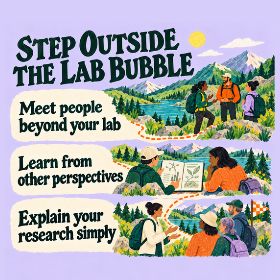
From the Lake District to Silverstone, Beccy Owen reflects on how meeting new people helped her think differently about research and communicating beyond academia.
Being a PhD student can sometimes feel quite isolating, particularly when you have been working independently for a few weeks. It was refreshing to step away from my usual routine and connect with people outside my immediate circle, who ultimately are in the same position as me.
What struck me the most throughout the week was how quickly we became a team. Most of us had never really spent much time together before, yet we developed a great bond and worked really well together. For example, some of the activities were slightly scary (like sliding down a rockface and dropping 3 metres into a gorge), but we all supported each other and worked incredibly well as a team. Everyone brought something different to the group.
It made me realise that a good team doesn’t mean having a group of people who are all the same. In fact, it was the differences between us which made the group work so well. By the end of the week, I found myself appreciating not only the strengths I could bring to the group, but also what I could learn from the people around me. One other, less profound takeaway from the week is that I used to be rubbish at orienteering, and I am still, in fact, rubbish at orienteering!
I bet you’re thinking “Coniston is a great story, but what does this have to do with your day-to-day PhD?”
Everyone brought something different to the group, and I think that science is no different. The best research teams aren’t made up of people with the same skillsets, knowledge, or way of thinking. They are made up of people who can bring their own strengths to a shared problem.
As a PhD student, I am learning that my research doesn’t exist in isolation. It is shaped by the people I work with, collaborators who bring different expertise, and people who change the way I think about a problem. It made me realise that teamwork and collaboration in research exists in many different forms. It can be collaborating on a grant application, a conversation with a colleague, asking someone for advice, or simply having someone to troubleshoot a problem with.
These interactions may not always appear on paper, but they are a huge part of doing science.
Another thing that I have come to appreciate during my PhD is that people around me are constantly changing. Over my four years, I will work alongside many postdocs, lab technicians, PhD students, and master’s students. Although it can be hard saying goodbye to people you have worked closely with, it is great to work with so many different people. Each person who comes into the lab brings their own experiences and skills, and there is always so much to learn from each other.
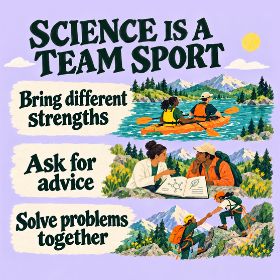
A PhD may be an individual qualification, but research thrives on shared expertise. Beccy Owen explores the value of different strengths, everyday advice and solving problems together.
This also made me think about how I interact with people outside of academia. Earlier this year, I had the opportunity to volunteer for Race Against Dementia at the Silverstone Grand Prix. Race Against Dementia is a charity which funds dementia research, applying a Formula 1 mindset of teamwork, innovation, and problem-solving to accelerate progress in dementia research.
At Silverstone, I was not only helping fundraise for the charity but also speaking to the public about my research. What struck me the most about it was how excited people were to hear about it. I am so used to talking about my research with other scientists, where conversations can quickly become technical. It was very refreshing to see how interested people were in the bigger picture.
I found myself explaining my research in a completely different way. I couldn’t rely on scientific terminology – instead, I thought about what the public would think is interesting about my research and found ways to explain it that people could relate to. It reminded me that science doesn’t exist solely within the lab. The research we do ultimately matters to the people it could benefit, and being able to communicate that research beyond academia is an important part of being a scientist.
Both experiences made me realise that getting out of the lab bubble isn’t necessarily about doing something completely different. It’s about being exposed to people who think, communicate and approach things differently.
Interestingly, I had an interview for an industrial placement a couple of weeks ago and was asked “Do you prefer working independently or as a team?” I found the question surprisingly difficult to answer. I value the independence that comes with doing a PhD and having ownership over my own research, but I also know that some of the best parts of my PhD have come from working with other people.
A PhD might be an individual qualification, but science is a team sport.
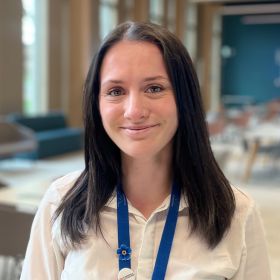
Beccy Owen
Author
Beccy Owen is a PhD Researcher at the University of Warwick, exploring how tau pathology disrupts neuronal ion channels and brain network activity in Alzheimer’s disease. As part of the Midlands Integrative Biosciences Training Partnership, her work uses electrophysiology to better understand the molecular drivers of neurodegeneration. Originally from the Welsh countryside, Beccy’s passion for dementia research was shaped during her postgraduate studies and through personal experience with a family member living with the condition. She will be sharing her journey, insights, and lessons learned throughout her PhD here on the blog.

 Dementia Researcher
 Bernie McInally
 LSE Impact Blog
 Dr Chloe Fawns-Ritchie
 Dr Yvonne Couch
 Dr Clíona Farrell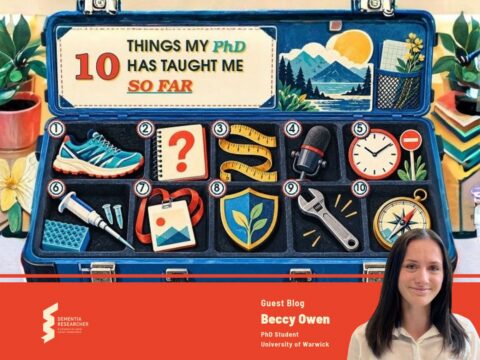
 Beccy Owen

 Rahul Sidhu