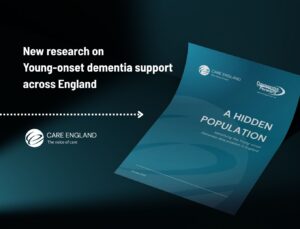
 Young-onset dementia – A new report finds that 95% of local authorities in England have no way of recording young-onset dementia as distinct from dementia in general, leaving tens of thousands of working-age people largely invisible to the systems meant to plan their care.
A Hidden Population: Identifying the Young-onset Dementia data problem in England was published this month by Care England, the largest representative body for independent adult social care providers, and Dementia Forward, the North Yorkshire and York dementia charity behind the U&ME campaign. It lands around Young Onset Dementia Awareness Day (#YODA), which the charity set up and which falls on 24 October each year.
The report was written by Alexander Devkota, Senior Policy Officer at Care England, with Jill Quinn MBE, Dementia Forward’s founder and Chief Executive, Karen Thomas, the charity’s Head of Young-Onset, and Cllr Peter Lacey of North Yorkshire County Council. In April 2026 the team sent Freedom of Information (FOI) requests to every council with adult social services responsibilities, every Integrated Care Board (ICB) and every NHS mental health trust in England. Responses came back from 139 local authorities (91%), 34 ICBs (94%) and 36 trusts (82%). They asked how young-onset dementia is recorded, whether it features in local strategies, how many people are known to services, what care is commissioned and what it costs.
Young-onset dementia means dementia where symptoms start before the age of 65. GP records in England show close to 35,000 people with a young-onset diagnosis, but the report puts the real figure somewhere between 60,000 and more than 100,000. The headline is that most of the system can’t see them.
Why this matters for dementia research
Prevalence estimates, service planning, trial recruitment and health economics all start from the same place: who is counted, and how. This report is a reminder of how much depends on a coding decision. If a person’s dementia isn’t flagged as young-onset at the point it is recorded, they drop out of the numbers that commissioners, funders and researchers work from.
There’s plenty here for anyone working in epidemiology, health services research, social care or applied dementia research. The FOI data is new, the questions are reproduced in full in the appendix, and the report is honest that its local authority figures rest on proxy measures. It also points to open questions that need researchers, not just campaigners, starting with whether age-appropriate community support saves money as well as improving lives.
A population the data can’t see
The standard way to count young-onset dementia is a snapshot of people aged 30 to 64 with a dementia diagnosis. The report argues that misses two groups: people whose symptoms started before 65 but who have since turned 65, and people whose symptoms started before 65 but who weren’t diagnosed until after it. Given the delays in diagnosis, the second group is not small. The authors borrow the phrase “hidden population” from Carter and colleagues’ 2022 analysis of primary care records, which made the same argument.
Clinical coding adds to the problem. In ICD-10, which sits under NHS records and many council systems, the only dementia code with an early-onset qualifier is G30.0, Alzheimer’s disease with early onset. Alzheimer’s accounts for around a third of young-onset cases, against nearly two-thirds in later life. Vascular dementia, frontotemporal dementia, Korsakoff’s syndrome and the rarer forms that make up the rest of young-onset dementia have no code that marks them as early onset.
NHS England’s primary care data does now publish a young-onset count, based on diagnoses made before 65, and from July 2026 it’s available at sub-ICB level without disclosure control. That figure stood at 34,783 in June 2026, up from 33,950 two years earlier. Set against estimates of 60,000 to 100,000 people with young-onset dementia, that implies a diagnosis rate of somewhere between 35% and 58%, well short of the 67% national target for dementia overall.
The upper estimate comes from North Yorkshire. Using the widely quoted prevalence of around 0.09% of 30 to 64-year-olds, you would expect about 262 people with young-onset dementia in the area. Local commissioners’ own strategy put the number at 173. Dementia Forward is currently supporting 449. If the rest of England looks like North Yorkshire, the national figure could be well over 100,000.
Slower to diagnose, harder to recognise
Young-onset dementia often doesn’t look like the memory-led picture people expect. Atypical presentations affecting vision, language, behaviour, executive function or movement are more common, and screening tools built for older patients can miss them. The report cites research putting the average time from symptoms to diagnosis at 4.4 years for people under 65, against 2.2 to 2.8 years for those diagnosed later.
The case studies show what that looks like for families. One man, a stay-at-home dad, was first treated for anxiety and depression, then told he had mild cognitive impairment and to be more active. With no follow-up, it was two years before he was diagnosed with Alzheimer’s disease. Another, a senior IT worker, made a costly mistake on a routine task he had done for years and faced disciplinary action months before his diagnosis at 59.
What the FOIs found
The responses paint a consistent picture across health and social care:
- 95% of local authorities don’t record young-onset dementia as a distinct category in their data systems. Where councils could give numbers, most used a proxy of people under 65 with dementia on file.
- 76% of local authorities have no specific mention of young-onset dementia in their dementia strategies, or couldn’t say.
- Just 10% commission any specialist young-onset support, and two of those are groups rather than care services. More than half (56%) commission nothing for this group at all.
- Just 41% of ICBs have a dementia strategy that specifically mentions people diagnosed under 65, though 40% of the rest said new strategies were in development.
- 70% of responding NHS mental health trusts had detained at least one person with young-onset dementia under the Mental Health Act in the previous 12 months, and a third had at least one person receiving Section 117 aftercare.
Among the 59 councils that shared any figures, 71% were aware of fewer than half of the people the report estimates are living with young-onset dementia in their area, and 64% were funding care for fewer than a quarter.
ICBs are the one part of the system required to hold figures on their local young-onset population, because of the GP data. That greater awareness hasn’t turned into much planning, and the report suggests the councils that have worked with ICBs on joint strategies are a small, engaged minority.
The cost of care that doesn’t fit
Most of the care that councils do fund for people with young-onset dementia is in residential and nursing homes, followed by homecare and direct payments. Across 55 councils that gave cost data, the average weekly cost of an in-area placement was £1,157, in line with dementia care for older people. Scaled up nationally and added to out-of-area placements, the report estimates councils spent around £267 million on young-onset dementia care in 2025/26.
The authors stress that most of this money pays for services that weren’t designed for people in their 40s, 50s and early 60s. And the figure leaves out the cost of hospital admissions, detentions and crisis care when things go wrong, as well as the unpaid care families provide.
One case study makes the point. A woman of 47, physically fit, was living in a care home for older people and close to being evicted because she kept removing her clothes and had stopped eating. Staff hadn’t recognised that she was going through the menopause, in a home kept warm for frail older residents. Once the home had specialist training, her GP prescribed HRT and she was offered the Asian food she loved, and things changed.
Another man, a regular at Dementia Forward’s day group, was taken to hospital under the Mental Health Act when his behaviour changed at home, against his wife’s wishes. Away from his routine and the people he knew, he deteriorated quickly, and spent time as a delayed discharge before a care home place was found.
The report’s findings echo earlier work on the dementia training gap in England’s care workforce, but with an extra layer: staff trained for later-life dementia can still be unprepared for someone decades younger.
A model from North Yorkshire
The second half of the report sets out Dementia Forward’s young-onset A-Z Blueprint, built up since 2013 and funded through fundraising rather than any dedicated young-onset money. It includes a Head of Young Onset Dementia and a small specialist team, triage from general Dementia Support Advisors to specialist advisors, three outward-bound respite days a week, advocacy on money, work, housing and legal issues, peer groups, and training for employers and care homes.
The charity’s belief is that age-appropriate, proactive support could save statutory services money while giving people better care. The report is clear that this hasn’t been proven yet. A two-year Knowledge Transfer Partnership with Leeds Beckett University will look at young-onset dementia and the impact of the model locally, and the authors call that evidence-gathering the next step.
What the report recommends
The authors make nine recommendations across three groups. For local authorities:
- Distinct data coding, updating care and assessment systems to record young-onset dementia as its own category rather than relying on age proxies
- Dedicated strategies for working-age adults with dementia, including support for carers
- Age-appropriate provision, shifting funding towards specialist community support, outward-bound day respite and supported living
For the NHS and ICBs:
- Standard diagnostic pathways for young-onset dementia across primary care and memory clinics, to cut the 4.4-year delay and pick up non-Alzheimer’s forms
- Co-commissioning, with ICB dementia strategies jointly owned with local authorities
- Fewer crisis detentions, through person-centred support that reduces reliance on antipsychotics, Mental Health Act detentions and emergency admissions
For NHS England, the Department of Health and Social Care and other national bodies:
- Revised classification standards, with ICD-11 and SNOMED coding that captures every form of young-onset dementia
- Scaling what works, funding and evaluating regional models like the A-Z Blueprint so that postcode doesn’t decide access
- Multi-year investment, through a three to five-year funding framework for young-onset dementia services
Many of these line up with Dementia UK and the Young Dementia Network’s young onset dementia framework for change, published in 2025 to help ICBs commission a defined pathway.
Counting people in
In his foreword, Care England’s Chief Executive Professor Martin Green OBE sums up the report’s argument: “What is uncounted in our data inevitably remains unplanned for in our communities.”
None of this is a new message to people working in young-onset dementia, and Care England says government responses to parliamentary questions on it have been underwhelming so far. What the report adds is a national evidence base on how far the data gap reaches into councils, ICBs and trusts. For researchers, it’s both a warning about the limits of routine data and an invitation. Better prevalence estimates, proper evaluation of models like Dementia Forward’s, and costed evidence on what age-appropriate care saves are all things our field can help deliver.


 Heather Wilkinson