 Print This Post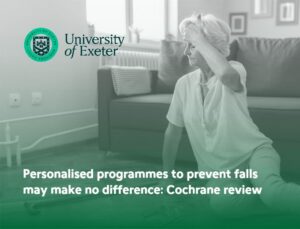
Falls are one of the most common causes of injury and death in older people around the world.
Personalised falls prevention programmes for older people probably make no difference to how often they fall compared with simple falls advice or education, according to a new Cochrane review led by the University of Exeter.
The review focused on multifactorial programmes, which tailor a package of treatments to each person’s individual level of risk, such as exercise combined with changes to medication, or removing hazards around the home. The researchers found these programmes are probably no more effective than giving people good falls prevention education, which is far cheaper to deliver. Compared with usual medical care they only slightly reduced the rate of falls or the risk of falling again, and when set against exercise it is unclear whether they help at all.
The team also looked at multi-component programmes, which combine several treatments but are not personalised. These showed little or no benefit on how often people fall when compared with usual care, exercise or falls prevention education.
Falls are one of the most common causes of injury and death in older people around the world, and around one in three people aged over 65 fall at least once a year. They are a particular concern for people living with dementia and for those who support them, and earlier research has shown that a structured falls prevention programme can be effective in care homes.
Simpler approaches may work best
Co-lead author Dr Lianne Wood, Bateman Family Chair in Peripheral Neuropathy at the University of Exeter Medical School, said: “In an ageing society, effectively preventing falls can save lives and help people live healthier lives for longer. Our health services operate on limited funding, and we need to ensure we’re being guided by the best evidence to prevent falls. There’s a lot of research out there, and we designed this review to find answers on what really works.”
Co-lead author Dr Cynthia Swarnalatha, of the University of Exeter Medical School, said: “We’ve conducted the most comprehensive review of the best evidence across the world, and we were surprised to find that many of the more complex programmes did not measure up. Providing effective education and focussing on encouraging the uptake of exercise are more simple approaches, and we also found them to have potentially the most benefit in falls prevention.”
Understanding why people fall
Co-author Professor Sallie Lamb, Mireille Gillings Professor of Health Innovation at the University of Exeter, said: “Our results show how much we still need to learn about how and why falls happen in the first place. We’re now conducting a major study to understand why people have unstable walking and are at higher risk of falls. Combined with this review, it will help us design the best prevention programmes in future, to reduce frailty and help people live well for as long as possible.”
The review, Multifactorial and multiple component interventions for preventing falls in older people living in the community, is published in the Cochrane Database of Systematic Reviews. The work was supported by the NIHR Exeter Biomedical Research Centre, the Dennis and Mireille Gillings Foundation and the Bateman Family Charitable Trust.


 Rahul Sidhu