 Print This Post
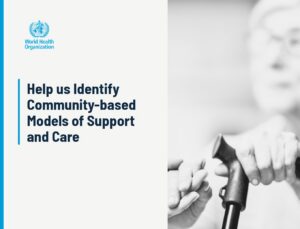 Dementia is now the fifth leading cause of death worldwide, according to recent WHO estimates. Yet health and social care systems in almost every country are struggling to keep pace with what people living with dementia, and the families and carers who support them, actually need. Much of that support happens in the community, long after a diagnosis and well away from hospitals and memory clinics, and that is exactly where the evidence on what works is thinnest.
A WHO-supported working group is running an international survey to change that. It is gathering real-world experience of community-based dementia models of support and care, to identify the approaches, innovations and priorities that could strengthen support for people living with dementia and their carers worldwide.
Who is behind it
The WHO Blueprint for dementia research is the global framework for prioritising and coordinating dementia research. To help turn it into practice and policy, WHO’s Dementia Research Dialogues: Where Blueprint Meets Practice series has set up a number of interest groups, including one on Community-based Models of Support and Care.
That working group aims to:
- identify community-based models of support and care for people living with dementia and their care partners
- evaluate their outcomes, including implementation, feasibility, effectiveness and costs
- develop a taxonomy and classification system for these models
The survey is the first step. A literature review is running alongside it, and the two sets of results will be brought together to map the evidence and help services choose models that fit local needs and capacities.
What counts as a community-based model
The definition is deliberately broad. Following WHO’s definition of models of care, it covers how support and services are delivered, how that changes as dementia progresses, and how providers, roles and resources are organised along the way.
‘Support’ sits alongside ‘care’ on purpose. It recognises the relationships, social connection and emotional needs that matter long before formal care is needed, and approaches such as re-ablement that help people build new routines and keep doing the things that matter to them after a diagnosis.
‘Community’ can mean a place, such as someone’s own home or another non-residential setting, or a group of people connected by shared interests, values or experiences. So a community can be a provider of support as well as the place it happens.
Crucially, the working group wants to hear about models both with and without a research base. Well-evidenced, established programmes are welcome, but so are lesser-researched, adapted and emerging grass-roots initiatives.
Why it matters
This work feeds directly into milestone 12.1 of the Blueprint. Strategic Goal 12 calls for affordable, effective care models that span the whole journey from diagnosis to end-of-life care, tailored to different cultural, regional and economic contexts. Getting there needs a far better picture of what is already happening on the ground, including the help available for carers.
Who should take part
Anyone who can describe community-based models of support and care for dementia that are used in their country or region, whether you research them, deliver them, design them or commission them. Researchers, clinicians, service providers and community organisations are all well placed to contribute.
Responses are processed confidentially and are not shared outside the working group. The survey was exempted from review by the ethics board at Wheaton College.
Take part
The survey is available in 16 languages and takes around 10 to 15 minutes to complete. Please share it widely with colleagues, partner organisations and networks, so the evidence base reflects as many countries and settings as possible.
👉 Take the survey: Community Models of Support and Care in Dementia

 Dr Chloe Fawns-Ritchie

 National Centre for Research Methods