 Print This Post
For a lot of people, a research assistant job is the first proper job in research. It’s how graduates and masters students get a foot in the door, how people find out whether a PhD is really for them. It’s also a sspace that’s getting crowded, not with jobs but with people applying for them. One London biomarker lab recently received more than 120 research assistant job applications for a single post, and closing dates are getting shorter as employers try to cope with the volume.
Most job application advice is generic. It tells you to tailor your CV, proofread, and “show your passion”. This guide is specific, not for all academic positions (although the advice we share could be applied to other positions), but to help you secure your first Research Assistant position. It covers the basics of a research assistant job application, because they still matter, but it also explains how university shortlisting works behind the scenes, what our own jobs board tells us about research assistant adverts, how to find out what a project actually needs before you write a word, and how to use AI without sounding like everyone else in the pile.
In brief
Research assistant jobs can be fiercely competitive, and adverts often don’t stay open long. On our own jobs board, UK research assistant posts had a median of 17 days left to apply when they appeared, and more than four in ten had two weeks or less. So the preparation you do before an advert appears matters as much as the research assistant job application itself.
Most university panels shortlist by scoring your application against each criterion in the person specification, using only the evidence you give them. Miss an essential criterion and you can be out, however good your CV. Once you’re through that screen, what makes you stand out is showing you understand the specific project, which you can usually research from public grant databases. AI can help you check and sharpen your application, but used to write it, it tends to produce exactly the bland, interchangeable statements panels are tired of reading.
On this page
We start with what a research assistant actually does, how competitive these jobs really are and what our jobs board data shows, including what to do if you can’t relocate. Then the practical part: getting ready before an advert appears, how shortlisting works, reading the advert like a panel member and reading the grant behind the post.
After that come the informal email to the PI, the supporting statement, your CV, using AI sensibly, visas and right to work, the interview and what to do if you don’t get it. We finish with tips from PIs who hire research assistants and answers to common questions.
 What a research assistant actually does
In UK universities, a research assistant post almost always exists because someone has won a grant. A PI or project lead has funding to do a specific piece of research and needs someone to help deliver it: running experiments, recruiting and assessing participants, collecting and cleaning data, keeping a study organised and on time. Many posts are fixed-term, and last as long as the funding does.
It may be obvious, but that information tells us something. You’re not being hired for your potential, you are being hired to help a particular project hit its targets, usually with a small team and a tight budget. The application that wins is the one that makes a busy PI think, “this person could start doing the work we need done.”
That doesn’t mean they expect a finished researcher. A PI hiring a research assistant knows most applicants are a year or two out of a degree, and nobody reading the pile is looking for decades of experience. They’re looking for signs you’ve already done a small version of the work: a term running Western blots on a placement, twenty participant interviews for your dissertation, a summer cleaning survey data for a lecturer. Examples like these count for more than applicants tend to think. In a pile of people with similar degrees, the one who can point to even a little real experience, and describe it clearly, has an advantage.
The different kinds of research assistant post
In dementia and neurodegeneration research, research assistant posts fall into a few broad types, and the skills that matter differ between them:
- Lab-based posts, such as cell culture, stem cell models, biomarker assays, histology or molecular biology. Techniques and careful record-keeping carry a lot of weight.
- Clinical and community studies, where you recruit participants, run cognitive assessments or collect samples, often in clinics or people’s homes. Working well with older people, people living with dementia and their families matters here, and posts often need a DBS check and Good Clinical Practice training.
- Applied health and social care research, including care home studies, qualitative interviews, service evaluations and policy work. Communication, organisation and an ear for people’s experiences count for a lot.
- Data and computational roles, including imaging analysis, clinical data science and working with large datasets. Here, what you can show you’ve done in R, Python or similar matters more than which degree it was in.
Research assistant or research associate?
The two titles are easily confused. In most UK universities, a research assistant is a pre-doctoral post, suited to graduates and masters students, while a research associate usually holds a PhD or is close to finishing one. Some adverts recruit at either level. On our jobs board, 15 of the 165 UK research assistant adverts we analysed were advertised as “Research Assistant / Associate”. Typically that means you’d be appointed at the lower grade if you don’t yet have a PhD, so read the grade and salary details carefully.
How competitive are research assistant jobs?
The honest answer is that it varies a lot, and some are very competitive indeed. That London fluid biomarker post with more than 120 applicants is not unusual for popular labs in popular cities, it also seems to be the same situation for positions in Psychology. Posts that are openly pitched as good preparation for clinical psychology training, for example, tend to draw large numbers of psychology graduates. A specialist lab post in a smaller city may attract far fewer, but the few who apply may all have the right techniques.
Picture the PI behind that biomarker post. More than 120 applications arrive, on top of everything else they’re doing. Nobody reads 120 applications closely. The first pass is a quick check against the essential criteria, and many applicants fall at the first hurdle. Often that’s not because a stronger candidate came along, but because the application never mentioned the assay experience the advert asked for, or buried it in a line of the CV. What’s left is perhaps a couple of dozen people who all look right on paper, and that’s where the real contest starts.
So a stand-out application has two jobs. It has to survive the screen, which is mostly about discipline. Then it has to give the panel a reason to pick you from a pile of qualified people, which is mostly about understanding the project. The rest of this guide is organised around those two jobs.
What our jobs board tells us about research assistant adverts
Because we list research assistant vacancies from across dementia and neurodegeneration research, we can look at what those adverts have in common. We analysed every research assistant listing on our jobs board between September 2024 and September 2026: 193 posts, 165 of them in the UK.
The window to apply is short
Once a UK research assistant advert appeared on our board, the median time left before it closed was 17 days. More than four in ten (42%) had two weeks or less, around one in eight (13%) had ten days or less, and nine had a week or less. Only a handful stayed open longer than a month.
And the window is shrinking. A year ago, if you spotted a research assistant advert on our board on a Monday, it would typically stay open until the weekend after next. Spot one on a Monday now and it’s more likely to close on the Tuesday a fortnight later. That’s a median of 15 days, down from 19. Ask PIs why and you tend to hear the same answer: a popular post can pull in over a hundred applications, and every extra day it stays open is more to read.
A few employers post most of the jobs
UK research assistant posts on our board were concentrated in a small number of places. The University of Oxford, University College London (including the UK Dementia Research Institute there) and the University of Cambridge between them accounted for more than four in ten, and London institutions together for about a third. That reflects where the big dementia research groups and centres are. By city, London, Oxford and Cambridge together accounted for more than six in ten UK research assistant posts on our board. Newcastle came next with 13, while the whole of the Midlands produced nine and Yorkshire six. If you can’t move, that matters, and we’ve set out how to handle it in its own section below.
The same groups recruit again and again
Research groups rarely hire only once. Between February and August 2026, for example, Oxford advertised five separate research assistant posts in neuronal cell biology on our board (we assume these were seperate jobs, rather than the same role advertised time and time again after failed recruitment). If there’s a group whose work you’d love to be part of, it’s worth following them, because missing one advert rarely means missing your only chance.
Where the jobs are also depends on what kind of research assistant you want to be. Most of the lab-based posts we listed were in London, Oxford and Cambridge, many of them at UK Dementia Research Institute centres. Newcastle’s posts were mostly clinical, applied and data work. So the more flexible you can be about where you live, the more of the market is open to you. A graduate willing to move anywhere for a stem cell post has far more options than one who needs to stay in Leeds, where we listed four research assistant posts of any kind in two years.
How we worked this out, and its limits
We counted every listing on our board tagged as a research assistant post from September 2024 to September 2026, and measured the days between the date we published it and its closing date. Employers often advertise on their own sites a few days before a post reaches us, so the real application windows are probably a little longer than these figures. This is also one board, not the whole sector, and a couple of hundred adverts is a modest sample. Treat the figures as a useful indication, not a precise measurement.
If you can’t move: finding research assistant jobs closer to home
Plenty of people can’t pack up and move to Oxford for a two-year contract. Caring responsibilities, a partner’s job, the cost of housing or simply having roots somewhere all keep people where they are. If that’s you, the regional figures above can look bleak. But fewer adverts in your region doesn’t always mean fewer jobs.
Why some posts never reach a jobs board
Our board only shows the adverts that reach us, and in some regions that’s a small part of what’s out there. The University of Manchester, home to one of the country’s larger dementia research communities, appeared on our board with a single research assistant post in two years. That probably says more about how and where it recruits than about how many research assistants it employs.
Some posts are also filled without ever being advertised widely. Most universities have policies requiring posts to be advertised, but they usually allow internal-only adverts, short adverts on the university’s own vacancy pages, and exceptions, for example for someone already named on a grant or being redeployed from a post that’s ending. Often, a PI already has someone in mind: an undergraduate who did a summer project in the lab, or a masters student whose dissertation fed into the grant. That person still applies through the formal process, but they start with a big advantage, because the PI has already seen them work.
The lesson is not that the system is closed. It’s that in regions with fewer adverts, being known locally matters more.
How to get in when you’re staying put
Map everyone within commuting distance. Don’t stop at universities. NHS trusts host research delivery teams and clinical research facilities. Your region’s NIHR infrastructure includes an Applied Research Collaboration (ARC) and, in some areas, a Biomedical Research Centre. Charities, care providers and contract research organisations employ research staff too. List them, bookmark their vacancy pages and sign up to their job alerts. For NHS posts, that means NHS Jobs.
Look for your region’s own schemes. Some NIHR Applied Research Collaborations run internships for people starting out in health and care research. We’ve listed several on our board, including the Dementia Capacity Internships at NIHR ARC East Midlands and a research assistant and intern post in social care research at NIHR ARC North East and North Cumbria. Check your local ARC’s website for anything similar.
Get known before the post exists. If a group near you does work you’d love to be part of, email the PI (you can find this from their websites, or through looking at papers published by those organisations). Say who you are, what you can already do, and that you’re local and keen to hear about future posts. Most will say there’s nothing right now. Some will keep your details, and a few will think of you when a grant comes through. Go to the department’s public seminars, and offer to help at public engagement events, where research teams often need an extra pair of hands.
Use the student route while you have it. If you’re an undergraduate or masters student at a local university, your supervisor and project lab are your best leads. Summer studentships, placement years and dissertation projects are how many local research assistants get noticed. Ask your supervisor directly whether anyone in the department has a grant starting soon.
Take a job next door to the one you want. NHS research delivery roles, clinical studies officer posts, research administration, data roles and technician posts all put you inside a research organisation. Internal adverts go to people who are already staff, and you’ll be the local candidate the PI has already met.
Ask about hybrid working. Some data and analysis posts are mostly desk-based. If one in another city looks like that, it’s fair to use your informal email to ask how much of it could be done remotely.
Be careful with unpaid work. Unpaid “voluntary research assistant” roles do exist. A short, well-defined spell of volunteering can help, but not everyone can afford to work for free, and substantial unpaid work that should be a paid job isn’t something you have to accept to prove your commitment.

Short application windows reward early preparation. Having your experience organised leaves more time to tailor your application when the right post appears.
Get ready before the advert appears
With windows that short, the applicant who starts from scratch when an advert appears is already behind. The single most useful thing you can do is prepare before there’s anything to apply for.
Start a running list of your evidence
Open a document today and give it a name you’ll find again, something like “RA evidence”. Under each of the headings below, write two or three sentences about a time you actually did it: the dissertation study where you ran 30 cognitive assessments, the summer you worked shifts in a care home, the week you rescued a messy dataset in R. Add to it whenever something new happens. These are the criteria that come up on research assistant adverts again and again. A good way to gather a list of things to document is looking at all the RA job adverts, even the ones you don't intend to apply for:
- Lab techniques you can actually perform unsupervised, not just ones you’ve watched
- Recruiting, consenting or assessing research participants
- Working with older people, people living with dementia, or carers, whether in research, care work or volunteering
- Data management and analysis, including the software you’ve used
- Organising your own workload, meeting deadlines and keeping accurate records
- Working in a team, and working independently
- Written and spoken communication, including explaining research to non-specialists
When an advert appears, you’ll be selecting and adapting evidence rather than dredging your memory for it at midnight before the deadline.
Line up your referees now
Most research assistant applications ask for referees, usually including an academic one such as your dissertation or project supervisor. Ask them in advance whether they’re happy to be named, tell them the kinds of posts you’re applying for, and send them your CV. A referee who knows what you’re aiming for writes a much better reference than one caught by surprise.
Set up alerts everywhere
Set up alerts on our jobs board, on jobs.ac.uk, and on NHS Jobs, since some research posts are hosted by NHS trusts. Check the vacancy pages of the universities and institutes you’d most like to work at, and follow the groups you’re interested in on social media, where PIs often share their own adverts.
Training worth having
If you’re interested in clinical studies, Good Clinical Practice (GCP) training is a common desirable criterion. The NIHR offers free GCP courses through NIHR Learn to people at the NHS, UK universities and other publicly funded organisations involved in clinical research, so if you’re still a student or already working at a university, check whether you can register. Many employers train new research assistants in GCP after they start, so it’s rarely essential, but having it shows you understand how clinical research works. Posts involving vulnerable adults usually require a DBS check too, which the employer normally arranges once you’ve been offered the job.
How your research assistant job application is shortlisted
This is the part most first-time applicants never get told, and it changes how you should write everything else.
At most UK universities, shortlisting is a structured exercise. The panel takes the criteria in the person specification and assesses each application against them. UCL’s recruitment procedure, for example, says shortlisting decisions are based solely on the evidence in the application, including the supporting statement and CV, and that applicants who don’t meet each assessable essential criterion should not be shortlisted. SOAS’s guidance to shortlisting panels tells them to score every candidate on each criterion, and to score accordingly when an applicant asserts a quality, such as being an excellent team player, without evidence to back it up. The University of Bristol suggests weighting and scoring the criteria to produce a rank order.
In practice, that means a panel member is often sitting with a grid: your name down one side, the criteria along the top, and a score in each box. Scales like 0 for not met, 1 for partly met and 2 for fully met are common. Three things follow from that:
- If it isn’t written down, it doesn’t count. The panel usually can’t give you credit for something they have to infer, however obvious it seems to you.
- Claims score badly and evidence scores well. “I have excellent organisational skills” is a claim. “I coordinated recruitment for my dissertation study, scheduling 40 participant visits across three sites” is evidence.
- Make the panel’s job easy. If they have to hunt through your statement to find where you address each criterion, some of your evidence will be missed. The University of Reading’s careers service recommends working through the criteria in the employer’s order, using them as headings, and mirroring the employer’s wording, partly because some recruiters use automated screening that may not recognise synonyms.

A panel can only score the evidence you provide. Make it easy to find how your experience meets each requirement.
Read the advert like a panel member
Before you write anything, read the whole recruitment pack properly, not just the advert. The two documents that matter most are the job description and the person specification. If you want to understand what a job description is really for, and why so many are edited from old templates, our guide to academic job descriptions explains it from both sides.
The person specification is your marking scheme
The person specification lists the criteria, usually split into essential and desirable. Many also say how each criterion will be assessed, for example “A” for application, “I” for interview and “T” for a test. The criteria marked for assessment at application are the ones your written application must evidence. List them and count them. That list becomes the skeleton of your supporting statement.
Be honest with yourself about the essential criteria. If you clearly don’t meet one, and have nothing close to it, your application is unlikely to get through a structured sift, and your time may be better spent elsewhere. If you meet it in a different way from the one the employer imagined, for example you learned a technique in a placement rather than a degree, say so explicitly and explain why it’s equivalent.
The details that tell you more than they seem to
- The end date. A fixed-term end date tells you roughly how long the grant has left, and how far through the project you’d be joining.
- The grade and salary. UK universities pay on grades with incremental points. New research assistants usually start near the bottom of the grade, and the salary also matters for visa eligibility (more on that below).
- The named contact. Many adverts name the PI or a contact for informal enquiries. That’s an invitation, and it’s worth taking up.
- The project name. Adverts often name the study or grant, sometimes by an acronym. That name is your way into the next step.
Read the grant, not just the advert
This is the step almost nobody takes, and it’s the one most likely to lift your application out of the pile.
Because most research assistant posts exist to deliver a specific funded project, the project itself is often described in public. Funders publish details of what they fund, and those records usually include an abstract setting out the aims, the methods and the plan. Reading it tells you what the PI actually needs done, which is far more useful than guessing from a generic job description.
Where to look depends on the funder:
- UKRI-funded projects, including those funded by the Medical Research Council and the other research councils, are listed on Gateway to Research, which is free, needs no login, and covers projects starting from 2006 onwards with abstracts, dates and funding values.
- NIHR-funded projects are on the NIHR Funding and Awards site, which includes abstracts and plain English summaries.
- US-funded projects, which you’ll sometimes find behind posts in UK labs with international collaborations, are on NIH RePORTER.
- Charity-funded projects are often summarised on the funder’s own website, so try searching the charity’s site for the PI’s name or the project title.
For clinical studies, the trial registration on ISRCTN or ClinicalTrials.gov will tell you the design, the participants and the outcome measures. Beyond the grant, look at the PI’s two or three most recent papers and the group’s website, or look to see what they have been posting on LinkedIn.
You’re not trying to become an expert overnight. You’re trying to understand enough to write one or two sentences that could only have been written about this project, and to arrive at interview able to talk about what the work involves. Compare “I am passionate about dementia research and would love to contribute to your work” with “The study’s plan to follow participants over three years with repeated blood sampling appeals to me because I ran sample processing and tracking on a longitudinal cohort during my placement.” The second is specific, it’s evidence, and it shows you’ve done your homework. Be careful not to overdo it, though. A panel wants to see that you understand the project, not a book report on their grant.
The informal email to the PI
When an advert names a contact for informal enquiries, sending a short email is usually worthwhile. It’s rarely assessed formally, but it can help you in two ways: you learn things that make your application sharper, and your name is already familiar when the panel opens the pile.
Do it early, since a PI with a two-week window and a hundred applicants won’t have much time in the last few days. Keep it short, and ask one or two genuine questions the advert doesn’t answer, such as which techniques you’d be using most in the first few months, or what the balance will be between participant visits and data work. Don’t ask things that are clearly answered in the recruitment pack, and don’t use the email to make your case. That’s what the application is for.
An example
Subject: Informal enquiry – Research Assistant, [study name]
Dear Dr [surname], I’m planning to apply for the research assistant post on [study name] and have read the project summary on [funder database]. I have a couple of quick questions before I do. Will the post be mainly based in the clinic, or will home visits be a large part of it? And is the plan to use [assessment or technique] throughout, or is that still being decided? I recently completed an MSc in [subject], including a placement running cognitive assessments with older adults. Thank you for your time. Best wishes, [name]
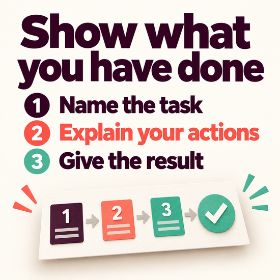
A specific example gives the panel more to assess than a confident claim. Explain your own contribution and what it achieved.
Writing the supporting statement for a research assistant job application
For most university research assistant posts, the supporting statement is the most important part of your research assistant job application. It’s where you evidence the criteria, and it’s what the panel will score.
Structure it around the criteria
Open with a short paragraph, three or four sentences, saying why you’re applying for this post on this project. Then work through the criteria assessed at application, in the order they appear in the person specification, using each one (or a closely related group) as a heading. Under each heading, give specific evidence. Finish with a brief closing paragraph. It isn’t elegant prose, but it’s exactly what a panel member with a scoring grid wants to see.
In our experience, this is the single easiest thing you can do to help yourself. A reviewer with the scoring sheet in front of them works down it in order. If your statement follows the same order, they can move down it with you: first criterion, evidence, tick. Second criterion, evidence, tick. If your best example of recruiting participants is buried halfway through a paragraph about your dissertation, they may miss it, and evidence the reviewer misses scores the same as evidence you never gave. Don’t make them hunt for it.
Follow any word or page limit to the letter. If there isn’t one, two pages is a sensible ceiling for a research assistant post. Longer statements don’t score higher, and they make it harder for the panel to find your evidence.
Turn claims into evidence
Take a criterion that turns up on almost every clinical research assistant advert: experience of recruiting research participants. A typical answer reads, “I have experience recruiting participants and strong communication skills.” A panel member with a scoring grid has nothing to score there.
Now compare this: “For my MSc project I recruited 32 family carers through two memory clinics. When sign-ups stalled at one clinic, I asked the nurses to hand out the information sheet at follow-up appointments, and I had my remaining participants within five weeks.” In two sentences, the panel learns that you’ve done the task, at what scale, with whom, and that you can fix a problem when it goes wrong.
The STAR structure (situation, task, action, result) is a handy scaffold for building answers like that. The numbers and the problem you solved are what earn the marks. And write “I” rather than “we”, because the panel is scoring you, not your old team.
Translate your experience
Many applicants undersell themselves because their experience doesn’t look like research. It often counts for more than they think:
- A dissertation project is evidence of planning, data handling, analysis and writing, and possibly ethics applications and participant recruitment.
- Care work, healthcare assistant roles or volunteering with older people is strong evidence for any participant-facing post in dementia research.
- Customer-facing jobs show you can handle difficult conversations, stay calm and communicate clearly with the public.
- Lab placements, summer projects and technician work count as techniques experience, as long as you say what you actually did.
Don’t forget the desirable criteria
When a panel has several applicants who meet every essential criterion, the desirable criteria often decide who gets an interview. Address any you genuinely meet, after the essentials.
Check the basics
Get the PI’s name, the project title and the university right. Proofread it, then read it aloud, because you’ll hear errors you didn’t see. It sounds obvious, but in a big pile these slips are an easy reason to move on to the next application.
If English isn’t your first language
Many of the strongest applicants for UK research assistant posts learned English as a second or third language, and nobody should be marked down for that. But panels are human, they read quickly, and anything that makes your evidence harder to find or follow can cost you. Where a person specification asks for good written communication, your application is also part of the evidence for it.
The problems we see most often are rarely about vocabulary. They usually come from sentences that were built in one language and then translated into another:
- Very long sentences. Several ideas joined by commas and “which” are hard to score quickly. If a sentence runs past three lines, split it.
- Over-formal phrasing. An opening such as “I am writing to humbly submit my application to your esteemed laboratory” reads as stiff in a UK application. Plain and direct is the norm: “I am applying for the research assistant post on the [study name] study.”
- The small words. Articles (a, an, the) and prepositions (in, on, at) trip up many writers and are easy for a reader to notice. They rarely change your meaning, which is also why grammar checkers catch them well.
- Tense. Describe finished experience in the past tense, “I ran 30 assessments”, rather than “I run” or “I have been running”.
- Terms and grades that differ between countries. UK applications use CV rather than résumé, and UK degrees are graded as a first, 2:1 and so on. If your degree was graded differently, give the grade and the scale, or its UK equivalent if you know it. Ecctis provides official statements of how overseas qualifications compare.
To check your application, start by reading it aloud, slowly. Then run it through the spelling and grammar checker in Word or Google Docs, or ask an AI tool to list grammar errors without rewriting your text. Checking spelling and grammar is the kind of AI use universities generally accept, as we explain in the section on AI below. Accept corrections one at a time rather than all at once, so the voice stays yours. If you can, ask someone who writes confidently in English to read it, ideally someone who knows research, such as a supervisor or colleague. Many universities also let recent graduates keep using their careers service for a while after they finish, and that often includes help checking applications.
Your CV
For a research assistant post, your CV should be short, usually no more than two pages, and arranged so the most relevant things come first. A skills and techniques section near the top works well for lab and data roles. List the software, methods and assessments you can use, and how confident you are with each. Put relevant experience ahead of unrelated jobs, and include posters, presentations or publications if you have them, but don’t worry if you don’t, since most research assistant applicants won’t.
Tailor it to each post, which is easy if you’re working from a master version. For more detail, Clíona Farrell’s blog on writing a standout CV and cover letter is written for PhD applications but applies just as well here, and if English isn’t your first language, see our tips for writing an academic CV in English.
Using AI sensibly
Lots of applicants now use AI tools such as ChatGPT, Claude or Copilot when writing applications, and universities have noticed. Several now publish guidance for job applicants on what’s acceptable, and it’s worth knowing where the lines are.
What universities say
The University of Bath and the University of Chester both set out acceptable and unacceptable uses, and warn that going beyond them could affect the outcome of your application. Broadly, using AI to structure your own ideas, brainstorm examples, research the department and check spelling and grammar is fine. Using it to produce polished text that doesn’t sound like you, inflating or inventing experience, or putting sensitive personal data into AI tools is not. The University of Liverpool’s careers service offers a simple test: could you comfortably explain, expand on and defend every sentence of your application at interview? If not, it has drifted too far from you.
Always check whether the employer you’re applying to has its own guidance. Some are stricter than others.
Why AI-written statements don’t stand out
There’s also a practical reason for restraint. As Oxford’s careers service points out, AI-generated text leans towards the most likely words and structures, because it’s built on what others have already written. When a panel is reading a hundred applications, a statement written by AI reads like many of the others: fluent, positive and interchangeable. In a big pile, sounding like everyone else is the one thing you can’t afford.
Where AI genuinely helps
The most useful role for AI isn’t writer, it’s critic. Used this way, it can do things that are hard to do for yourself:
- Play the panel. Give it the person specification and your draft, and ask it to score each criterion the way a shortlisting panel would and tell you where your evidence is weak or missing.
- Decode the project. Ask it to explain a grant abstract or an unfamiliar method in plain language, so you understand what you’re reading. Then check anything important against the source.
- Prepare for interview. Ask it for the questions a panel is likely to ask about this specific project, then practise answering them and ask it to challenge your answers.
- Tighten your writing. Ask it to point out vague phrases, repetition and claims without evidence, and then fix them yourself.
Prompts you can adapt
“Here is a person specification and my draft supporting statement. Act as a university shortlisting panel. Score each criterion marked for assessment at application as 0 (not met), 1 (partly met) or 2 (fully met), quote the evidence you used, and tell me what’s missing. Don’t rewrite my statement.”
“Explain this grant abstract to me as if I’m a recent psychology graduate. What would a research assistant on this project probably spend most of their time doing?”
“Based on this job description and project summary, list ten questions an interview panel might ask a research assistant candidate. After I answer each one, tell me what a strong answer would have included that mine didn’t.”
Whatever you use, the final words should be yours, every claim should be true, and you should be ready to talk about all of it at interview. Don’t paste referees’ details or anyone else’s personal information into AI tools.
Visas and right to work
If you don’t already have the right to work in the UK, check whether a post can be sponsored before you invest hours in an application. Some adverts state plainly that the role isn’t eligible for Skilled Worker sponsorship, and that’s worth looking for first.
Where an advert doesn’t say, two rules are worth knowing. Since July 2025, jobs sponsored on the Skilled Worker route generally need to be at degree level (RQF level 6) in the relevant occupation code, unless the occupation appears on a shortage list, as UKCISA explains. The salary also has to meet the rules. According to gov.uk, the standard requirement is £41,700 or the job’s going rate, whichever is higher. Some people can be paid between 70% and 90% of the going rate, including those under 26 and recent graduates, but only if the salary is still at least £33,400.
That matters for research assistant posts, because their salaries can be close to, or below, those figures. If the advertised salary is below £33,400, sponsorship on this route is very unlikely. If it’s above, it may be possible, but it depends on the occupation code and your circumstances. The best step is to email the university’s recruitment or HR team before applying and ask directly. Immigration rules change often, so always check gov.uk for the current position. This section is general information, not immigration advice.
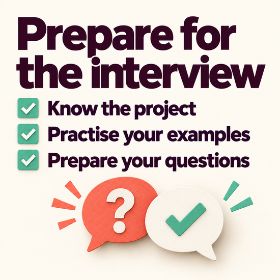
Use your supporting statement as a revision guide, then connect your examples to the work this particular project needs.
The interview
Research assistant interviews are usually a panel of two to four people, often including the PI, someone else from the project, and a member of staff from another group or HR. Some include a short task, such as a data exercise, a practical lab question or a brief presentation, and the invitation should tell you if so.
What they’re likely to ask
Questions tend to follow the person specification, so your supporting statement is your revision guide. Expect to be asked why you want this post on this project, to describe a technique or method you’ve used in detail, and how you manage your time when several things are due at once. Participant-facing posts often include a question about handling a difficult situation, such as a participant becoming distressed during an assessment. You may also be asked about a mistake you made and what you did about it, since panels want to know you’ll own up to errors, which matters a great deal in research.
This is where reading the grant pays off again. A candidate who can talk about the project’s aims, and how they’d fit into the work, stands out from one who can only talk about themselves.
What to ask them
You’ll almost always be invited to ask questions at the end, so have two or three ready. Good ones include what training you’d get, how the team works together, and what previous people in the role went on to do. If you’re interested in a PhD later, it’s fine to ask whether the group has supported research assistants towards one.
For more, see our blog on nailing your research job interview.
If you don’t get it
With a hundred or more applicants for some posts, most people won’t get most jobs, and that includes a lot of very good candidates. It’s not a verdict on your future in research.
If you were interviewed, ask for feedback, and make it easy to answer. “Any feedback would be appreciated” often gets a vague reply or none at all. A specific question gets a real answer: “Was there anything in my answer on participant recruitment that fell short of what you were looking for?” If you weren’t shortlisted, panels are less likely to reply, but a two-line email costs you nothing.
Then put the person specification next to your application and go down it line by line. For each essential criterion, could a stranger point to the sentence where you proved it? If the answer is “sort of”, that’s the gap to close before the next advert appears.
Remember that groups recruit again and again. Sometimes a post is re-advertised, or a second post appears on the same project within months. A good interview, even one that didn’t end in an offer, can mean the PI remembers your name next time.
If you want to see how others got their start, our career stories include people who came into dementia research by many different routes, from teaching to nursing to psychology. And if you’re weighing up further study to strengthen your applications, our guide on whether a masters in dementia is worth it may help.

"Read up around the topic area - read the latest key reports and recent papers from the research group you are applying to. Then at interview (if you get shortlisted) you will be able to talk about the topic in more detail than just about how your skills match the job description."

"Bullet point your cover letter to match the essential criteria for the job. Brief, to the point and specific. My RA positions have over 100 applications and this is easiest way to show me you understand the job requirements, and that you’re the person for it."

"You should develop the skill of reading papers, and the knowledge of basic statistics, at least to the level of interpreting the tables in the article you are reading".


 Nature Careers Blog