 Print This Post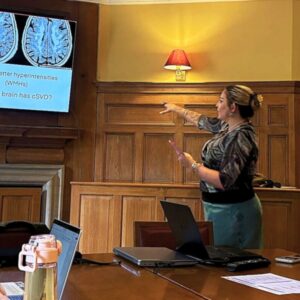
Honey Blossom McLaughlin presenting a research proposal on cerebral small vessel disease.
Honey is completing a BSc in Psychology with work placement at the University of Bath. She is building a route into dementia neuroscience through research on brain imaging and biomarkers, clinical work with carers, computational research and public science communication.
“Non-linear pathways are a strength, and initial doubts from others do not define your scientific capability.”
Finding psychology and biological science
My route into research began with two interests that initially felt separate. True crime introduced me to forensic psychology while I was studying for my GCSEs, and during my A levels I became increasingly interested in biology. Psychology gave me a way to study human behaviour, while biology made me curious about the brain and the mechanisms behind illness.
Work experience with BCP Council Adult Social Care in 2022 gave me an early view of case reports, mental health policy and occupational therapy. It helped me see that academic ideas sit within systems of care and have practical consequences for people and families.
Starting university without an established route
I began a BSc in Psychology with work placement at the University of Bath in 2023, supported by a Gold Scholarship. I came from a state-school and low-income background without established academic networks or family experience of navigating research careers. Moving from a broad psychology degree towards specialist neuroscience therefore required me to find opportunities and information for myself.
A psychology teacher had encouraged my ambition to pursue science in higher education, but earlier doubts from other teachers had affected my confidence in the core sciences. University gave me space to test those assumptions. I became a peer representative for the Gold Scholarship Programme and later a peer mentor, supporting students while developing my own confidence and leadership.
Dementia as a personal and professional concern
My commitment to dementia research is connected to my family. I watched my grandfather, previously the most independent man I knew, develop mild cognitive impairment and eventually move into residential care. I also became a young carer for my grandmother following a stroke.
These experiences showed me the emotional and physical effects of neurological illness on individuals and families. They also helped me recognise why research must connect biological understanding with the everyday support available to people living with illness and those who care for them.
A placement that changed my direction
My work placement as an Assistant Psychologist with The Mindful Life Group CIC became a major turning point. I worked with adults aged over 65 who were caring for loved ones, many of whom were living with dementia. I helped deliver Mindfulness for Older Adult Caregivers, which used Mindfulness-Based Stress Reduction (MBSR), and the Better Sleep Programme for Caregivers, which combined MBSR with Cognitive Behavioural Therapy for Insomnia (CBT-I). I also analysed programme data to assess caregiver burden and quality of life.
The work carried emotional responsibility. Structured clinical supervision helped me manage difficult conversations and develop resilience. When one caregiver told me that our support had improved their wellbeing and the quality of life of their relative with severe dementia, I understood how valuable applied work could be.
Before the placement, I had considered clinical therapy, psychiatry and forensic psychology. I could also have pursued the Doctorate in Clinical Psychology route after the placement. Instead, working with carers and people affected by neurodegeneration gave me the sense of purpose I had been looking for. I chose to continue building towards dementia neuroscience while keeping a strong interest in clinical impact.
Teaching myself the neuroscience I needed
Changing direction from broad psychology to neurobiology was demanding. Neuroimaging, biomarkers, neuroanatomy and advanced statistics were not all built into my undergraduate route, so I sought out projects, placements, summer programmes and research opportunities that would help me learn them.
I taught myself unfamiliar methods, including principles of neuroimaging and Bayesian statistical modelling. I later began using R for data wrangling, analysis and visualisation, and GitHub for reproducible research. Learning independently strengthened my resourcefulness, although I wish I had started coding earlier in my degree.
Testing a dementia research question at Cambridge
In 2026, I was selected for the University of Cambridge Psychiatry Summer CAMP (Cambridge Access to Mental Health and Psychology). I developed and presented a proposal on predicting cognitive dysfunction in cerebral small vessel disease. The project asked whether advanced diffusion MRI combined with routine blood measures of inflammation, lipids and blood sugar could identify early executive difficulties more effectively than structural MRI alone.
My supervisor helped me refine the proposal and encouraged my plans for postgraduate neuroscience. The experience confirmed that I wanted to pursue research involving neuroimaging, biomarkers and multimodal methods, with the long-term aim of improving earlier and more accessible detection of dementia risk.
Building computational research experience
Alongside my degree, I undertake an unpaid, part-time Comparative Neuroscience Research Apprenticeship through the Research Apprenticeship Scheme in the University of Bath’s Department of Psychology. I work within the Comparative Crossmodal Cognition Collective, supervised by Dr Alexandra de Sousa and Professor Michael J Proulx. The project compares relationships between brain measures and behaviour across species.
I extract, organise and standardise information from published studies for a large open-access database. I use R and GitHub, contribute to comparative analyses and help solve technical problems. Although the project is not solely about dementia, it is giving me the computational and critical-appraisal skills needed for future neuroscience research.
Bringing together inflammation brain age and loneliness
My final-year dissertation, supervised by Professor Esther Walton, is titled “Inflammation, Brain Age, and Loneliness in Mid-to-Late Adulthood: A Longitudinal Analysis”. It uses longitudinal data from the Midlife in the United States study to investigate how markers of inflammation, predicted brain age and loneliness relate to one another. The work allows me to examine biological health, social isolation and neural ageing within the same question. I expect to graduate in 2027.
This combination reflects the kind of scientist I hope to become. Dementia cannot be understood through one measure alone. I am interested in approaches that connect brain imaging, blood-based biomarkers, health and lived experience.
Communicating neuroscience beyond the laboratory
I write about neurodegenerative disease for Bath Psychology Magazine and created Brains with Honey to make dementia neuroscience accessible through social media. As of September 2026, my Instagram platform reaches around 35,000 monthly viewers. Translating technical research into useful explanations has become an important part of my work.
I also serve as a Psychology Ambassador at Bath and Lead Student Ambassador for the British Psychological Society. Giving laboratory tours, speaking with prospective students and developing resources for psychology students have strengthened my interest in encouraging future scientists, particularly those who do not begin with established academic networks.
Balancing opportunity with capacity
The hardest part has often been the combined workload. At different points I have balanced study, research, leadership, applications, tutoring, caregiving and public communication. Saying yes to worthwhile opportunities helped me build experience and contacts, but I have also had to learn that an opportunity must fit within my capacity.
Professional networks have helped. Joining organisations such as the British Neuroscience Association and the International Society to Advance Alzheimer’s Research and Treatment has made the field feel more accessible. LinkedIn has also allowed me to learn from people already doing the roles I hope to pursue.
Preparing for postgraduate dementia research
I am now applying for postgraduate roles in neurodegeneration research. I am particularly interested in neuroimaging, biomarkers, multimodal research and pathological protein accumulation. A Research Assistant position or funded PhD would allow me to deepen my technical skills, contribute to empirical studies and clarify the longer-term route I want to take.
Possible routes include doctoral training through a PhD or Doctorate in Clinical Psychology, followed by academic, clinical or industry research. I do not see my psychology background or non-linear route as a disadvantage. Clinical experience, caregiving, computation, communication and biological research each contribute something different to the questions I want to answer.
Three practical actions
- Say yes to opportunities that genuinely interest you and fit within your capacity. Do not let self-doubt make the decision for you.
- Join professional networks such as the British Neuroscience Association or the International Society to Advance Alzheimer’s Research and Treatment. Attend events and use them to understand possible routes into the field.
- Build a professional presence and contact people doing roles that interest you. Share what you are learning and ask specific questions about their route and work.
What I wish I had known
I wish someone had told me earlier that a non-linear route can be a strength. Early judgements about scientific ability do not determine what someone can learn or contribute. Moving from psychology towards neuroscience required self-direction, but it also gave me experience of clinical care, communication and human behaviour that I can bring into biological research.
Further reading and resources
- Brains with Honey on Instagram
- Brains with Honey on TikTok
- Brains with Honey on YouTube
- Bath Psychology Magazine — Honey recommends her articles in Issue 06 on brain age and neuroethics and Issue 05 on mitochondria in neurodegenerative research.
- Mindfulness for Older Adult Caregivers
- The Better Sleep Programme for Caregivers
 Adam Smith

 LSE Impact Blog
 Yasmin Bonsu