
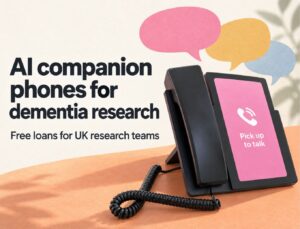
 Are you planning a study on technology, communication or wellbeing for people living with dementia? Amical, a startup from Québec, is offering its AI companion phones to UK research teams free of charge. The programme is open now, with no closing date, and is aimed at researchers in geriatrics, gerontology, nursing, psychology, speech and language therapy and occupational therapy.
Amical is a telephone with no screen and no buttons, built around a voice-only AI companion. It’s designed for people with cognitive impairment who can no longer use apps, tablets or smartphones on their own. They just pick up the handset and start talking. It also works as an ordinary phone for family calls, and it can alert care staff to signs of distress. The device is already in use in more than 80 care facilities in Québec, with further sites in Ontario, the United States, France and Luxembourg.
Why the UK?
The evidence base is thin. Amical points to a systematic review published this year that found only nine studies of large language model (LLM) based conversational agents involving older adults, with a median sample of just 12 participants. Big questions remain open, particularly about how voice AI copes across languages, cultures and different cognitive profiles.
That’s where the UK comes in. With our range of regional accents, and the many older people who speak another language at home, it’s a good place to test how well this kind of technology works in practice. Amical speaks English with British accents among more than 80 languages and accents, so a single study could include participants from different regions and language backgrounds.
What’s on offer
- Phones on loan at no cost, with shipping included.
- Installation support and training for care staff.
- Help developing your research protocol, drawing on Amical’s Canadian studies.
- Access to their AI tools to support protocol development and grant writing.
- De-identified interaction data from your own participants.
- No restriction on publication.
Be clear on one thing before you start: Amical does not fund the studies. You’ll need your own funding to cover staff time and research costs.
What’s involved
The study is yours. Your team sets the design, the length of the study and the number of participants, and Amical ships the phones, supports the installation and trains the staff. Participants need no training at all.
As with any study involving people, you’ll need ethics approval through the usual routes. If your participants may lack capacity to consent, that means review by an NHS research ethics committee flagged for the Mental Capacity Act (or the Adults with Incapacity (Scotland) Act), not just a university committee, so build that into your timeline. It’s also worth involving your data protection officer early, as conversations are processed by the company’s AI. Our blog on getting the balance right in care home research is a good read if you’re new to working in these settings, and Alzheimer Europe’s ethics guidance on technology covers many of the questions a committee is likely to ask.
Where the research stands
Three studies are underway in Canada with Université Laval, the CIUSSS de l’Ouest-de-l’Île-de-Montréal and the REISD. Around ten independent researchers also work with the device, across speech and language pathology, occupational therapy, geriatrics, ethics and human-computer interaction.
How to get involved
Interested researchers can write to the Amical research team at research@amical-ai.com, or contact Tony Aubé, President, at tony@amical-ai.com. You can find out more about the device on the Amical website.
With thanks to Dr Kaija Sander, Scientist in Residence at the Québec Government Office in London, for bringing this opportunity to our attention.
Open now: no closing date


 Beccy Owen



 Nature Careers Blog






 Bernie McInally

 Dr Yvonne Couch