 Print This Post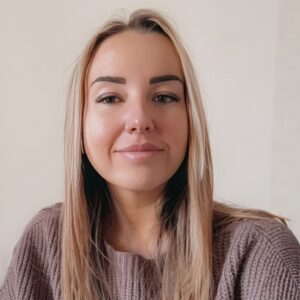
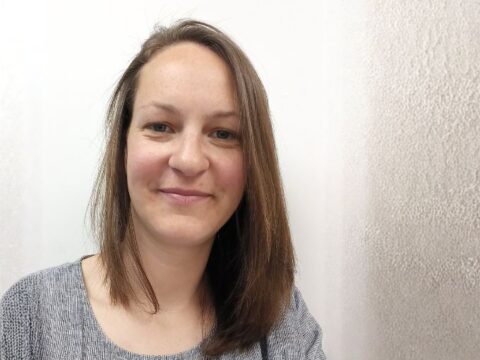
Claire Rowley
Claire combines NHS clinical work with applied research to improve hospital care for people living with dementia, delirium and other cognitive difficulties. Her route has taken her from primary school teaching through psychology and mental health services to dementia research, and she is preparing to begin a dual-award PhD with the University of Hertfordshire and Western Sydney University.
“There is no single correct route into research, and changing direction does not mean that the time spent pursuing another path has been wasted.”
Changing direction after teaching
I began my career in education. I completed a BA in Early Childhood Education at the University of Birmingham from 2009 to 2012, followed by a PGCE in Primary Education at Newman University. I then worked as a primary school teacher from 2013 to 2019, mainly with young children, including Reception classes.
Teaching gave me skills that still shape my work: explaining complex ideas clearly, adapting to individual needs, listening carefully and working with families and other professionals. However, I became increasingly interested in psychology and wanted to understand cognition, behaviour and mental health in greater depth.
Leaving an established profession felt like a significant risk. Because my first degree was not in psychology, I completed an MSc Psychology conversion course at the University of Nottingham in 2019 and 2020. Research methods and statistics were unfamiliar, but my dissertation on language processing, handedness and brain lateralisation gave me my first substantial experience of designing a study, collecting data and making sense of the results. It was when I realised that I wanted research to be part of my future career.
Learning through frontline mental health work
After the MSc, I worked for Birmingham Mind as a Mental Health Helpline Worker and Psychiatric Liaison Recovery Worker. I supported people experiencing distress and mental health crises, helped them find appropriate services and worked alongside hospital and community teams. These roles strengthened my communication, risk-awareness and collaborative-working skills.
In 2022, I became an Assistant Psychologist in an NHS Early Intervention Dementia Service. I carried out neuropsychological assessments, supported people after diagnosis, worked with complex presentations and facilitated psychoeducational groups. This was where my interest in dementia and neuropsychology became much stronger, particularly the effects of changes in cognition and perception on everyday life.
Building clinical neuropsychology experience
From 2023 to 2025, I worked in the Warwickshire Integrated Community Stroke Service. I conducted cognitive screening and neuropsychological assessments, developed formulations and delivered interventions under supervision. I also contributed to audits, quality-improvement work and staff training. The role showed me how psychological evidence can be applied directly to rehabilitation and care.
For several years, I intended to train as a Clinical Psychologist. I built experience across mental health, dementia, stroke and health psychology and applied for Doctorate in Clinical Psychology training. I did not secure a place, which was disappointing, but it prompted me to think more carefully about the parts of my work that I found most rewarding.
By then, research, service evaluation, data analysis, writing and presenting findings had become increasingly important to me. I realised that I especially enjoyed taking a question from clinical practice, investigating it systematically and producing evidence that could influence care beyond one individual patient.
Using NHS data to improve dementia care
Since 2024, I have worked as a Research Assistant within the Dementia and Delirium Outreach Team at South Warwickshire University NHS Foundation Trust. The team aims to improve the care and experience of people admitted to hospital with dementia, delirium or other cognitive difficulties.
I developed and manage the team’s clinical database, analyse routinely collected patient data and conduct audits and service evaluations. The work examines who is referred, the difficulties people experience in hospital, the support they receive and what happens when they leave. We have explored delirium screening, person-centred and non-drug approaches, inequalities in access, length of stay and discharge outcomes.
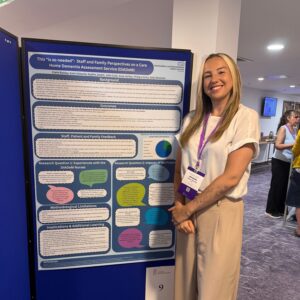
Claire presenting a poster on staff and family perspectives of a care home Dementia Assessment Service (DiADeM). Photograph: Claire Rowley.
I work full-time at Band 5, splitting my week approximately equally between these roles: 2.5 days as a Research Assistant in DDOT and 2.5 days as an Assistant Psychologist in Clinical Health Psychology. My psychology work comprises 1.5 days in the Staff Support Service and one day in Paediatric Diabetes. It includes psychological assessment and intervention, contributing to formulation and multidisciplinary discussions, developing resources and workshops, and evaluating outcomes. I receive regular supervision from qualified Clinical Psychologists and work closely with psychologists, doctors, specialist dementia nurses and other colleagues.
The combination matters to me. Clinical work keeps the questions grounded in real experience, while research and evaluation help the team look beyond individual cases and understand patterns across the service.
The realities of applied research
Real-world healthcare data are rarely collected with one research question in mind. Information may be missing, recorded inconsistently or change as a service develops. A great deal of work can happen before analysis begins: checking quality, deciding how information should be categorised and making sure that conclusions reflect what the data can and cannot show.
Research also has to fit within a busy clinical environment where patient care is the immediate priority. That requires flexibility, strong relationships and ways of collecting useful information without creating unnecessary work for clinical staff. These constraints can be difficult, but they are also why I value applied research, the questions come directly from problems experienced by services, patients and families.
Recognition and a route into doctoral research
Supportive supervisors and colleagues have made a major difference. They trusted me with projects, encouraged me to contribute ideas and supported me to write and present the work rather than treating research as separate from my NHS role. Professional networks have also helped me feel part of the wider dementia research community.
I would particularly like to acknowledge my former supervisors, Becci Dow and Julia Cook. Their support, encouragement and mentorship have played an important role in my development and in helping me pursue dementia, neuropsychology and research.
On 3 June 2025, I received the British Psychological Society Faculty of the Psychology of Older People (FPOP) Una Holden Award, recognising achievements by an early-career psychologist working in older adult services. On 20 May 2026, I received the Best Poster Prize at the British Geriatrics Society Dementia, Delirium and Brain Health Meeting for “Development and early impact of a Dementia and Delirium Outreach Team in an acute hospital setting”. Although I presented the poster and received the prize, this research reflects the work of the wider DDOT team. These experiences helped build my confidence and my identity as a researcher.
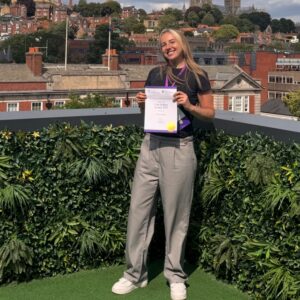
Claire with her Una Holden Award 2025 certificate. Photograph: Claire Rowley.
I explored PhD opportunities alongside the clinical psychology route. There were unsuccessful applications, and it took time to find a funded project that genuinely matched my interests. I eventually secured a dual-award PhD opportunity with the University of Hertfordshire and Western Sydney University focused on dementia.
This is a fully funded CRIPACC Dual Award PhD Studentship, including tuition fees, a doctoral stipend and support for travel to Australia. The programme is structured with Year 1 at the University of Hertfordshire, Year 2 at Western Sydney University and Year 3 back at Hertfordshire. My proposed project title is “From Burden to Caring Well: Exploring and Developing a Framework for Supporting Diverse Family Carers of People Living with Dementia”. This may change following discussions with my supervisory team. At the time of approving this profile, I was awaiting formal confirmation of the start date and final project details.
The PhD will allow me to build greater independence, develop more advanced research methods and work collaboratively with people affected by dementia across different settings and countries. My clinical psychology experience has not been wasted. It has shaped the researcher I want to become, someone who understands services, works closely with people affected by dementia and keeps research connected to real-world needs.
Skills that travelled with me
Communication and listening have been the most transferable skills across teaching, mental health, psychology and research. Research is useful only when it can be explained in a way that is meaningful to people affected by dementia, clinical colleagues and wider audiences.
My research and data skills developed later, through formal study and repeated practical use. Managing a clinical database, conducting evaluations, writing reports and presenting findings taught me that research methods and statistics are not abilities that some people simply possess. They grow through practice.
Collaboration, leadership and project management have become more important as I have taken greater ownership of work. I have learnt to coordinate evaluations, bring different professional perspectives together, deliver training and take findings through to dissemination.
Three practical lessons
- Find one research, audit or evaluation opportunity within the role you already have, and try to follow it from the question through to sharing the findings.
- Speak to people doing two or three roles you might consider next. Ask what their week looks like, how their work is funded and which skills they actually use.
- Start becoming part of the dementia research community. Join networks, attend events and consider presenting a dissertation, audit or small applied project.
Selected publications and presentations
- Behaviours that Challenge in acute care: Rethinking psychological support and the use of sedatives (2026)
- Development and early impact of a Dementia and Delirium Outreach Team in an acute hospital setting (2026)
- Staff and family perspectives regarding a care home Dementia Assessment Service (DiADeM) (2026)
- Reflections from the Una Holden Award Winner 2025 (2026)
- Psychological approaches to treating visual hallucinations in Lewy body dementias (2023)
- Suspected Dementia, the Eye and the “Mind’s Eye” (2022)