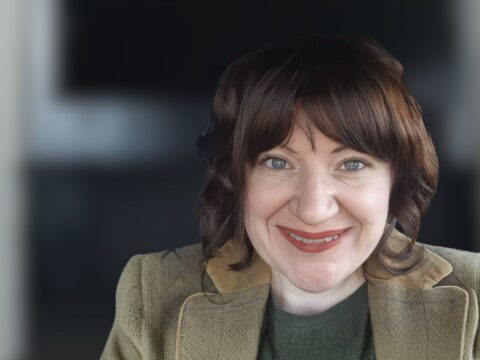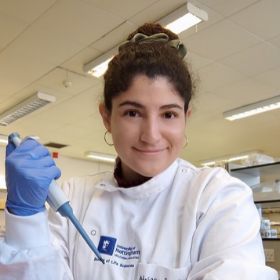
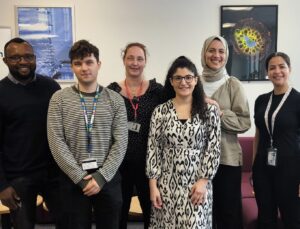
Dr Adriana Perez Grovas. Photo credit: Adriana Perez Grovas Saltijeral.
Adriana is a medical doctor and specialist in genetics whose career has taken her from clinical training in Mexico to genetic research in Germany and doctoral research in the UK. She studies the epitranscriptomics of neurodegenerative disease, principally Alzheimer’s disease, using human brain tissue.
“Publishing my work has been extremely rewarding, because you can see how useful it is for other researchers.”
A clinical route into neurodegeneration
I studied medicine from 2009 to 2015 and then specialised in medical genetics in Mexico City from 2016 to 2019. During my residency, my specialist research focused on Huntington’s disease. That experience drew me towards neurodegenerative disease and showed me how research could connect clinical genetics with questions that still have no straightforward answer.
My clinical background remains central to the way I think. It helps me understand the experiences of patients and families as well as the molecular questions behind disease. Working with international researchers also taught me how to adapt to different professional cultures and research environments.
Moving from Mexico to genetic research in Germany
After completing my genetics training, I was offered an opportunity with CENTOGENE, a company specialising in genetic testing and rare-disease research. I moved from Mexico to Rostock, Germany, in 2019 to work as a Clinical study researcher, a role I held until 2020.
The move was significant. I had the chance to work in an international genetics company and could have continued building a life and career there. At the same time, I had applied for funding from the Mexican government to pursue a PhD in the UK. I moved to Germany without knowing whether that application would succeed.
Choosing the PhD
About three months after relocating to Germany, I learned that I had been awarded the scholarship. Completing a PhD had been a lifelong ambition, but accepting meant leaving a promising new job and moving countries for the second time in a short period.
I could have remained in Germany, or returned to Mexico and developed a wholly clinical career. Instead, I chose the PhD and moved to Nottingham in 2020. It was a difficult decision, but it gave me the chance to pursue the research career I had imagined for years.
Starting doctoral research during the pandemic
I began doctoral research in medical genetics at the University of Nottingham in February 2020, just as the COVID-19 pandemic was beginning. Starting a PhD is demanding in ordinary circumstances; beginning one while research sites, travel and everyday life were being disrupted made the transition particularly challenging. My PhD runs from 2020 to 2026.
Support from my principal investigator and colleagues was very important. My PI had encouraged me strongly to join the group, and the other PhD students helped me through a period when normal opportunities to settle into a laboratory and research community were limited.
Studying Alzheimer’s disease in a small laboratory team
My project, “Investigating the regulation of DNA and RNA modifications in neurocognitive diseases”, is based in the Brain Genomics Group at QMC, University of Nottingham. My doctoral research is in basic science and focuses on epitranscriptomics in neurodegenerative disease, particularly Alzheimer’s disease. I use human brain tissue to investigate molecular changes associated with disease.
Our group is small: the principal investigator and three PhD students, without a technician, research assistant or postdoctoral researcher. That means doctoral researchers have to take considerable responsibility for the practical work that keeps research moving, as well as for their own experiments and analysis. The experience has helped me become resourceful and independent.
Working with limited research funding
Funding has been one of the greatest constraints on my PhD. My CONAHCYT scholarship for postgraduate students abroad covered both my stipend and research costs, and the available amount was small compared with many European doctoral awards. We could not carry out every experiment we would have liked to perform.
Limited funding also affected my ability to attend conferences. The support available through the university covered only a small part of the cost of an international meeting. For an international researcher, travel, registration and accommodation can quickly exceed that amount. I learned that securing funding early is not simply an administrative task: it shapes which experiments, networks and development opportunities become possible.
Skills that cross clinical and laboratory work
My clinical training gives me a perspective that is useful in the laboratory. I understand the medical context of neurodegenerative disease and can connect molecular questions with their possible importance for patients. My experience in international research settings also helps me communicate across different working styles and expectations.
Laboratory practice has been equally important. Techniques become familiar through repetition, troubleshooting and being present in the lab. For someone considering a similar route, I would recommend joining a university laboratory, helping with ongoing work or taking a technician role to build practical experience before beginning a PhD.
Mentorship, colleagues and opportunity
The government scholarship made the PhD possible, but people mattered just as much. My PI supported my application and pushed to bring me into the group. My colleagues then helped me navigate the early stages of doctoral research during the pandemic.
Those relationships reinforced the importance of mentorship. A supervisor who believes in your potential can open a route that might otherwise feel inaccessible, while colleagues provide the everyday advice and encouragement needed to continue when experiments, funding or circumstances become difficult.
 Seeing research become useful
Publishing my work has been one of the most rewarding parts of research. A paper makes the work available to other researchers, who can test it, use it and build on it. That sense of contributing to a larger body of knowledge is particularly meaningful in a field where progress depends on many groups approaching neurodegenerative disease from different directions.
The harder side is that the work you want to do is not always the work you can afford to do. A good research question still depends on equipment, materials, staff time and access to professional networks. Researchers from different funding systems do not always begin with the same resources.
Considering the next career stage
A conventional academic route after a PhD would lead to a postdoctoral or research associate position and, over time, towards becoming a principal investigator or professor. My own route may be different because my primary profession is clinical medicine. I am considering a return to medical practice, bringing the research knowledge and international experience I have gained with me.
Looking back, I wish someone had told me that I could complete a PhD later, once my clinical career was more established. That does not mean the decision to pursue research was wrong. It means that career stages do not have to follow one fixed order, and the timing of a PhD can affect both financial security and the ease of returning to clinical work.
Three practical lessons
- Get practical laboratory experience. Join a university laboratory, help with ongoing work or consider a technician role so that you can learn how research operates day to day.
- Practise techniques rather than expecting immediate confidence. Repetition and troubleshooting are essential parts of becoming capable in a laboratory.
- Apply early and plan funding carefully. Research costs and conference access can depend on support secured well before the project begins.
Find out more

 Nature Careers Blog
 LSE Impact Blog
 Dr Yvonne Couch