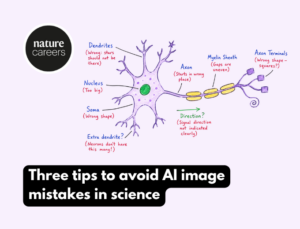
Artificial-intelligence tools can be useful for brainstorming and creating graphics, but they can introduce errors. If you’re going to use them, here’s how to avoid problems.
In early 2024, a startling illustration in a published paper sparked spirited debate on social media. The image showed a rat endowed with a penis and testicles that were bigger than the rest of the animal’s body. The authors noted that the illustration was generated by an artificial-intelligence model called Midjourney, but it was obviously inaccurate, depicting four testes and including strange, misspelt text such as ‘sserotgomar cells’. Somehow, it passed peer review.
“This was the first mainstream example of where an AI-generated image made it into a scientific paper — and it shouldn’t have been published,” says Elisabeth Bik, a science-integrity consultant in San Francisco, California, who wrote about the incident on her blog. AI tools at the time were not good enough to create credible user-prompted illustrations, as the rat figure showed — but that was then. Two years later, “AI is much better and continuously improving, and we’re at a point where we can no longer distinguish fake from real,” says Bik.
Still, errors continue to crop up. In April, a study by researchers in China was retracted by the New England Journal of Medicine because of image manipulation. The numbers on a tape measure, displayed at the top of the figure, were incorrect, exposing the use of an AI tool. In a comment on the post-publication discussion forum, PubPeer, one of the authors notes that they had used an AI tool to adjust the placement of the tape measure, which had been improperly positioned during an emergency medical procedure. “The irregular numbering is an unintended artefact from this adjustment,” they wrote.
Graphics, which include schematics, data figures and diagrams, are a crucial part of scientific publishing. And they can substantially affect an article’s influence: an analysis of eight million graphics published in scientific papers found “a significant correlation between scientific impact and the use of visual information, where higher impact papers tend to include more diagrams” (P.-S. Lee et al. IEEE Trans. Big Data 4, 117–129; 2018). However, many researchers have neither the resources nor the skills to create aesthetically pleasing and informative images themselves.
The potential for modern AI systems to assist researchers in generating graphics is “huge”, says Sebastian Porsdam Mann, an ethicist at the Centre for Advanced Studies in Bioscience Innovation Law at the University of Copenhagen. AI tools can make scientific illustration accessible to everyone, allowing researchers to better communicate their science in a fraction of the time and at a lower cost than ever before, he says. And it is in researchers’ interests to have good papers that explain complex topics, with good data visualizations and graphical abstracts, he adds.
But, as with text, AI image generators such as Midjourney and OpenAI’s DALL-E still make mistakes — the effects of which can range from personal embarrassment to professional censure. “It’s still early days and these are still largely untested waters,” says Mann. But if there’s the slightest hint that you’ve done something wrong while using AI tools, “journals will probably take that very seriously right now”.
Here are some guidelines to help researchers navigate this rapidly changing landscape.
Check the publisher’s rules
The first step for anyone wanting to use AI tools in their scientific articles is to check the policies of your preferred journals. There is little agreement around the use of AI tools among academic-journal publishers, with some allowing AI-generated images as long as AI use is disclosed and others forbidding them entirely.
The publisher PLOS, for example, allows the use of AI tools, but authors must report how they used them (including the names of any tools used, how they were used, how their output was evaluated and what sections of the article they were used in).
Other publishers have a more restrictive stance. Cell Reports (published by Cell Press) prohibits any use of AI-created graphical abstracts and places restrictions on AI use in data visualizations. Springer Nature (which publishes Nature) prohibits the use of generative AI for images but makes exceptions for AI-generated images and videos in articles that are “specifically about AI”, adding that “such cases will be reviewed on a case-by-case basis”. The policy also allows researchers to use AI image-generation tools “developed with specific sets of underlying scientific data that can be attributed, checked and verified for accuracy, provided that ethics, copyright and terms of use restrictions are adhered to”. (Nature’s editorial team is independent of its publisher.)
But guidance from journals on the use of AI is rarely specific, says Mann, who investigates AI policies in academic publishing. When talking about AI-generated images, people usually think of art and illustrations. But scientific graphics can also include schematics, visual abstracts, figures that depict a study’s data and images used as evidence. “The ethical issues are very different, if you’re using images as evidence or using them to explain things,” he says.
Don’t manipulate original data
In April, biologist Mikael Elias at the University of Minnesota in Saint Paul, posted a series of convincing western blots to the social-media site X. Western blotting detects specific proteins in complex mixtures after they have been separated on a gel. But these images had been created by entering a single prompt into ChatGPT: “generate western blots that represent an experiment in a nature journal article”.
“While making up data always existed, this is making it unprecedently [sic] easy and accessible,” Elias wrote on the blogging platform Substack (see go.nature.com/4wacqm9). “I am fearing an avalanche of fabricated pieces, with very little ways to distinguish them from legit work. Not tomorrow, but soon.”
Bik agrees. She says that although there are clues in Elias’s images that the blots are fake, it would be easy to miss them. And she struggled to suggest any instance in which it would be acceptable to generate images that are provided as primary evidence using AI tools.
Rules around plots depicting data trends, however, are more fluid. For instance, when creating graphs, Marc-Oliver Gewaltig, co-founder of the academic-writing consultancy Thesify in Lausanne, Switzerland, suggests that researchers plot their data themselves first, and then ask AI to make their figures more aesthetically pleasing — a step that can be time consuming to do manually.
“Pre-AI, that would have taken you days.” Now, you can do it in minutes, and validation is easier because you know what the figure should look like, he says. “That’s a very different situation from these image generators that just fabricate things out of the blue.” He recommends using the time saved to check the generated figures and graphs.
However, he cautions against visualization technologies that can remove defects and enhance images — even ones built into commonly used tools such as Adobe Photoshop. “The temptation is just too big” to do more than the bare minimum, he explains. If you do use such tools, he adds, it is crucial to document exactly how and why the image was altered — such as to remove blemishes — because that decreases the likelihood that a researcher will over-edit their images.
Other researchers find it useful to brainstorm what their illustrations should look like using an AI model. For instance, Amir Syafrudin, a PhD candidate at the Auckland University of Technology in New Zealand, has detailed on his blog how he uses the online collaborative workspace Miro to generate diagrams from written descriptions of the processes he wishes to visualize (see go.nature.com/3sd5gkb). “The main benefit was avoiding a blank-canvas problem and sparking ideas for visual representation,” he wrote.
“I share my thoughts and data, of course,” Syafrudin tells Nature. He asks the AI tool to “share its opinion, and it just flows from there.” Graphics require more detailed prompts than does text generation, and researchers might need to “allocate more time and effort” to going back and forth with the AI model to get things right, he adds.
Take responsibility
Ultimately, all work should be the creative work of a person, not a machine, says Paul Graham Fisher, a paediatric neurologist at Stanford University in California and a council member of the Committee on Publication Ethics (COPE), which is based in Eastleigh, UK. “AI is meant to be a cognitive extender, not a cognitive offloader,” he says.
According to COPE guidelines, AI tools cannot be co-authors on academic papers. Similarly, “AI cannot be a graphic designer,” says Fisher. But it can be a useful assistant.
“The bottom line: make sure it’s your original work, even with the assistance of AI,” says Fisher. You need to ensure that it “reflects the integrity of your data and that it’s not encroaching on anyone else’s data, work or property rights”.
Gewaltig says that he has three rules when it comes to using AI tools for image generation. First, “if you don’t understand what a tool is doing to your data or what it is doing to your image, don’t use it”, he says. Second, the burden of proof and validation sits with the author. And third, be transparent.
“The purpose of scholarly publishing is to explicitly detail, as closely as possible, everything that was done in communicating your results, from methodologies to sample selection,” says Todd Carpenter, executive director of the National Information Standards Organization, a US non-profit group that develops technical standards for managing information. The same is true of graphic design for scientific papers. “Rigour is going to be domain-specific, but we all know what transparency looks like,” he says.
Meanwhile, the technology continues to evolve — and so do attitudes. Bik says that three years ago, even before she first saw the graphic of the improbably endowed rat, she would have refused to use any form of AI tool. But since then, her position has become more nuanced. “We’re pushing the boundaries of what we feel is ethically responsible,” she says. “Our thoughts about what is ethical are continuously changing.”
Find the original and more great content on the Nature Careers Website Nature 655, 1093-1094 (2026) doi: https://doi.org/10.1038/d41586-026-02233-w

 Dementia Researcher
 Dr Yvonne Couch
 Nature Careers Blog