Print This Post
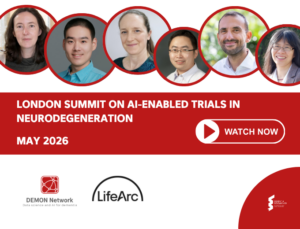 On 27 May 2026, the DEMON Network and LifeArc hosted the London Summit on AI Enabled Trials in Neurodegeneration, bringing together researchers, clinicians, data scientists and trial specialists to explore how artificial intelligence could reshape the way neurodegeneration trials are designed, delivered and evaluated.

Dementia Researcher attended the event to record a selection of talks for those unable to join in person. Together, these presentations offer a wide ranging look at how AI might support clinical trials, from improving recruitment and patient selection to enabling remote participation, strengthening outcome measurement, supporting personalised interventions, and helping researchers make better use of complex health data.
The talks cover practical examples from dementia, Alzheimer’s disease, depression, diabetes, imaging, digital trials and platform trial design. They also raise important questions about inclusion, trust, safety, patient preference, data quality, trial efficiency and the need to ensure that new technologies support people and services in ways that are useful, ethical and realistic.
- Professor Claudia Cooper reflects on the APPLE Tree trial, a group based lifestyle intervention designed to support cognitive wellbeing in older adults at increased risk of cognitive decline. Her talk explores how prevention trials can reach the people most likely to benefit, how to reduce barriers to participation, and how future work might use AI and electronic health records to support long term follow up and implementation.
- Dr Qiang Liu discusses how multimodal AI can support more personalised clinical trials in dementia and neurodegeneration. Drawing on work with imaging, electronic health records, natural language processing, synthetic data and treatment prediction, the talk considers how AI could help identify suitable participants, analyse biomarkers, characterise cohorts and tailor treatment recommendations.
- Professor Anne Corbett shares learning from the PROTECT platform at the University of Exeter, showing how remote and hybrid trials can widen access, improve efficiency and support large scale dementia research. Her presentation explores online recruitment, consent, follow up, cognitive testing, home based biomarker collection, participant support, safety monitoring and the possible role of AI in future remote trials.
- Professor Lu Liu introduces a range of AI methods for healthcare and trial design, including digital twins, medical knowledge graphs, reasoning based AI and patient to trial matching. The talk explains how these tools could support clinical prediction, identify vulnerable patients, predict deterioration, improve eligibility screening and make trial matching more transparent.
- Professor Xujiong Ye focuses on causal AI and virtual clinical trials, explaining how researchers can move beyond prediction to ask what might happen if an intervention or treatment were changed. His talk introduces structured causal models, counterfactual reasoning, generative AI and trial emulation, showing how these approaches could help researchers explore treatment effects and simulate virtual populations.
Together, the playlist captures an important conversation about the future of trials in neurodegeneration. It shows both the promise of AI and the practical work still needed to make these tools safe, inclusive, trustworthy and useful for researchers, clinicians, participants and people affected by dementia and related conditions.

Causal AI for Virtual Clinical Trials - Professor Xujiong Ye
AI, Digital Twins and Trial Matching - Professor Lu Liu
Remote Trials for Dementia Research - Professor Anne Corbett
Using Multimodal AI to Personalise Trials - Dr Qiang Liu
Dementia Prevention Trials & The APPLE-Tree Study - Professor Claudia Cooper
 Adam Smith
 Nature Careers Blog