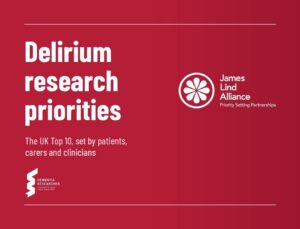
 Patients, carers and clinicians have agreed the ten questions about delirium they most want research to answer. The Delirium (UK) Priority Setting Partnership, run with the James Lind Alliance, published its Top 10 this month. Top of the list is how to make delirium shorter and less severe, followed by what shapes a person’s recovery and its long-term effects on their health, daily life and quality of life.
Delirium is a sudden change in how the brain works, brought on by illness, surgery, medication, drug withdrawal or other medical treatment. It is a clinical emergency, and it is the most common complication for people over 65 in hospital. A quarter of older adults admitted to hospital in the UK develop it during their stay, and the partnership puts its cost to UK health and social care at £10.8 billion a year. Despite that, its protocol notes that research funding and public awareness have not kept pace with what we now know about the condition.
The Top 10 priorities
- What approaches work best to shorten how long delirium lasts and make it less severe?
- What affects a person’s recovery from delirium, and its long-term effects on health, daily activities, and quality of life?
- Which education and training are most effective in helping staff recognise, understand, and support people with delirium, so that care is safe, compassionate, and centred on the person’s needs and wishes?
- Which combined (multi-component) approach is the best overall strategy to treat delirium?
- How should delirium be identified, prevented and managed effectively in the community to reduce hospital admissions?
- Why does delirium look different in different people, and how can it be recognised reliably despite these differences?
- What is the best way to support people with delirium when they leave hospital and return home, including helping them stay safe, making sure everyone understands what is happening, and ensuring important information is shared between healthcare services?
- How should health care professionals best communicate with and support patients experiencing delirium and their friends, families and carers?
- What changes happen in the brain and body during delirium, and how do these changes vary between different forms of delirium?
- How can healthcare professionals tell the difference between delirium and other conditions, such as memory problems or long-term brain conditions?
A further 15 questions were discussed and ranked at the final workshop. They include the longer-term emotional and psychological effects of delirium, whether post-traumatic stress after an episode goes unrecognised, detecting delirium in underserved groups such as people with learning disabilities or mental illness, telling delirium apart from the normal dying process, and the role of medicines, sedation, diet, hydration and the hospital environment. The full ranked list is on the James Lind Alliance website.
Why it matters for dementia research
Dementia and delirium are closely tied. People living with dementia, cognitive impairment or another neurodegenerative condition such as Parkinson’s are among those most at risk of delirium, and an episode of delirium can speed up cognitive decline. The two can also be hard to tell apart, particularly when someone already has memory problems, which is exactly what the tenth priority asks researchers to tackle. The sixth, on why delirium looks so different from one person to the next, speaks to the same problem: the sleepy, withdrawn hypoactive form is easily missed or mistaken for dementia or low mood.
People living with dementia were one of the groups the partnership made a particular effort to reach, alongside care home residents, people in intensive care, people receiving palliative care and people with sensory impairments or learning disabilities. For more on where the two conditions meet, read our blog Delirium and dementia: A neglected area of research? or listen to our podcast Delirium and Dementia: Clearing the Fog of Misunderstanding.
Who was behind it
The partnership grew out of Delirium Matters, a policy report published in April 2025 by the NIHR Policy Research Unit in Dementia and Neurodegeneration at Queen Mary University of London, which called for the gaps in our knowledge to be identified. It was supported by the Academic Centre for Healthy Ageing, a partnership between Barts Health NHS Trust, Queen Mary University of London and Barts Charity, with project coordination shared with the NIHR Applied Research Collaboration Greater Manchester.
It was co-led by Professor Elizabeth Sampson, Professor of Liaison Psychiatry at the Academic Centre for Healthy Ageing, and Professor Emma Vardy, Consultant Geriatrician at the Northern Care Alliance NHS Foundation Trust and the University of Manchester, and chaired by James Lind Alliance adviser Dr Jonathan Gower. The steering group brought together six patient and carer representatives with clinicians from geriatric medicine, old age and liaison psychiatry, neurology, anaesthesia, general practice, nursing, palliative care and learning disability services, including Professor Mani Krishnan.
The scope covered adults aged 18 and over in the UK, across every setting where health and social care is delivered, and every aspect of delirium from prevention and diagnosis to treatment, services and the challenges of caring for someone with it. Delirium caused by non-prescribed drugs or alcohol withdrawal was left out.
How a Priority Setting Partnership works
The James Lind Alliance, coordinated by NIHR, has been bringing patients, carers and clinicians together since 2004 to agree which unanswered questions matter most in a given area, so that funders know what really matters to the people affected. The process follows a set route:
- Gather questions: an open survey asks patients, carers and professionals what they want to know.
- Check the evidence: questions are grouped, reworded and checked against existing research, and any already answered are set aside.
- Interim ranking: a second survey narrows the long list down to around 25.
- Final workshop: up to 30 patients, carers and clinicians spend a day discussing those questions and agree the Top 10.
The priorities are not written as research questions. The idea is that researchers and funders work with the partnership to turn them into studies that can be funded and delivered. You can read how the Delirium (UK) partnership set out to do this in its protocol.
What this means for early career researchers
If you work on delirium, or on hospital care, dementia, frailty or perioperative medicine, these priorities are worth having to hand. A grant application that can point to a question patients, carers and clinicians have ranked as a priority is a stronger one, and funders including NIHR pay attention to James Lind Alliance outputs when shaping their calls. Several of the ten also sit well outside traditional clinical trials: staff training, communication with families, discharge and information sharing between services are questions for health services researchers, nurses, allied health professionals and social scientists as much as for clinicians.
It is also a good reminder of what patient and public involvement can achieve when it shapes the questions from the start, rather than being added once a study is designed. Other partnerships are running all the time, and earlier this autumn we covered the Multiple Long-Term Conditions Priority Setting Partnership survey, so keep an eye out for ones in your area.



 Adam Smith

 NIHR