 Print This Post
 Precarious contracts, international mobility, pressure for quick wins and an obsession with league tables. Sound familiar?
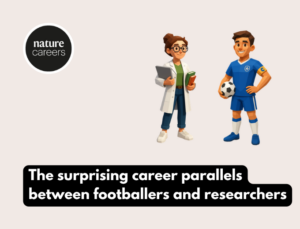
You’ll probably recognise these realities of academic life. But you might be surprised by how much you have in common with the professional footballers battling it out at the men’s FIFA World Cup 2026 and other high-level tournaments (perhaps not the salaries).
At the early-career stage, both professional footballers and academic researchers are driven by the kind of passion and talent that can demand sacrifices in home life, leisure and personal time. For players, this means long hours at the training ground, dreaming of a winning goal in the national league or on the international stage. For researchers, it means hopes for a breakthrough discovery or highly cited paper.
But success in both soccer and science requires more than talent and dedication. It also demands resilience, adaptability and a willingness to remain constantly on the move.
For elite footballers, this is down to the transfer system, through which players get sold to clubs around the world. For working scientists, it means ‘academic mobility’ — moving between research groups near and far, depending on where your expertise is most valued.
Both moves can involve uprooting your life, adjusting to new colleagues and cultures, and occasionally learning a new language, before the cycle begins again a few years later. Short-term contracts make long-term planning difficult. In both research and football careers, you might always have an eye on your next contract. Yet insecurity does not necessarily disappear for those who secure a permanent academic position.
In football, there is always the prospect of landing a position as manager or head coach, allowing you to stay in the profession. In research, the equivalent is to become a group leader or professor. Ironically, both promotions bring a whole new set of skills and challenges: people and resource management, recruitment, mentoring, training, budgeting and pressure for your team to deliver results.
Papers published, goals scored
Whereas football managers are judged on league position, researchers are evaluated through publication metrics, grant income and international profile. These parameters influence promotion prospects, future funding opportunities and even an institution’s position in national and international league tables, similar to a football club. Furthermore, a talented researcher or group leader might be headhunted on the basis of their h-index, much as footballers and their managers are because of their goal-scoring record.
For those who succeed in football, there are rich pickings — a place in the national team, a seven-figure salary, media and sponsorship opportunities galore. Successful researchers are very unlikely to enjoy Premier League wages or global fame. Their victories are more about impact: a treatment developed, a problem solved, knowledge advanced.
Yet researchers have important advantages over footballers when it comes to long-term career prospects. Whereas professional sporting careers are often constrained by age or injury, a research career can evolve over time, creating opportunities both in and beyond academia.
Members of both professions can move into teaching and training, or into communication roles such as public engagement or media commentary — whether as a scientific ‘talking head’ or as a football pundit. But the technical expertise, analytical thinking, adaptability and capacity for continual learning developed during a research career create opportunities across multiple sectors long after time in academia has ended.
Support off the pitch
Furthermore, researchers today often have access to much greater career support than did those of previous generations. I have witnessed this shift at first hand over my three decades in academic career consultancy. And, although provision remains patchy, universities are increasingly investing in professional-development programmes, dedicated career staff, mentoring schemes and coaching to help researchers prepare for careers in academia and beyond.
Of course, neither footballers nor researchers are motivated only by career prospects. For researchers, the opportunity to explore unanswered questions, make discoveries and contribute to society remains a powerful draw. Much like a footballer dreaming of representing their country, many scientists are driven by the chance to be part of something larger than themselves.
Not many footballers win the World Cup. Few researchers win a Nobel prize. But both professions continue to attract people willing to devote themselves to the pursuit of something uncertain. And for researchers, at least, leaving academia need not mean leaving the field.
Shared from Nature Careers, for this and more great content visit doi: https://doi.org/10.1038/d41586-026-01794-0

 Dementia Researcher

 Nature Careers Blog