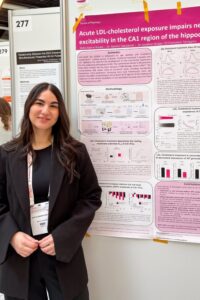
Sofianna Nouka, PhD student in Pharmacy at the University of Reading. Photograph credit: Sofianna Nouka.
Sofianna Nouka investigates how lipids associated with “bad cholesterol” may change the electrical activity and communication of nerve cells in models of Alzheimer’s disease. A six-week undergraduate placement opened an unexpected route from Biological Sciences into doctoral research.
“Sometimes following a route you never thought was possible might be the best decision you ever make.”
Choosing a degree that felt exciting
Growing up, I imagined becoming a professional dancer, but I also loved biology and was fascinated by neuroscience. The idea that we can study what happens inside the brain always held my attention.
I studied Biology, Chemistry and Business Studies at Reading College from 2019 to 2021. My studies were disrupted by COVID-19, but I completed my qualifications and secured a place at the University of Reading. I had originally enrolled for Business Management, then changed my mind only a few days before the course began. I told my mum that if I was going to spend three years studying, I should at least find the subject exciting, and switched to Biological Sciences.
I completed my BSc between September 2021 and July 2024. Biological Sciences offered the flexibility to experience different areas before committing to a specialism. My early course did not contain much neuroscience, and the set laboratory practicals did not initially convince me that research was the right career. I enjoyed the science, but the practical sessions did not feel like the work I wanted to pursue.
Learning useful skills beyond the laboratory
Alongside my A levels and the first part of university, I worked in retail, including roles at Hugo Boss and Victoria’s Secret. The work taught me to communicate clearly, manage pressure, work as part of a team and deal with conflict.
I later worked as a GCSE Biology, Chemistry and Physics tutor, mainly supporting pupils with special educational needs one to one in schools. I also taught science part time at Red Balloon in Reading. Planning lessons, explaining complex ideas and adapting quickly to pupils’ needs helped me become a more confident communicator and presenter.
As a Student Ambassador for Biological Sciences, I supported open days and demonstrations, welcomed prospective students and their families and explained practical activities. These experiences became useful preparation for communicating science during my PhD.
Six weeks changed the direction of my career
During my second year, I applied for the University of Reading’s Undergraduate Research Opportunities Programme. I found a six-week project in Dr Francesco Tamagnini’s laboratory examining the role of lipids in Alzheimer’s disease. After the interview, I was excited by the research even though I had little background in the area.
The placement, which ran from July to August 2023, was very different from a scheduled undergraduate practical. I worked independently, read the literature, planned experiments and began learning how a real research question develops. I saw how much remains unknown about the brain and what changes in Alzheimer’s disease.
By the end of the placement, stopping did not feel right. New questions had emerged from the preliminary work. I asked to change my final-year dissertation, which had been planned around women’s health, so that I could continue developing the Alzheimer’s project. We then began discussing how it might become a PhD.
The placement showed me that not enjoying large undergraduate practical classes did not mean I would dislike research. It also gave me time to build a working relationship with my supervisor before making a much larger commitment.
Moving directly from undergraduate study to a PhD
I did not have a long-term plan to complete a doctorate and had not expected to be accepted. When the opportunity appeared, I knew I would regret saying no. I moved directly from undergraduate study into the PhD without completing a master’s degree.
I began my PhD in Pharmacy in September 2024, with completion expected in September 2027. My project is titled “Lipid Invasion as a mechanistic hypothesis for the development of Alzheimer’s disease”. My primary supervisor is Dr Francesco Tamagnini, with additional supervision from Dr Jonathan Rudge and Dr Nandini Vasudevan.
That transition was difficult. The methods, independence and expectations changed quickly. Having already spent time in the laboratory and developed trust with my supervisor helped. Dr Tamagnini challenged me, encouraged me to work beyond my comfort zone and supported me to attend conferences and build my own network.
My PhD asks how nerve cells communicate in different models of Alzheimer’s disease. Evidence suggests that lipids, particularly those associated with “bad cholesterol”, may be linked to a higher risk of Alzheimer’s disease. I investigate how exposing nerve cells to these lipids changes their electrical activity and communication pathways, which may affect how information involved in learning and memory is processed.
Finding a way through funding uncertainty
When we decided to continue the undergraduate project into a PhD, funding was not in place. I had to consider whether to fund the project through student finance while working alongside doctoral study.
I successfully secured a University of Reading Regional Bursary, which covered tuition fees, but research costs remained unresolved. Support for those costs came from the University of Reading School of Pharmacy, a San Marino Pilot Research University Grant (PRIU) and an in-kind donation from Dr Jonathan Rudge.
The experience showed me that financial uncertainty can affect researchers at every stage, but it also introduced me to different sources of support that may be available when a standard funded studentship is not.
Laboratory work in the final year
My week combines experimental planning, troubleshooting, laboratory work and analysis of complex datasets in MATLAB. I also help teach undergraduate and master’s students undertaking shorter laboratory projects, as well as newer PhD students. As I enter the final year, more time is going into manuscripts, thesis preparation and deciding what should come next.
Experiments fail regularly. Learning a method is challenging, but continuing to return when results do not work is harder. Perseverance, or sometimes simply being stubborn, is one of the most important skills I use.
For much of my PhD, I have worked with animal models. I knew this would be part of the project, but working with mice every day has been more emotionally difficult than I anticipated. Animal research can feel hard to discuss precisely because it is routine within some areas of science. I believe it is important to speak about it openly and to keep the purpose and wider research question in view.
Caring responsibilities and starting again in a new country
My eldest sister has muscular dystrophy, is a full-time wheelchair user and requires continuous support. I have been one of her carers throughout my life, and those responsibilities have become more demanding as we have both grown older.
Our family moved to the UK 11 years ago in search of a better life for my sister and for all of us. Alongside caring responsibilities, I had to learn how to live in a new country and communicate in an unfamiliar language.
These experiences developed time management, adaptability and the ability to work under pressure. They also showed me perseverance through my sister’s example. Those qualities now help when experiments fail, plans change and I need to return to a difficult problem the next day.
Communication, networks and collaboration
Scientific communication matters whether I am speaking with another researcher, a younger student or someone affected by dementia. Teaching and tutoring gave me an early foundation, and the PhD has allowed me to develop it through posters, seminars and research showcases.
Winning best poster at the ARUK Thames Valley ECR Day 2025 and best second-year presentation at the University of Reading Pharmacy PhD Showcase 2026 has strengthened my confidence.
I am also a member of the Alzheimer’s Research UK Thames Valley Early Career Researcher Committee. Working with early-career colleagues from Reading, Oxford and Oxford Brookes has helped me organise events, develop skills beyond the laboratory and build relationships across the regional network.
Collaborations with the O’Keefe laboratory at the Sainsbury Wellcome Centre, UCL, led by Professor John O’Keefe, and the Salman Group in the Department of Physiology, Anatomy and Genetics at the University of Oxford, led by Dr Mootaz Salman, have expanded my methods and network. They have also challenged me to approach the research question from different directions rather than remain within one laboratory’s way of working.
Three practical lessons
- Do not dismiss research because you dislike large undergraduate practical classes. Contact researchers whose work interests you and ask whether a short placement is possible.
- Start communicating your work early. Practise presentations aloud until the explanation feels natural, and use every poster or talk as another opportunity to improve.
- Say yes to opportunities that interest you, even when they were not part of your original plan. A less structured route may lead to work you enjoy more.
Useful links
- O’Keefe laboratory, Sainsbury Wellcome Centre
- Alzheimer’s Research UK Thames Valley Network
- Find PhD opportunities on Dementia Researcher
- FindAPhD

 Alzheimer's Association
 LSE Impact Blog