
For early-career researchers, securing a fellowship can be one of the most important, and daunting, steps towards establishing an independent research career. After months developing a proposal, getting invited to a fellowship interview is an enormous achievement. But what actually happens in those interviews? What are panels looking for, and how much difference can a 30-minute conversation really make?
Having previously observed an Alzheimer’s Research UK (ARUK) grant review panel, earlier this year I was fortunate enough to sit in on a series of ARUK fellowship interviews. While the initial review process is largely about evaluating a written application, the interview introduces an entirely new dimension: the applicant themselves, in something resembling a thesis defence. It was fascinating to see how candidates presented their research, responded to difficult questions, and, perhaps most interestingly, changed the panel’s opinions.
Here, I’ll share my observations and lessons for anyone preparing for a fellowship interview. As with my previous article, the specifics of applicants, projects, and deliberations are confidential, so I’ll only discuss general themes. These are my impressions from one set of interviews, rather than a formal account of ARUK’s assessment criteria.
What Happens in a Fellowship Interview?
First, the setup. The interviews involved a substantial panel, with around 25 people physically present, another 10 online, and four observers, including myself. This made for a big and mildly intimidating (though certainly not hostile) room. Alongside senior researchers from different scientific backgrounds were reviewers with lived experience of dementia.
Each interview followed a structured process. Before the candidate entered, three assigned reviewers would lead approximately 10 minutes of discussion, summarising the application, its strengths and weaknesses, and identifying questions to ask. Of the three, at least one was a technical expert in the project area, but usually one was not, meaning candidates were assessed on both highly technical and broader scientific questions.
The candidate would then enter and give their five-minute presentation, followed by approximately 20–25 minutes of questioning. After they left, the panel discussed their performance and whether the interview had changed their assessment. The assigned reviewers announced their scores, noting any changes from their initial assessment, before the broader panel voted electronically using Vevox.
It was made clear that scores in the upper 3s and 4s were generally needed to be competitive for funding. A score in the 3s would usually represent a project deserving support in an ideal world, but here likely unfundable given budget constraints. Final prioritisation was based on median scores, although applicants would receive detailed feedback rather than the numerical scores themselves.
What Candidates Focused on in Their Presentations
Despite the diversity of research, most presentations followed a similar structure: an introduction to the candidate and their background, the scientific problem, preliminary findings, an outline of the proposed aims and methods, and a summary of why they should be funded in particular. I’m not sure whether candidates were given specific instructions, but several approaches stood out.
The strongest presentations made a clear case for why the research mattered, establishing its novelty, significance, and potential impact rather than getting bogged down in technical detail.
Addressing reviewer feedback directly was also very well received. Some candidates explicitly outlined concerns raised during the initial review and explained what they had changed. One had even secured additional funding to address methodological concerns, demonstrating initiative and a willingness to respond constructively to criticism.
Almost all presentations also included an explicit “Why Fund Me?” section, highlighting publications, expertise, collaborations, and their research environment, often using the classic “Person, Project, Place” framework. Several outlined ambitious five- or ten-year career plans. Far from appearing cocky, having a clear long-term vision was generally viewed favourably.
The presentations that stood out therefore made a coherent case for the research, the candidate, and why the fellowship was the right next step.
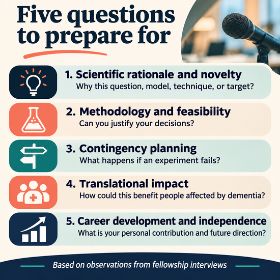
Five areas to prepare for before your fellowship interview. Practise explaining your decisions, not just describing your research.
What Questions Did the Fellowship Interview Panel Ask?
Across the interviews, several themes emerged repeatedly.
Scientific rationale and novelty: Why this question, model, technique, or target? What does the work add to existing literature? Reviewers wanted candidates to understand their research within its broader scientific context. One memorable piece of career advice mentioned during the session was to study a process, rather than just a molecule.
Methodology and feasibility: This was probably the most persistent category. Questions concerned sample sizes, statistical power, experimental controls, biological variability, confounders, and the limitations of different models. Reviewers wanted candidates to justify their decisions, not simply quote figures from their applications.
Contingency planning: What happens if an experiment fails? Can later work packages proceed independently? What if results are negative? Strong candidates had anticipated these possibilities and developed credible alternatives.
Translational impact: How might the research ultimately benefit people affected by dementia? What would a positive result mean? Even fundamental scientists were expected to articulate how their work might contribute to future progress, without necessarily promising an immediate clinical application.
Career development and independence: What had the candidate personally contributed to previous research? How would the fellowship distinguish them from their supervisor? Where would their research go afterwards? Remaining in the same institution was not necessarily viewed negatively, but candidates needed to explain how they would develop genuine independence. Even repeatedly saying “we” rather than “I” left reviewers uncertain about individual contributions.
What Made Strong and Weak Interviews?
The strongest candidates demonstrated deep scientific understanding, gave thoughtful answers, acknowledged limitations, and had convincing plans for managing risks. They had good “Whats”, but what made them stand out was their “Why” – they had very convincing rationales for why the research was important to do, and why they should be the one doing it.
They had good “Whats”, but what made them stand out was their “Why”.
Conversely, several weaknesses repeatedly undermined otherwise strong applications.
One surprisingly common problem was not actually answering the question. Candidates sometimes gave detailed explanations containing plenty of relevant science without addressing the reviewer’s specific concern. Occasionally, reviewers repeated or reframed questions to give them another opportunity, but when they still didn’t, this was noted in the discussion afterwards.
Others struggled to justify methodological decisions, appeared overly ambitious without clear prioritisation, or knew their immediate scientific niche extremely well but could not articulate the bigger picture. Short or incomplete answers were another problem, with reviewers sometimes disappointed when candidates stopped before fully demonstrating their knowledge.
Interestingly, a highly practised and polished presentation did not necessarily predict a strong fellowship interview. Some excellent speakers struggled under questioning, while less polished presenters demonstrated impressive expertise and judgement when challenged.
Does Confidence Matter? And What Should You Wear?
One thing I suspect applicants worry about disproportionately is what to wear to a fellowship interview. Interestingly, there was considerable variety. Male-presenting candidates wore full suits and ties, or suits without ties, and some just wore collared shirts with trousers and sometimes a jumper. Female-presenting candidates almost all wore smart dresses, sometimes dressed down with a cardigan or jumper, and occasionally blouse and trousers. There was no obvious uniform, no clear correlation between dress and performance, and nothing in the discussions suggested clothing meaningfully influenced scores.
Presentation style was more consequential. Some candidates stood while others remained seated. Many were visibly nervous, sometimes struggling with pauses, false starts, or finding the right words. Understandable, given the stakes.
Confidence and enthusiasm could make a positive impression. Some reviewers, particularly those with lived experience of dementia, responded strongly to candidates who communicated their work with energy and conviction. Conversely, a lack of apparent enthusiasm could leave reviewers unconvinced, even when the science was strong.
However, the panel was also explicitly conscious of the danger of confusing confidence with competence. At one point, reviewers discussed effectively trying to “listen with their eyes shut” to avoid being overly influenced by someone’s demeanour.
I thought that the panel’s thoughtfulness on this issue was fairly reassuring. As they put it, they’re assessing the science and the competence of the candidate to execute it, not their ability to present. Certainly, some candidates were not strong presenters but nevertheless were extremely strong on their science and their answers, and the panel was able to recognise this. Regardless though, the stronger presenters definitely made a bigger impression and it was interesting to see how the scientific and lay reviewers diverged in their reactions to certain candidates. Rather than necessarily needing a super slick presentation, being personable, engaging, and enthusiastic, while also serious about the science clearly mattered.
Reviewers discussed effectively trying to “listen with their eyes shut” to avoid being overly influenced by someone’s demeanour.
How Much Did the Fellowship Interview Change the Panel’s Opinions?
Perhaps the most fascinating part of the process was watching the panel deliberate after candidates left.
Reviewers entered with fairly well-formed opinions, but these were certainly not fixed. Strong performances sometimes reinforced or improved already positive assessments, while others exposed weaknesses not obvious in the written proposal.
Some candidates had impressive scientific plans but struggled to defend crucial methodological choices. Others demonstrated excellent technical knowledge but left reviewers uncertain about their independence or longer-term vision. Often, reviewers had explicit questions or weaknesses they wanted to see addressed in the interview, and when these were not met, scores dropped.
These changes weren’t necessarily dramatic. A shift from the high 3s to the mid 3s might seem small, but in a competitive funding environment could be consequential. Reviewers also sometimes disagreed considerably, particularly when weighing exciting, ambitious science against concerns about feasibility.
I was impressed by how carefully the panel interrogated its own judgements. When reviewers expressed negative impressions, others sometimes pushed them to articulate specific reasons rather than relying on vague feelings about a candidate’s performance.
The fellowship interview could therefore meaningfully strengthen, or undermine, the case for funding someone. It was not simply a formality after a successful written application.
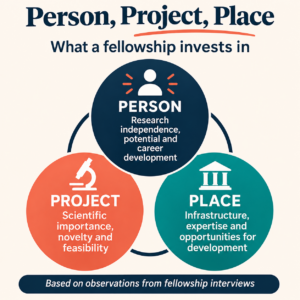
A fellowship is an investment in the researcher, their scientific proposal and the environment that will support their development.
Additional Insights from the Process
One particularly useful framework repeatedly mentioned was that fellowships are assessed on the “Person, Project, and Place”.
The project needs to be scientifically compelling and feasible. The place needs to provide the right infrastructure, expertise, and opportunities for development. But the person is equally important. The panel is investing not simply in a set of experiments, but in a researcher’s potential to establish an independent career.
Another important observation was the contribution of reviewers with lived experience of dementia. While scientific reviewers often focused on methodology and novelty, lived experience reviewers asked how the work would benefit people affected by dementia, how findings would be communicated, and how patients and the public would be involved.
They also raised scientifically relevant questions about confounding factors and real-world applicability. Their role was therefore much more than checking whether applicants had included patient and public involvement and engagement (PPIE) activities. They brought perspectives that genuinely contributed to the scientific assessment.
Finally, the panel clearly valued ambition, but only when grounded in feasibility. Innovative technologies, unconventional models, and high-risk questions could generate considerable enthusiasm, provided candidates demonstrated a realistic understanding of the challenges and a convincing plan for overcoming them.
Final Notes
Overall, I’d strongly recommend observing a fellowship interview panel if you ever get the opportunity. It is a fascinating insight into how funding decisions are made and what reviewers value beyond the written application.
For anyone preparing for a fellowship interview, I’d particularly recommend practising being questioned, rather than simply rehearsing your presentation. Get colleagues from different disciplines to challenge your assumptions, identify weaknesses, and push you to explain the wider significance of your work. Be ready to discuss not just your proposed experiments, but where you want your research career to go.
Perhaps the most reassuring takeaway was that the panel did not expect perfection. They understood that these were early-career researchers, that many were understandably nervous and took some time to warm up, and that fellowships are intended to support development, and scientific uncertainty is inevitable.
I also came away appreciating how difficult these decisions are. Many candidates were excellent, and the difference between a fundable and unfundable application could be relatively small. It is somewhat confronting that months of preparation and years of future research can hinge partly on a short interview.
For all the complaints that we have about the funding and review process, and for all we might wish that it were more streamlined, I was impressed with how rigorously the panel took their work, how much they felt the weight of the decisions they were making, how they didn’t allow long days to influence their judgement, and how they tried as much as possible to treat every candidate fairly.
It was also cool and exciting to see a range of fellowship candidates who were engaged in a broad set of really cool science. I certainly came out impressed and inspired by the ideas people had, how thoughtful they were about their work, how they could respond under pressure, and how passionate some of them clearly were about their research.
If you have an interview coming up soon – prepare, practise, be personable, and remember the reviewers are people too. Good luck!
Dr Ajantha Abey
Author
Dr Ajantha Abey is a Postdoctoral Researcher in the Kavli Institute at University of Oxford. He is interested in the cellular mechanisms of Alzheimer’s, Parkinson’s, and other diseases of the ageing brain. He previously explored neuropathology in dogs with dementia and potential stem cell replacement therapies. He now uses induced pluripotent stem cell derived neurons to try and model selective neuronal vulnerability: the phenomenon where some cells die but others remain resilient to neurodegenerative diseases.

 Dementia Researcher

 Rahul Sidhu


 Dr Sam Moxon